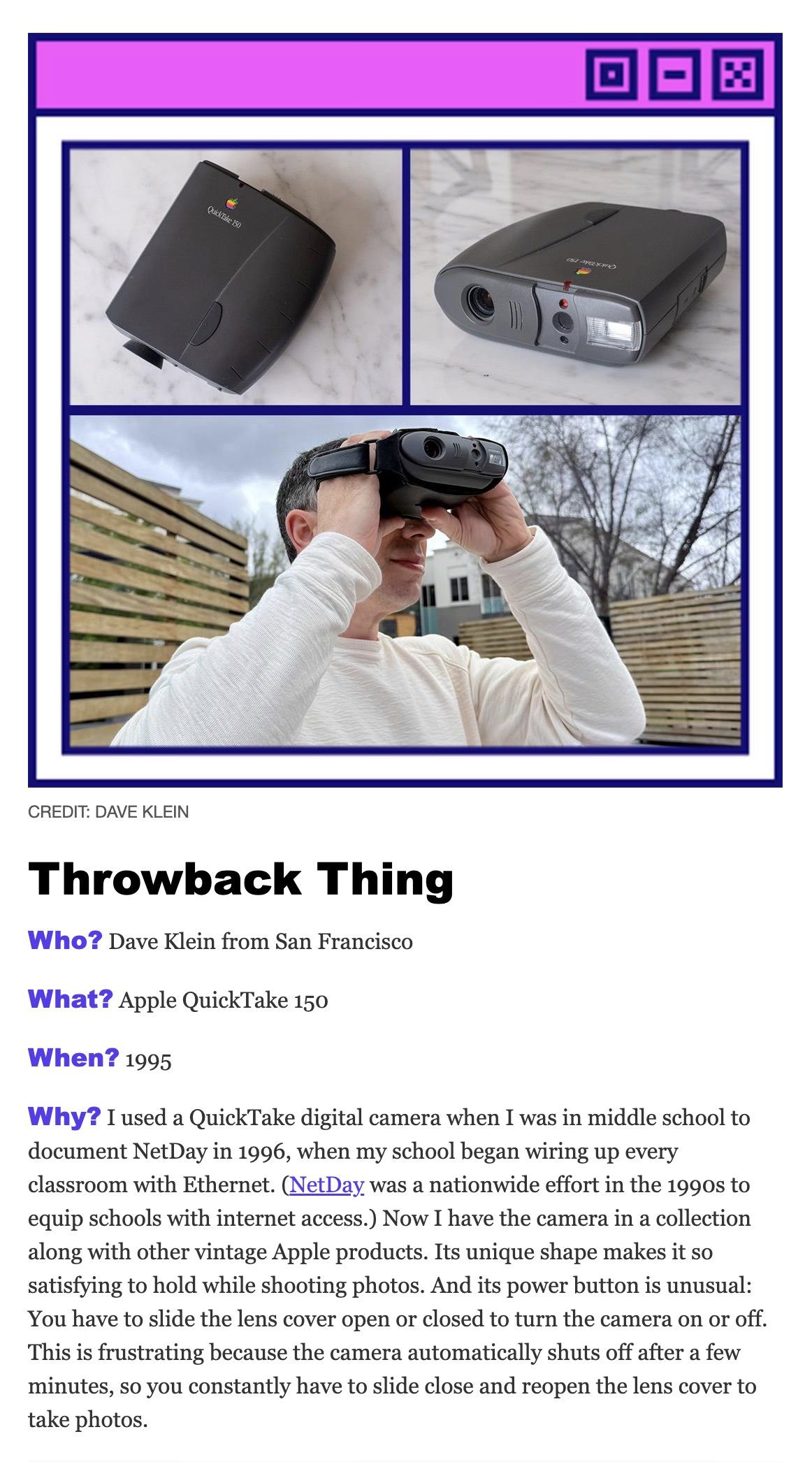
Last week I noticed the following text at the end of Joanna Stern’s Tech Things newsletter:
Got an idea for a throwback? Reply to this email with a photo of your old tech and tell us why you loved—or hated—it.
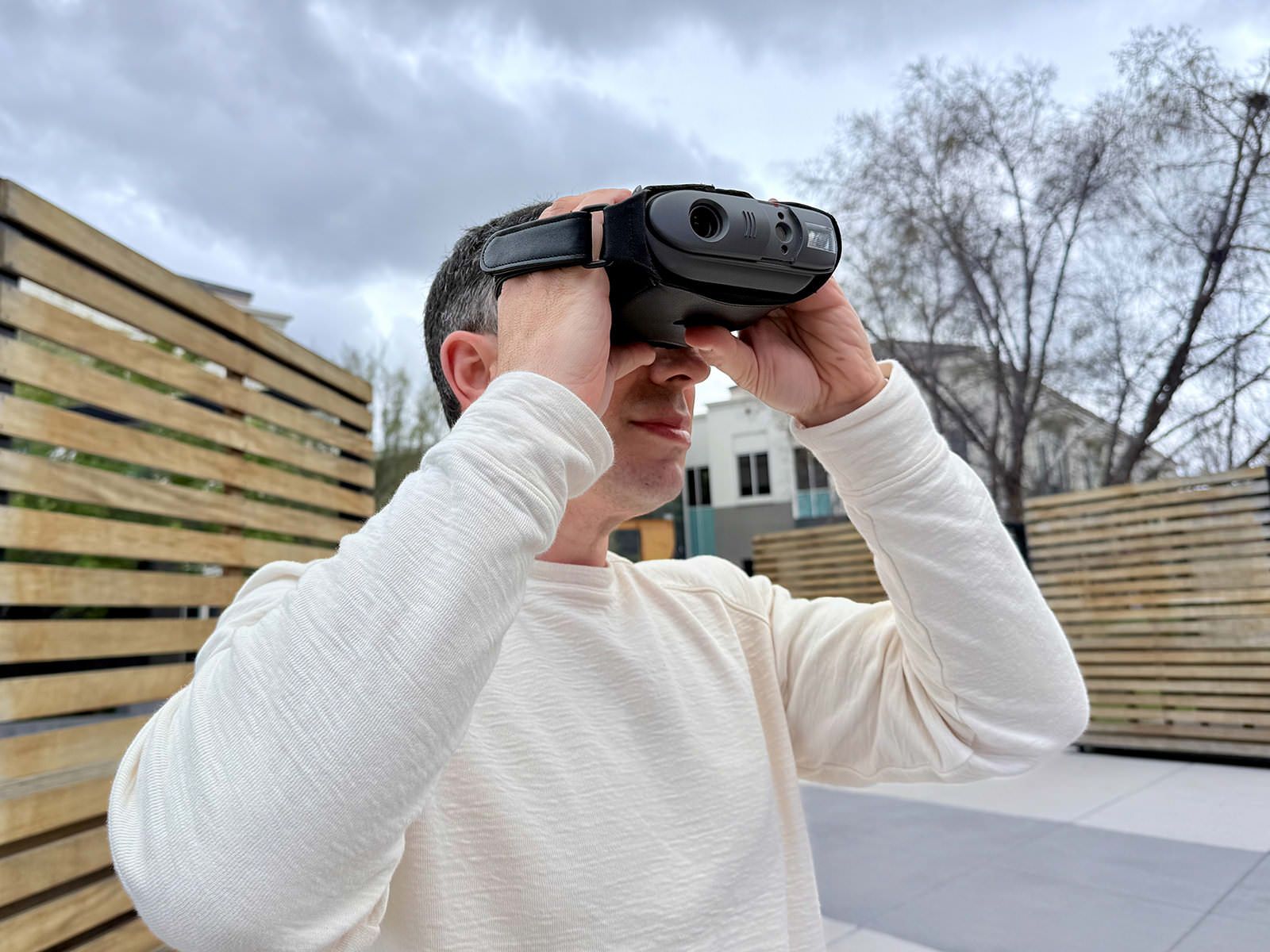
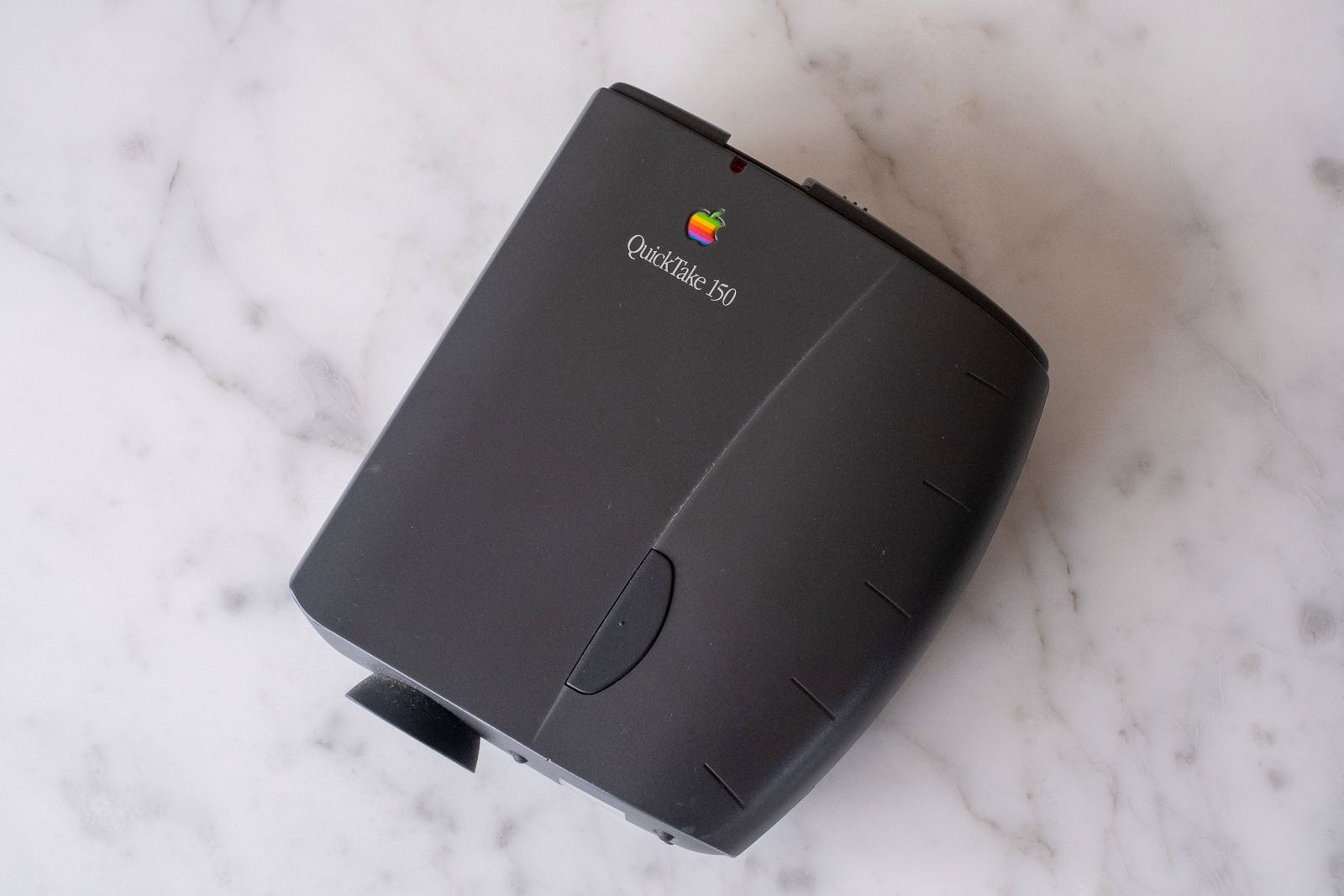
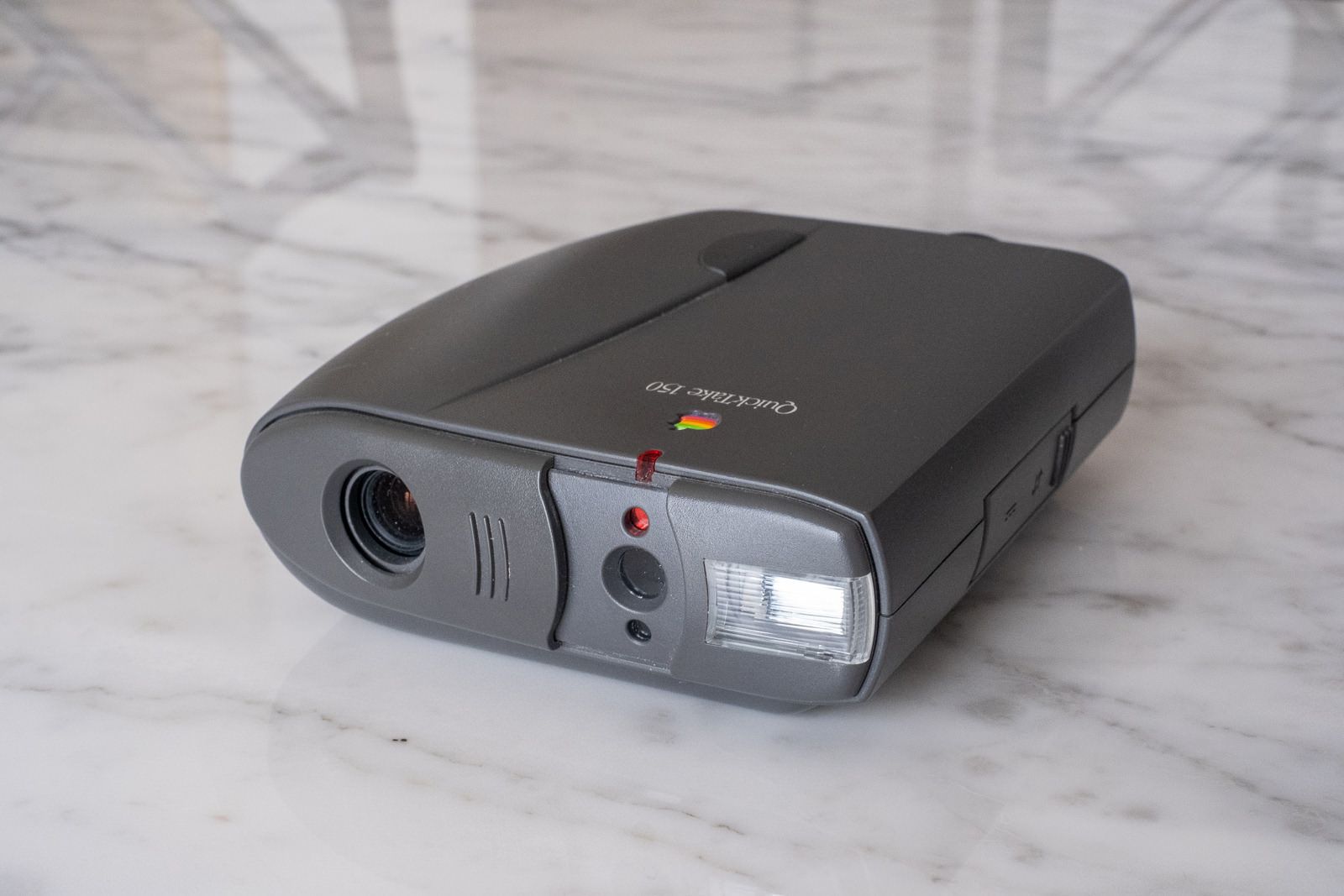
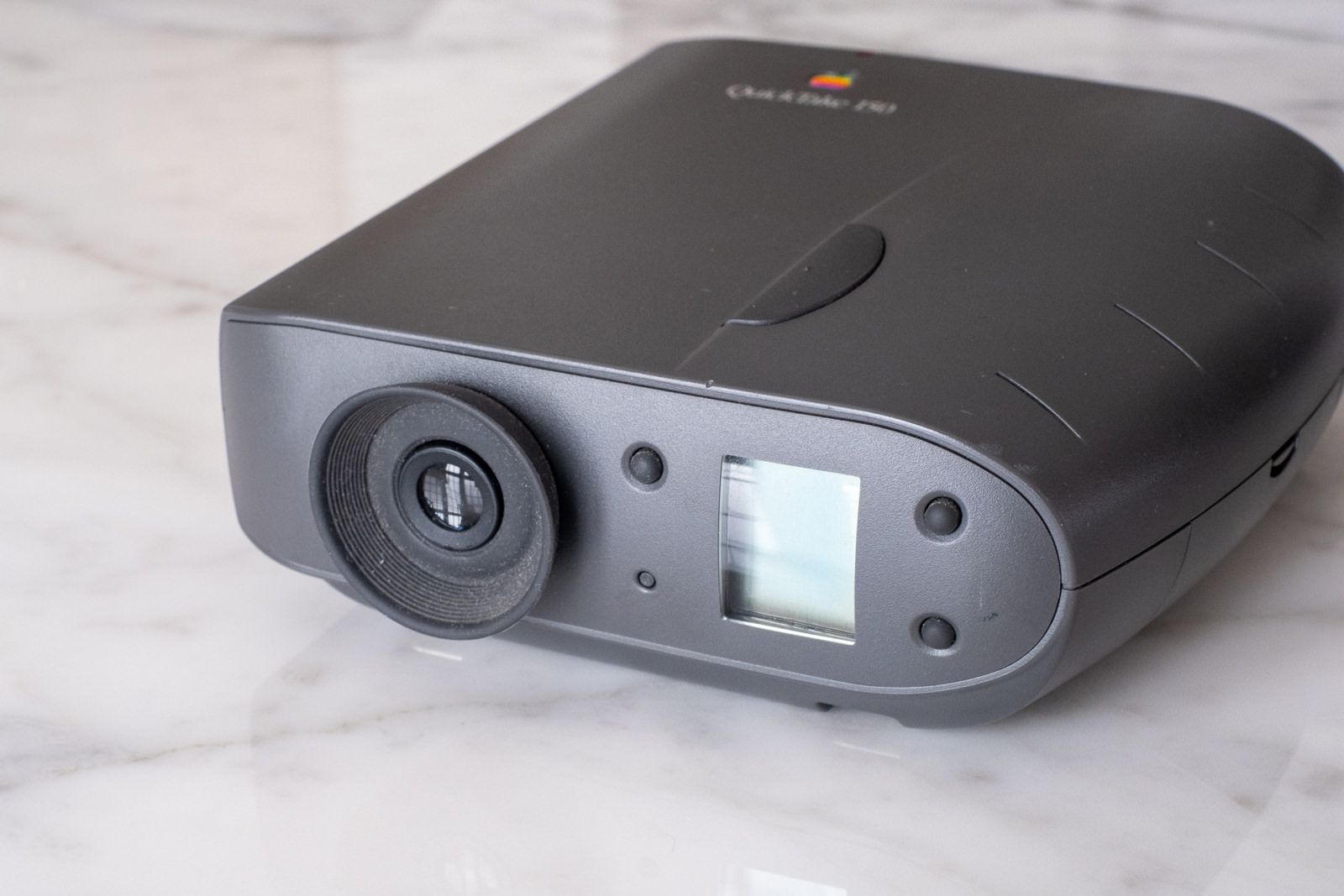
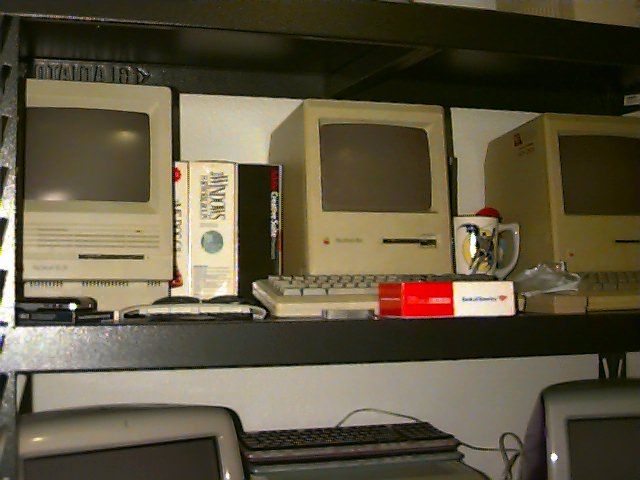
A lightbulb in my head instantly turned on and exploded. My primary hobby at the moment is obviously researching and collecting “throwback” hardware from Apple and companies that collaborated with Apple. I decided I must immediately respond with a quick summary of my recent How to Use an Apple QuickTake in 2025 post. I attached a few photos, clicked “Send,” and hoped for the best.
A couple days later I received an enthusiastic response along with a request for permission to edit my entry for “clarity and length.” Of course they had my permission! My overzealous entry also managed to answer all of their questions.
Three days later and boom! I’m in the newsletter! Unfortunately they removed the link to my collection. I’ll live.
I upgraded from an Asus mesh networking setup to a Ubiquiti setup with access points wired directly to a router via ethernet. As a result the network’s speed, latency, and reliability dramatically improved. My computers also now use ethernet instead of WiFi to ensure maximum speed.
Ubiquiti hardware and software are both robust and simple. If have an opportunity to install ethernet cables in your home, go for it.
For years I have dreamt of living in a home riddled with ethernet cables. In November of last year that dream became a reality when my family moved into a house that has ethernet ports in most rooms. I could finally let go of WiFi when working and maximize both speed and reliability. Yes, I have tried mesh networking products like the Eero suite and a set of Asus ZenWiFi AX6600s. Wired will always beat wireless.
I quickly encountered a mystery because I could not find where the cables terminated. Eventually my brother in law noticed a small panel in a random closet. He popped it open and a dozen cat 5e cables fell out. I was giddy until I noticed that there was no jacks on the cables. Project! I acquired a Brileine RJ45 crimp tool, a bag of jacks, and painstankingly connected each cable to a jack. The next step was to figure out which cable went to which room since the cables
were not labeled.
Another mystery arose since the Brileine RJ45 network cable tester I purchased failed to detect any signal traversing the cables. I removed a wall plate and discovered that the cables were not connected to keystones on the other side! This project went from peculiar to maddening.
Or was I? The true catalyst for this project was actually my brother in law’s generous Christmas gift of a stack of Ubiquiti products. Yes, he gets me. Let’s walk through the new setup.
Cable modem
First, I upgraded my cable modem to an Arris S33. When I called Comcast to provide its MAC address the tech support representative was impressed by this choice. Also it’s neat how cable modems are only 5 inches tall nowadays.
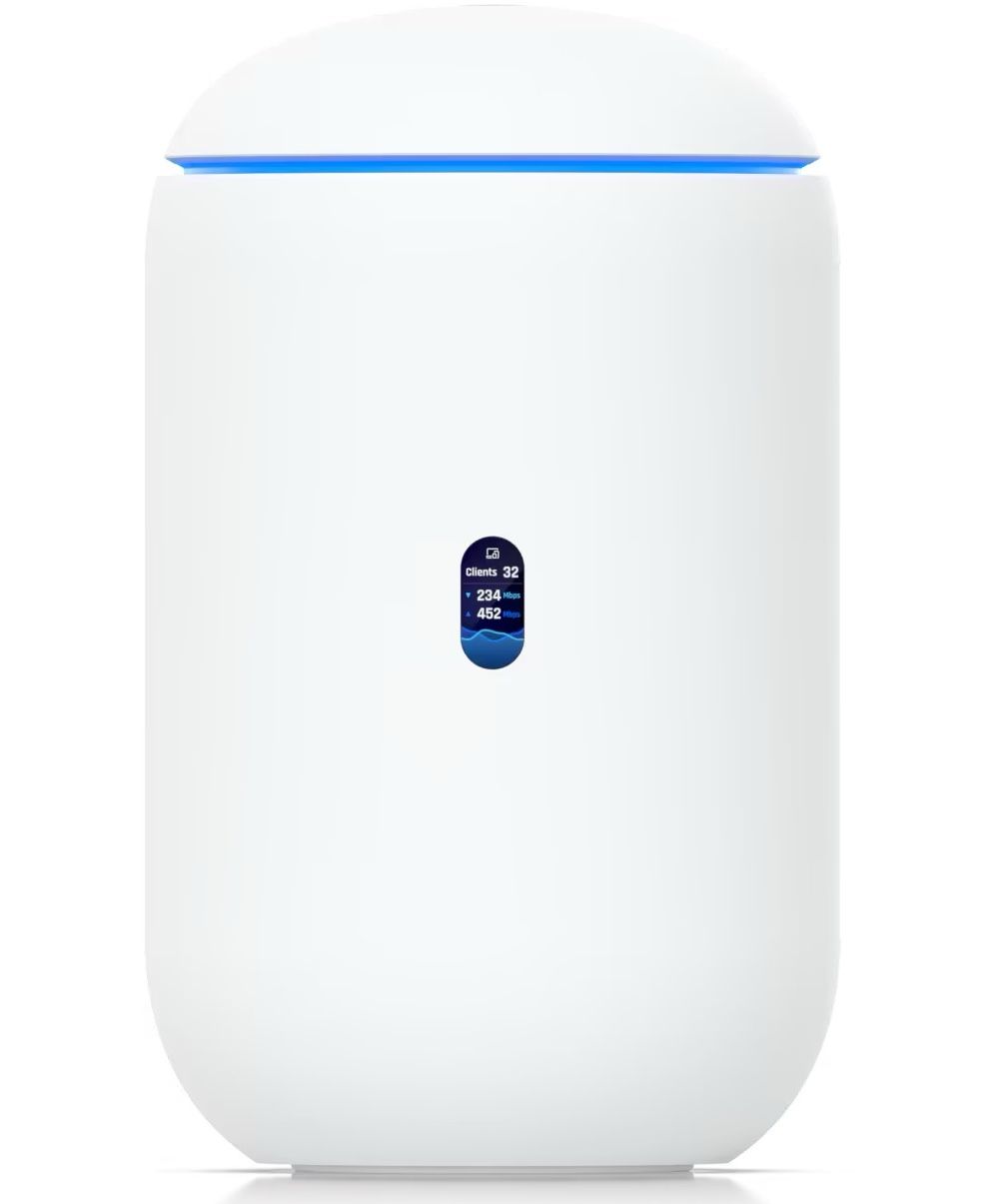
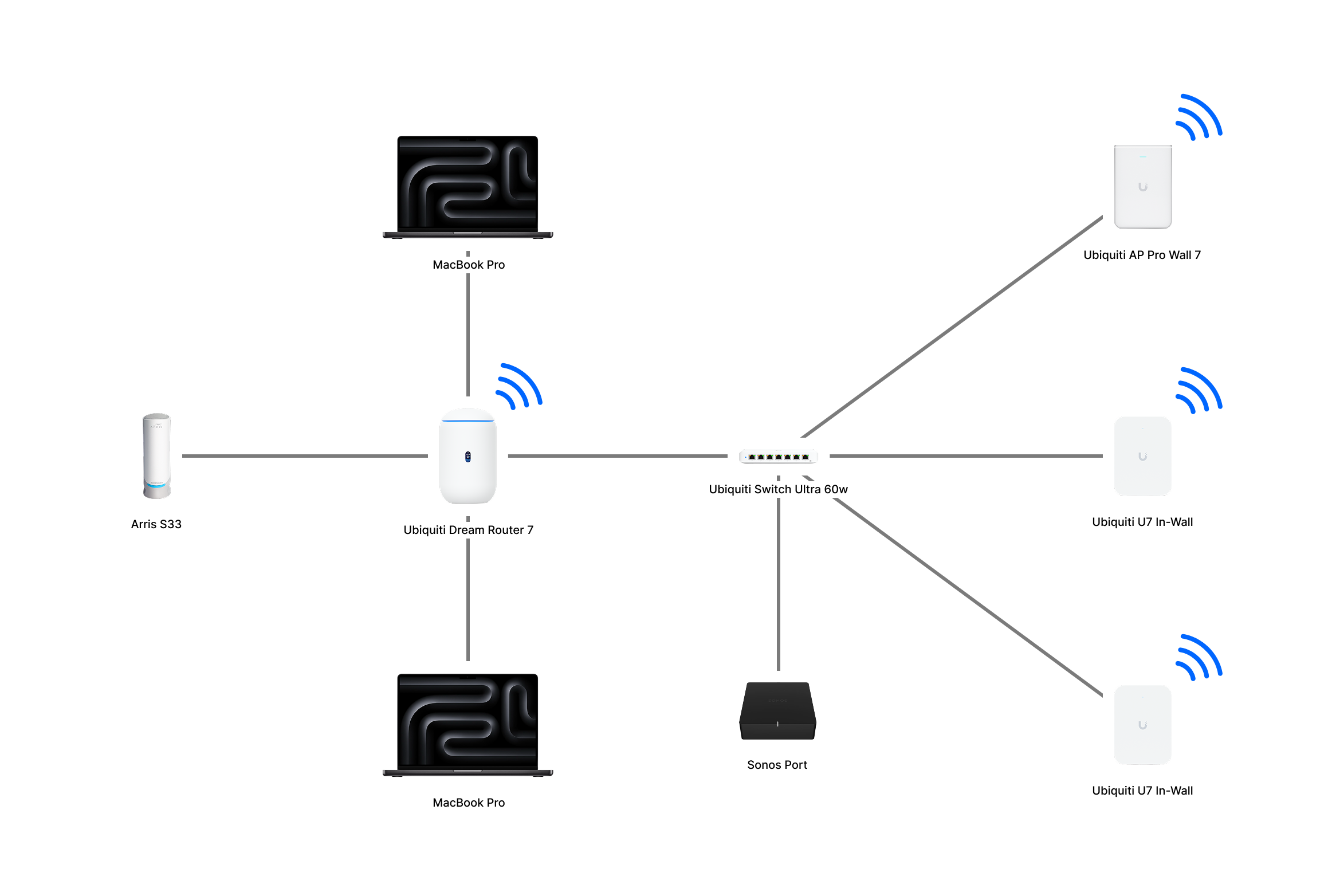
The most important product in the setup is the router and I selected a Ubiquiti Dream Router 7. Yes, 7 as in WiFi 7 which as of April 2025 is only available in two Apple products: the iPhone 16 and 16 Pro. The Dream Router also acts as Ubiquiti’s “gateway” which allows one to monitor and manage the network and Ubiquiti products like access points, switches, cameras, etc. Two of the router’s four ethernet ports are wired to the jacks next to my and my wife’s desks allowing us to connect our laptops directly to the router.
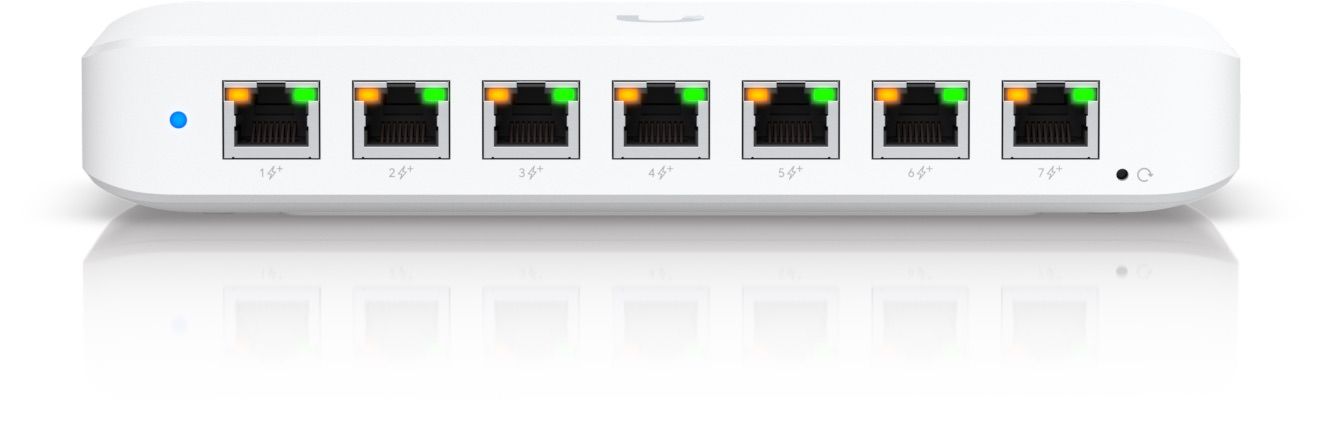
The Dream Router 7 does not support power over ethernet, so I purchased a switch that supports PoE to sit between the access points and the router. Enter the Ultra 60W. It’s small, wall-mountable, and fast. I have 3 access points and a Sonos Port wired to it. Perhaps someday I’ll connect a Canon PRO 310 printer, but that’s for another blog post.
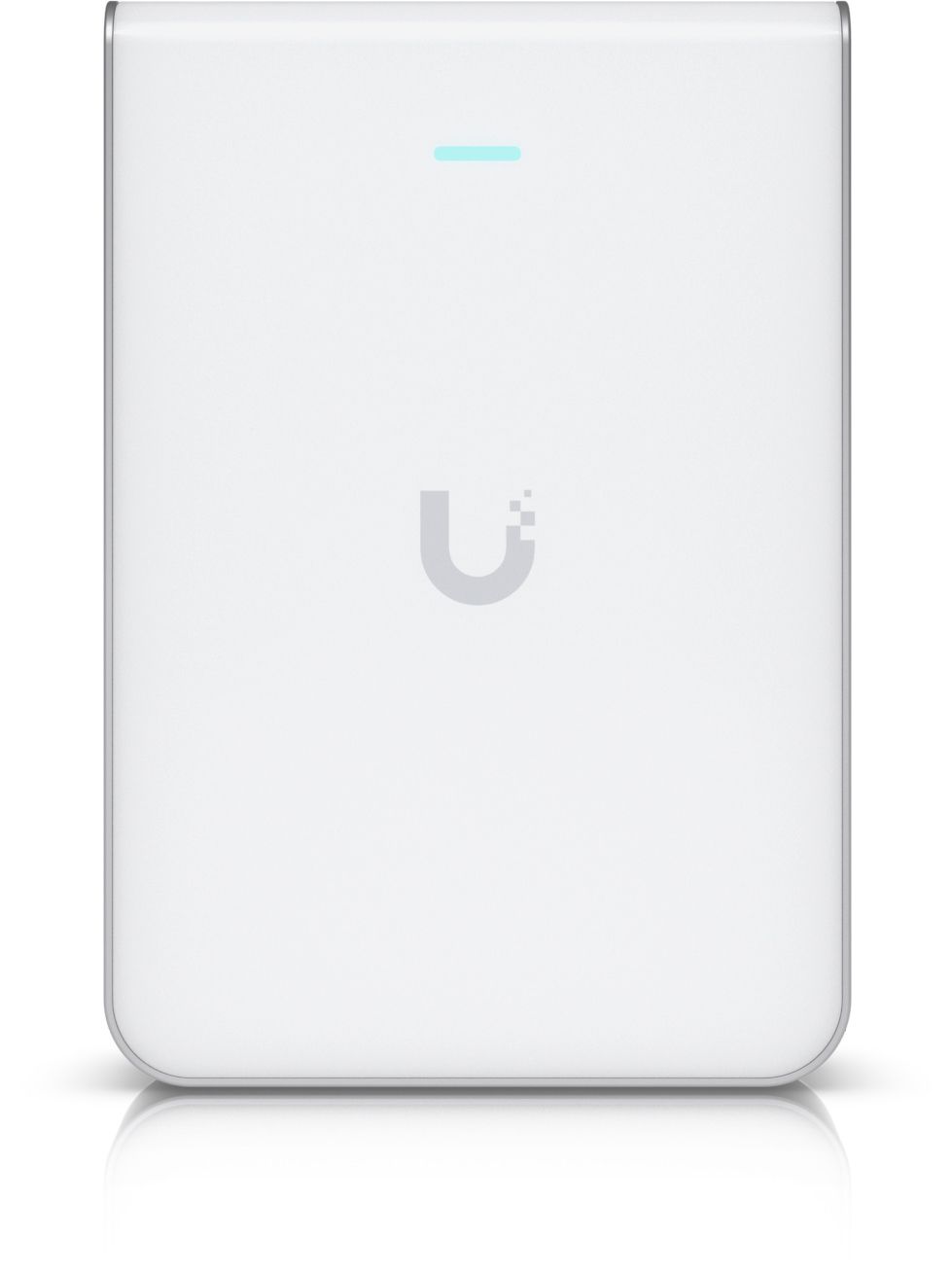
In addition to the Dream Router’s WiFi signal I acquired access points for the family room, the kitchen, and the primary bedroom. Each is mounted over spots where the previous owner had installed plates with ethernet and coax ports. As a result my house is now overrun with WiFi 7.
Just for fun I sprang for a “pro” model for the primary bedroom. It’s a bit larger and less elegant than the in-wall version, but no one will know since it’s hidden behind a bed.
Each product had its delightful moments. For example, the Linksys could be upgraded to OpenWRT for extra capabilities. It also supported UPnP for remotely accessing IP cameras and streaming cable TV using the original Slingbox. Each also had its quarks with setup and management. Some relied on clunky web apps, Apple naturally built an elegant macOS app, and both eero and Asus leaned in to the modern age with iOS apps. However none were as powerful or beautiful as Ubiquiti’s web and iOS apps.
iOS apps
Yes, apps. Plural. Ubiquiti makes a suite of apps for managing its various product families. For my purposes I focus on 3: UniFi, Portal, and WiFiman.
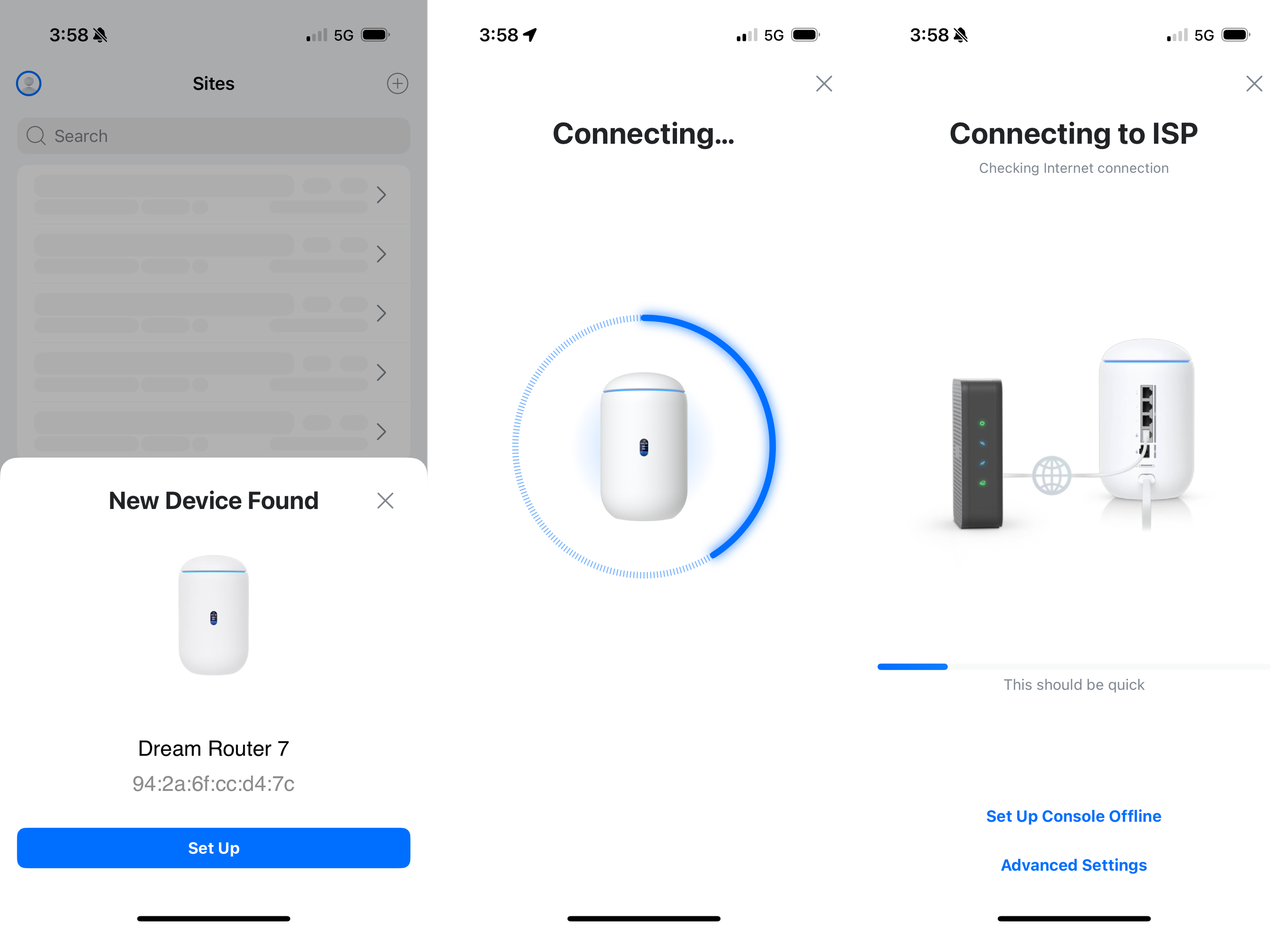
Installing the Dream Router 7 in the UniFi app
UniFi is where you start and end as it’s used for both installation and management. Once the router (“gateway”) is configured the other products automatically appear alongside a simple “adopt” button. A few seconds later my switch and access points recieved updated firmware and were broadcasting the network. This was beyond enjoyable for its simplicity and clarity. Previous systems required adding products indivdiually through laborious flows that required selecting a product family, selecting a device, waiting on a “searching…” stage, etc. Ubiquiti simplified this flow into a few obvious button taps.
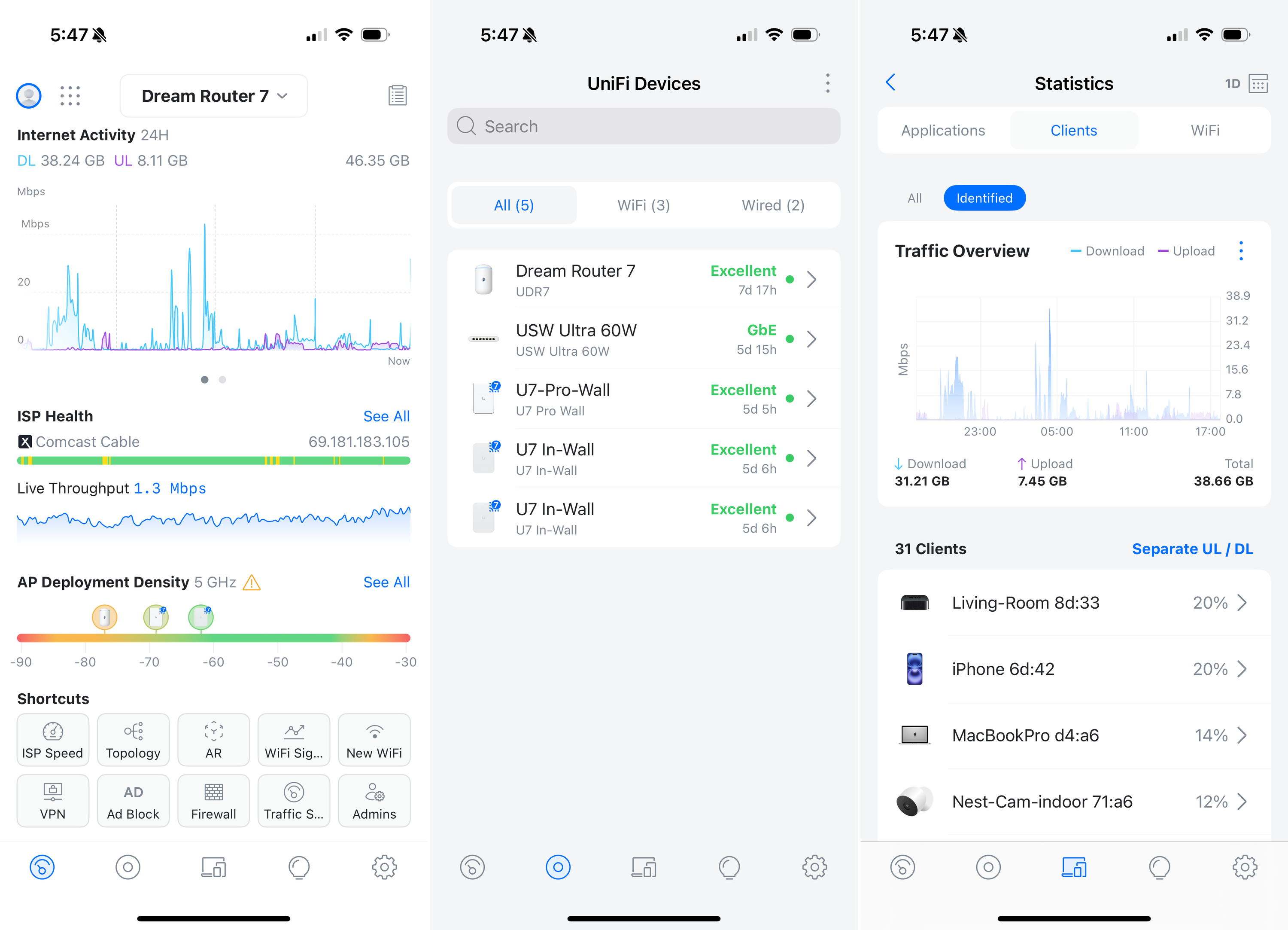
Managing the network in the UniFi app
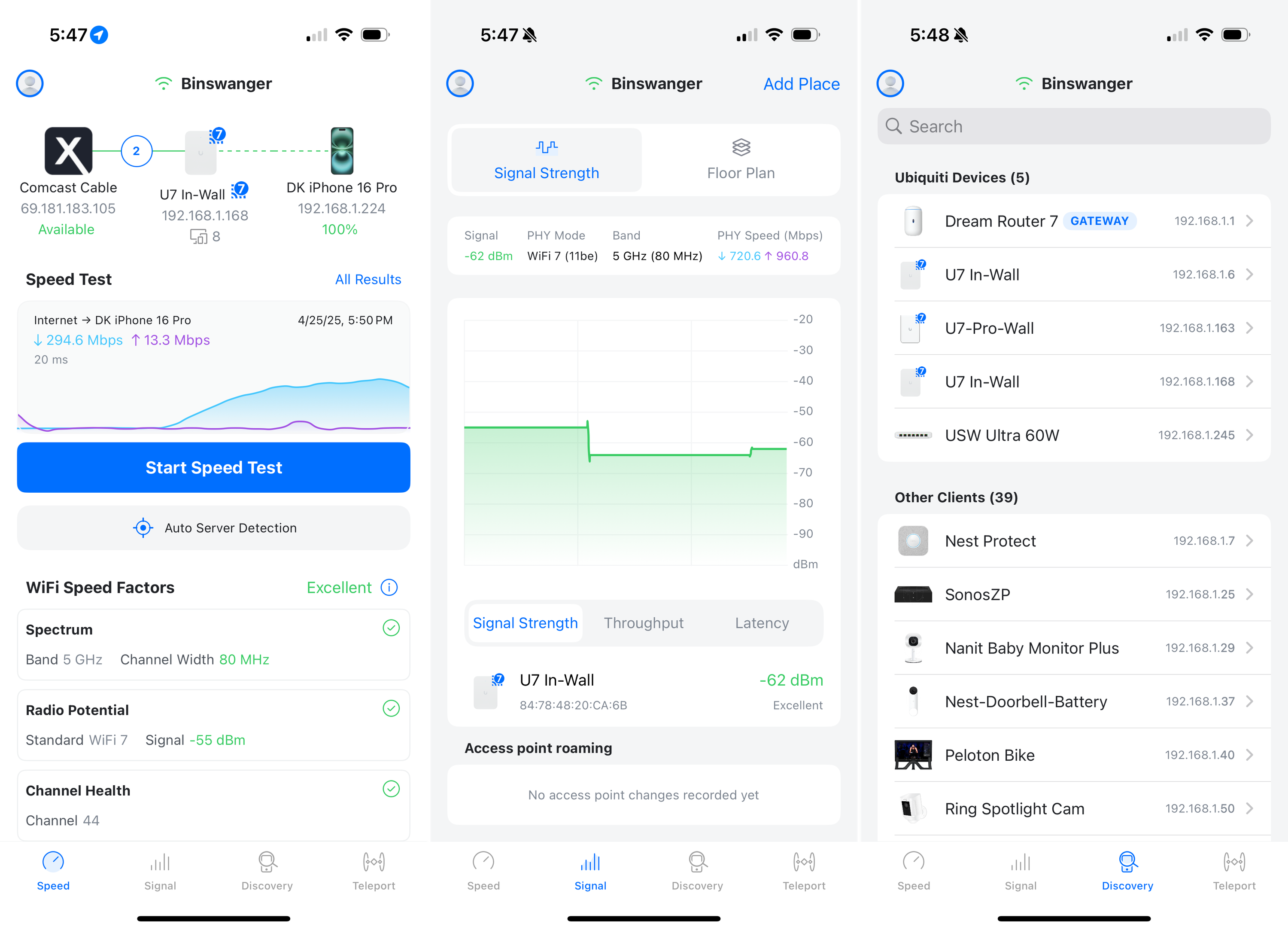
WiFiman is Ubiquiti’s version of Speedtest.net or fast.com, but with a few extra fun features like analyzing signal strengths and the ability to “teleport” into your home network.
Learning about the network in the WiFiman app
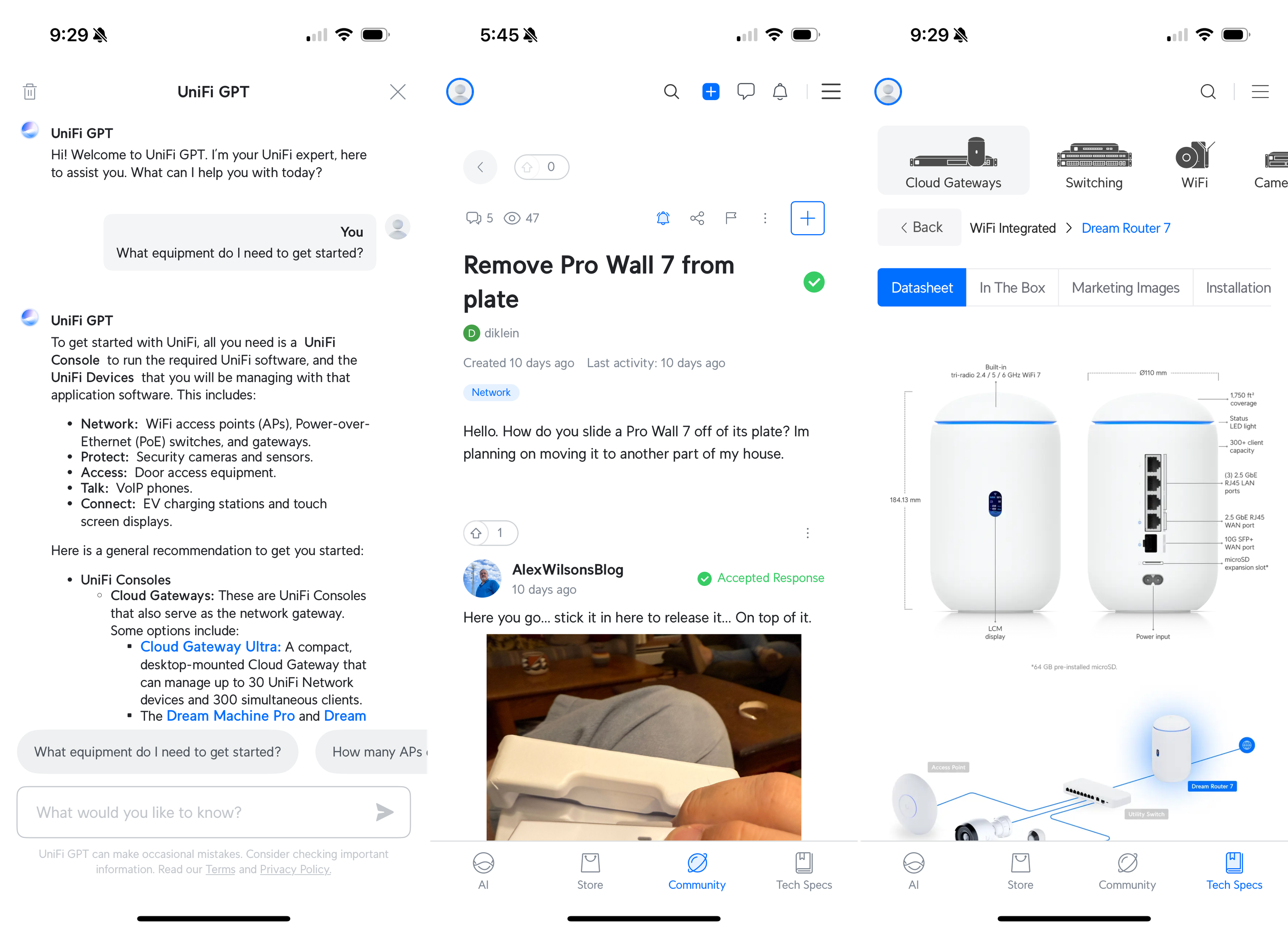
Portal offers an AI assistant named UniFI GPT, a store (which I used to purchase an additional access point), forums (which I used to ask a question and promptly receive a helpful answer), and tech specs for every Ubiquiti product. I’m always hesitant to post noob questions in a forum because of how insufferable experts can be in responses. I was pleasantly surprised to receive kind replies.
Getting help in the Portal app
Web app
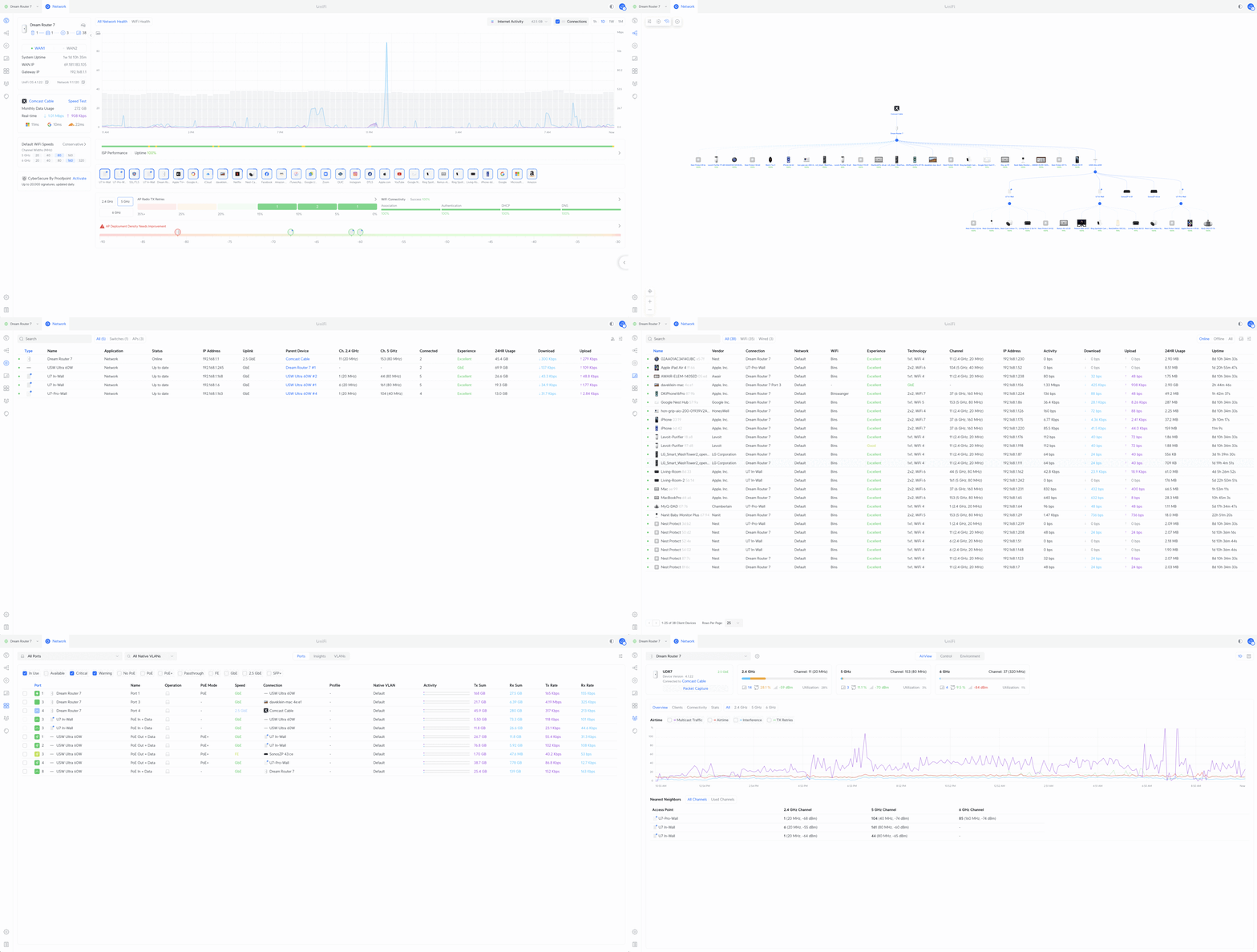
The UniFi web app can be accessed by navigating to unifi.ui.com. If you’re still reading this then you have definitely navigated to 192.168.1.1 at some point to log into your router and fiddle with settings. Ubiquiti’s portal is unmatched in its capabilities and data. The gif below includes screenshots of the dashboard, topology, UniFi devices, client devices, ports, and radios screens. I’m particularly entertained by the topology screen which lays out how each device in the house is connected to the network similar to a complex org tool at a large company.
Elegant complexity is quite an achievement
Summary
I spent a few minutes creating a diagram in Figma to demonstrate how data flows through the various Ubiquiti products. I did not include the dozens of wireless products like Apple TVs, air purifiers, smoke detectors, etc. You can see the complete topology above in the animated gif.
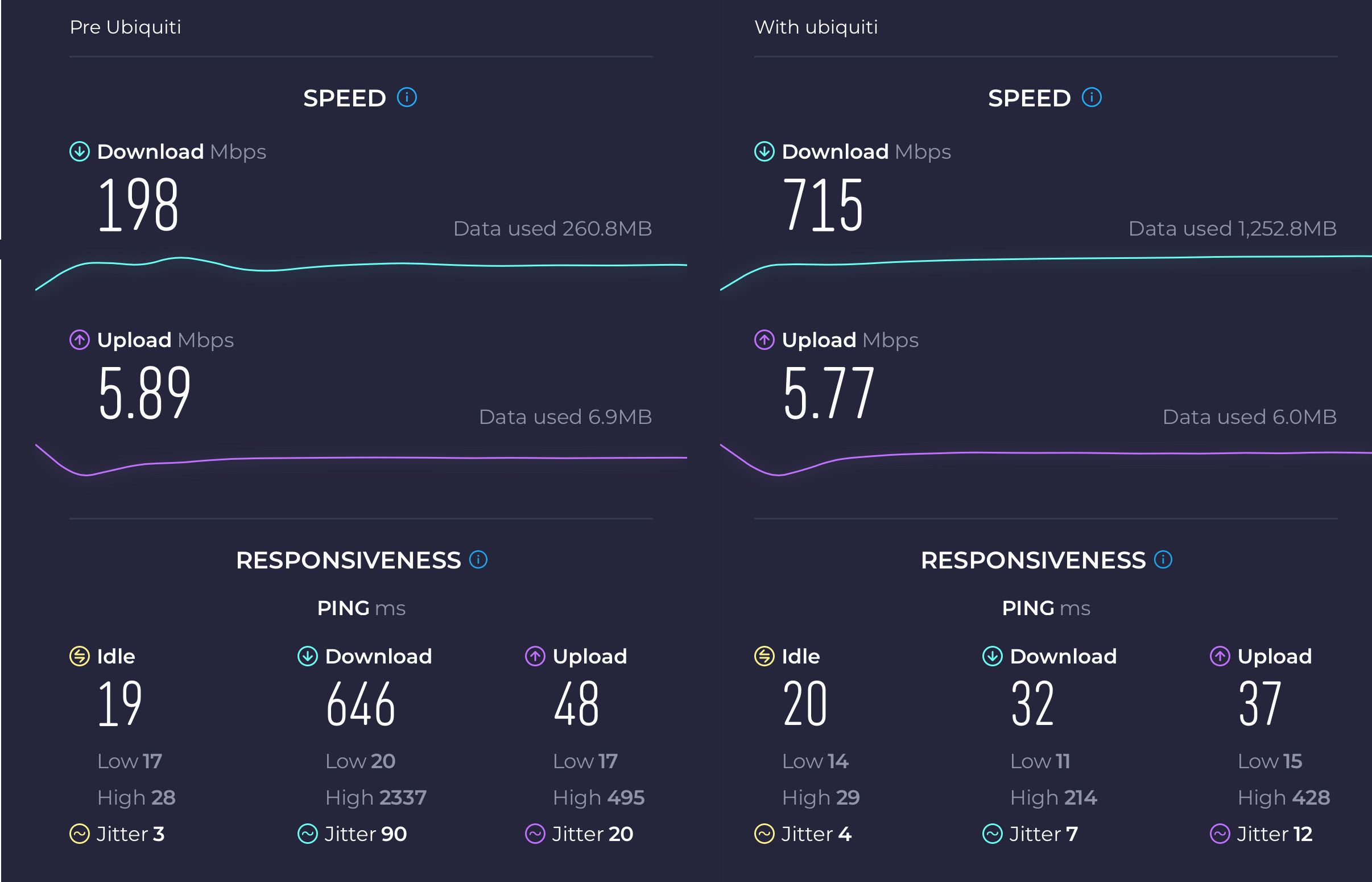
Knowing that this project was coming I planned ahead by capturing a Speedtest.net screenshot that I could use for comparison. The left screenshot was taken with the Asus mesh networking setup, and the right was taken with the Ubiquiti setup. The improvements are clear.
Of course this is not scientific but the download speed on my iPhone 16 Pro shot up to 715 Mbps from 198 Mbps, and the ping time plummeted. It was a mistake to also not perform a test on my MacBook Pro which is not equipped with WiFi 7 yet.
This was a fun project filled with twists and turns. (Seriously who spends the time and money to install ethernet cables but neglects to finish the project by actually connecting the cables to jacks and keystones?) I’d like to thank my brother in law, Zach, for supplying me with hardware, and my wife for her patience as I continue to temporarily disable the network while further experimenting with settings. If you are looking to truly master WiFi, dump that system you have now and upgrade to Ubiquiti.
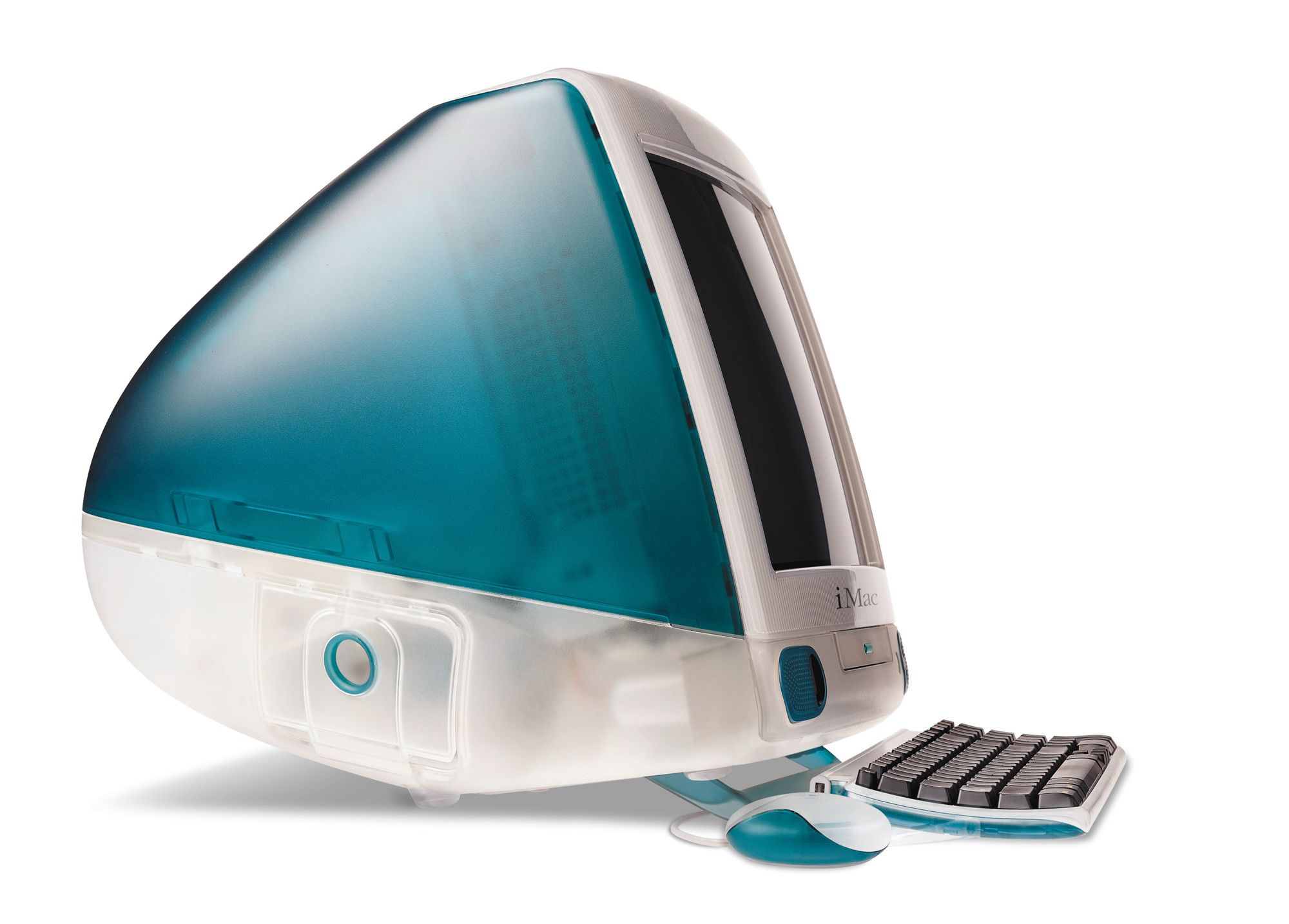
The purpose, the goal of having a handle was you may understand nothing about the nature of this object. Not understand its capability. But when you see a handle it references immediately and unamibigously your hand… you understand therefore something about this object. You make a connection to it. And so I think that the way the form was developed and the way that we developed the nature of the polymer… that it was slightly transulencet and that it was colorful. You talk about a color. Not gigahzertz or harddrive capacity. Suddently the language was way more accessible and egalitarian. But the product looked like it had just arrived or that it was going to go somewhere. It felt alive.
One of the reasons why I adore Apple is reflected in Ive’s philosophy when designing products. When I first started using Macs in the late 1980s the emphasis on accessibility and making connection was reflected in the aesthetics and interaction design of the operating system. The iMac’s introduction in 1997 expanded this approach to hardware design.
Emphasizing color and affordances like a handle seem obvious now after so many companies attempted to adopt a similar philosophy, but in the 1990s computer marketing was obsessed with processor speed since megahertz values consistently rose seemingly each month as new computers were released. Fast forward to today and the iMac’s tech specs page doesn’t even mention processor speed; just which M series SoC it comes with and a number of cores.
The leather case makes the QuickTake much easier to hold.
As a collector of Apple products people often ask me, “Do they work?” To be completely honest I do not track which work and which require repairs. For example, I have not tested my 20th Anniversary Mac yet; I’m just overjoyed to own one. I primarily enjoy the process of researching and acquiring products and the resulting conversations with fellow collectors.
However, I do occasionally feel the urge to explore how I can design a workflow to make an old product work in modern times. The QuickTake 150 is a perfect example since it combines my passion for photography with collecting. After printing my first book last year I thought about how I would expand this year’s book, and one way is relaxing the Ricoh GR IIIx requirement by incorporating additional cameras.
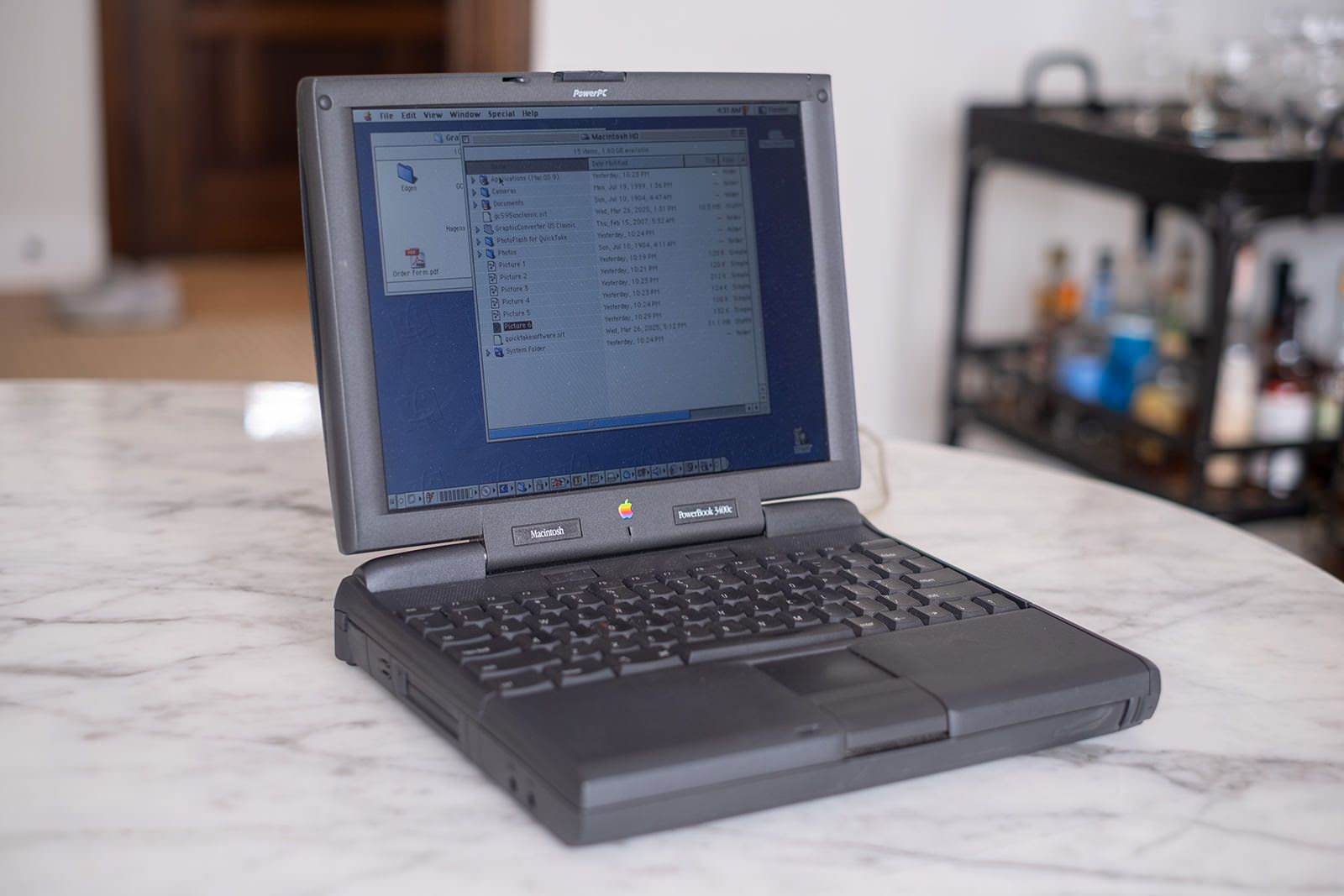
The workflow I devised is one of several possible ways to reinvogorate an old QuickTake. After completing this project I discovered JQuickTake which supposedly allows a modern Mac to communicate with a QuickTake using a combination of cables and adapters. Perhaps someday I will try that method as well. For now, I was thrilled to tinker with an old PowerBook.
Acquire a QuickTake 100 or 150
Notice the button is perfectly placed for a finger to rest on while holding the camera.
The QuickTake 100 (the first generation camera) was released in 1994 under Michael Spindler’s tenure as Apple’s CEO. It’s funny to reflect on the years I became acquainted with Apple and began debating its products’ merits with friends on the playground. Sculley, Spindler, Amelio… and no Jobs. The company was a mess and the product lines were scattered (Centris, Quadra, Performa, etc.). But we had Apple computers at school, and I knew they were special.
I would avoid using a QuickTake 200 because of the extra variable of its special data transfer cable that is challenging to find. It also requires a rare SmartMedia card (which coincidentally my 200 had when I acquired it!).
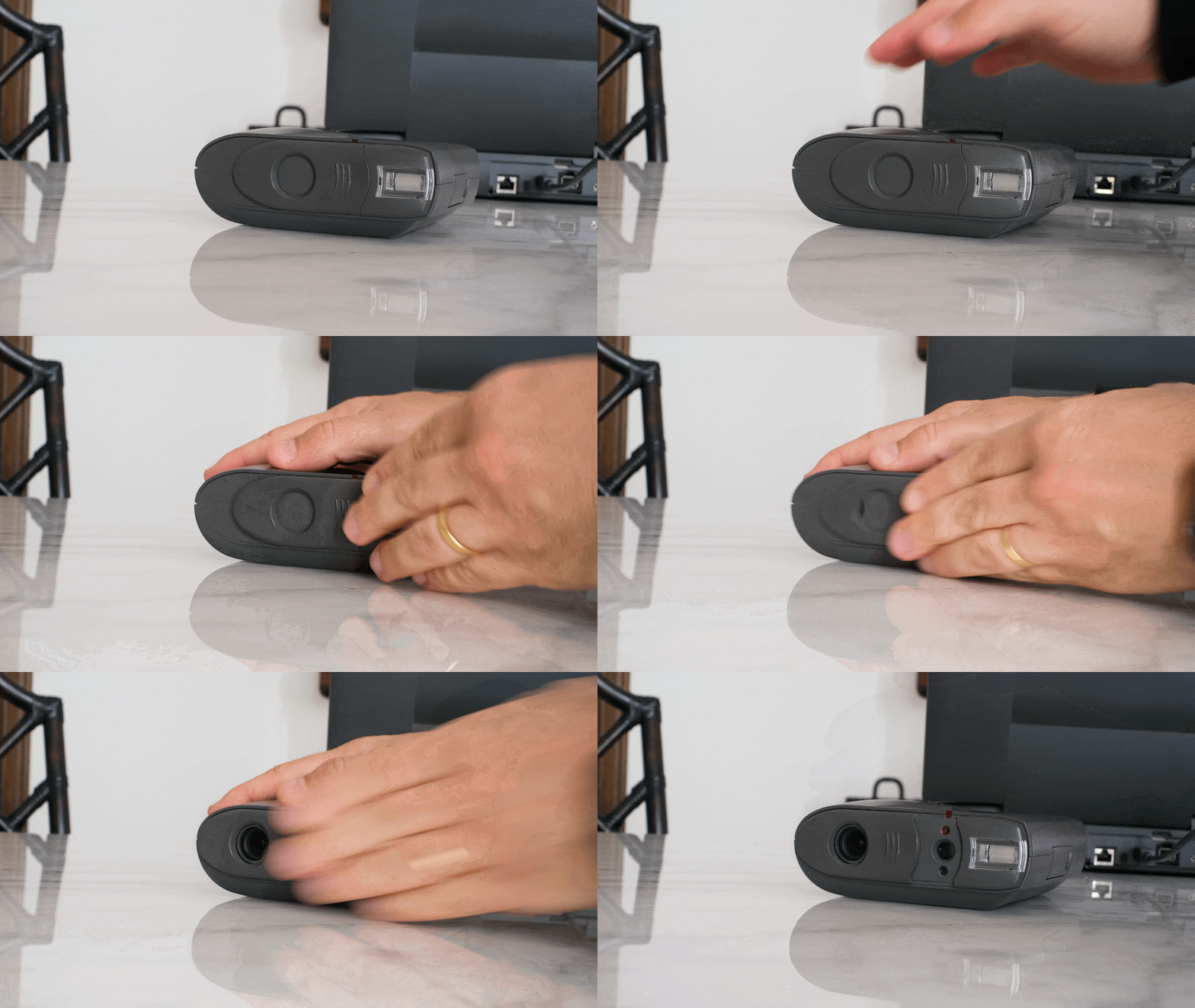
One slides the lens cover open to power the camera on and off.
I remember using a QuickTake to document construction progress on NetDay in 1996 at Crocker Middle School. It felt like magic at the time to take a photo, transfer it over a wire, and see it on a screen. Of course now there are no wires and the magic is gone. This is why I enjoy looking to the past.
A small display indicates the mode and number of photos stored.
Fortunately a QuickTake 100 or 150 can be purchased for approximately $100 on eBay or Facebook Marketplace.
Acquire a PowerBook 3400c
There are several challenges when shooting with a QuickTake, and all can be overcome by using an old Mac. First, the camera uses a serial cable for data transfer so you need a serial port. Second, the software used to communicate with the camera only runs on Mac OS 7, 8, and 9. Third, the camera stores photos using the PICT format which can only be converted to modern formats using classic Mac OS software. Lastly, after taking photos, transferring them off of the camera, and converting them to a modern format, the files need to be easily moved to a device that can share them!
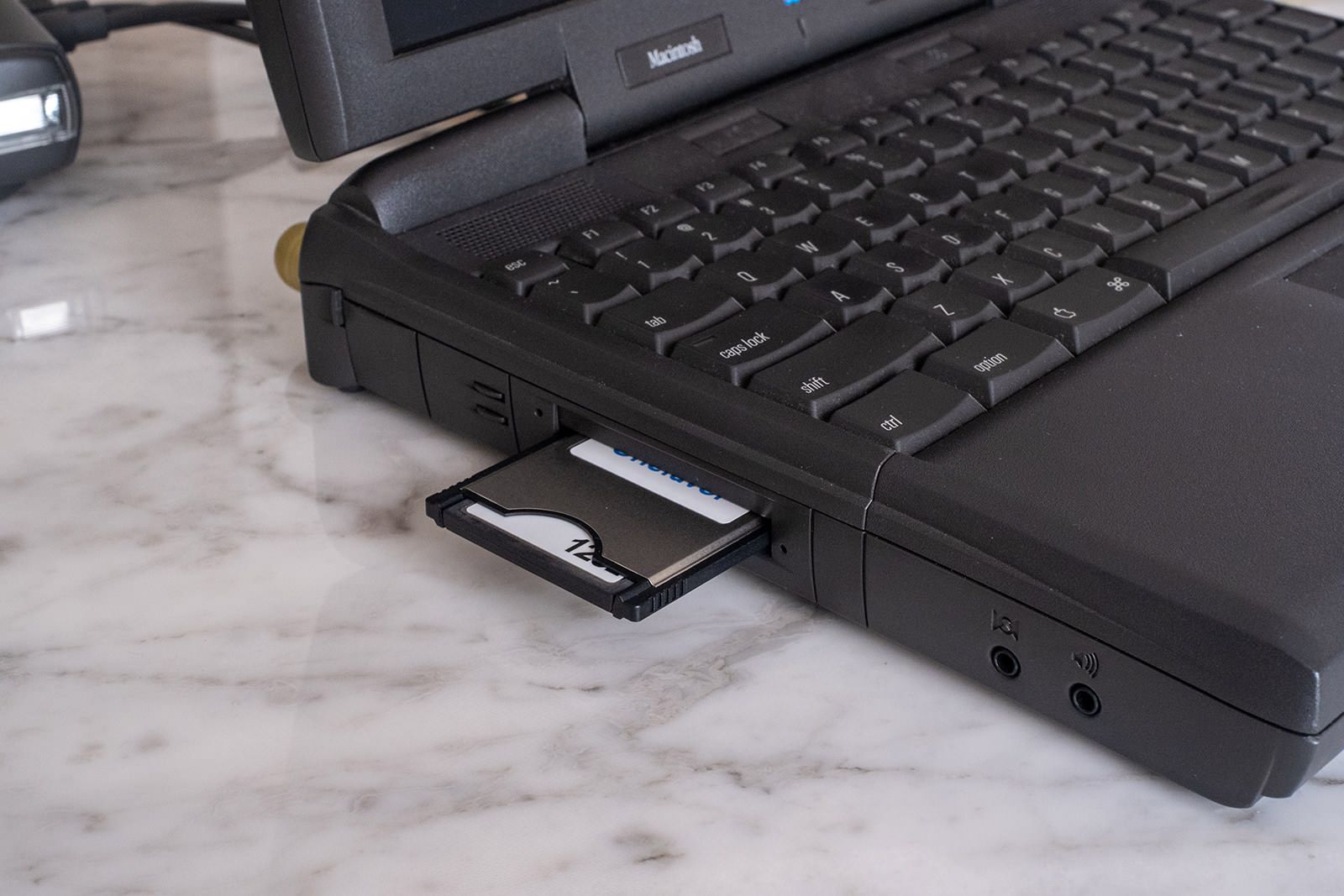
Enter the PowerBook 3400c from 1997 with its ability to run Mac OS 9, a built-in serial port, and PCMCIA slots. Each of these features will help you work with the QuickTake. You may recall this particular PowerBook as the laptop Meg Ryan uses in You’ve Got Mail.
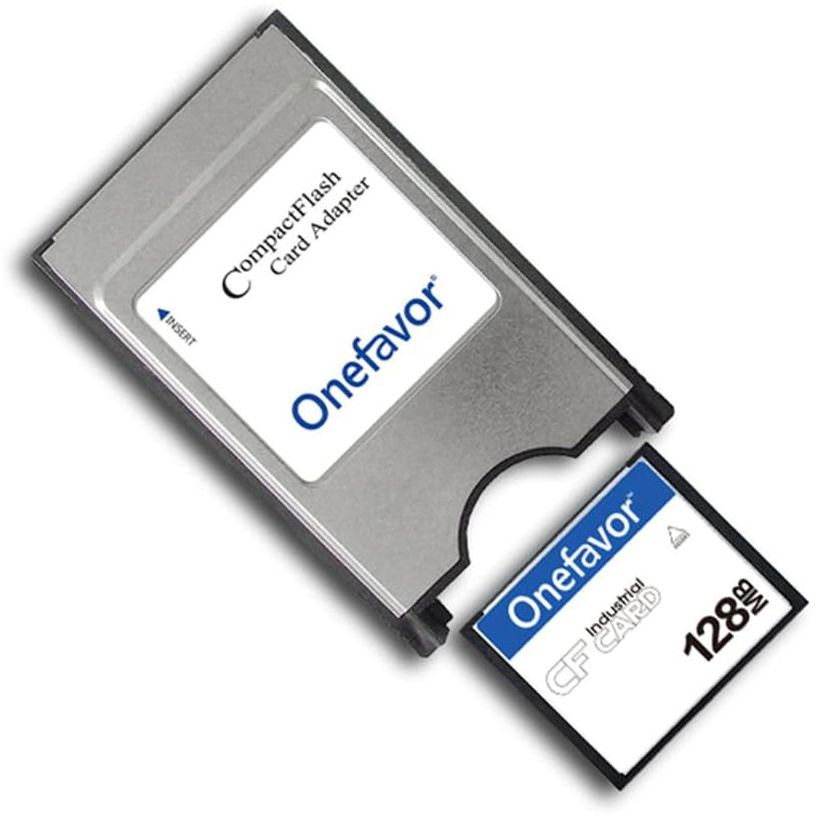
Acquire a CompactFlash PCMCIA adapter
You may remember PCMCIA slots used to add a modem or WiFi card to a laptop in the 1990s. For this project a slot will be used for the crucial step of transferring data between a modern Mac and the PowerBook.
In addition to transferring photos we also need to transfer a few application installer files to the PowerBook. It’s very important to note that you must use a real CompactFlash card and not a CompactFlash card that houses an SD card. I started with that and it refused to fit into the PCMCIA card which was quite frustrating.
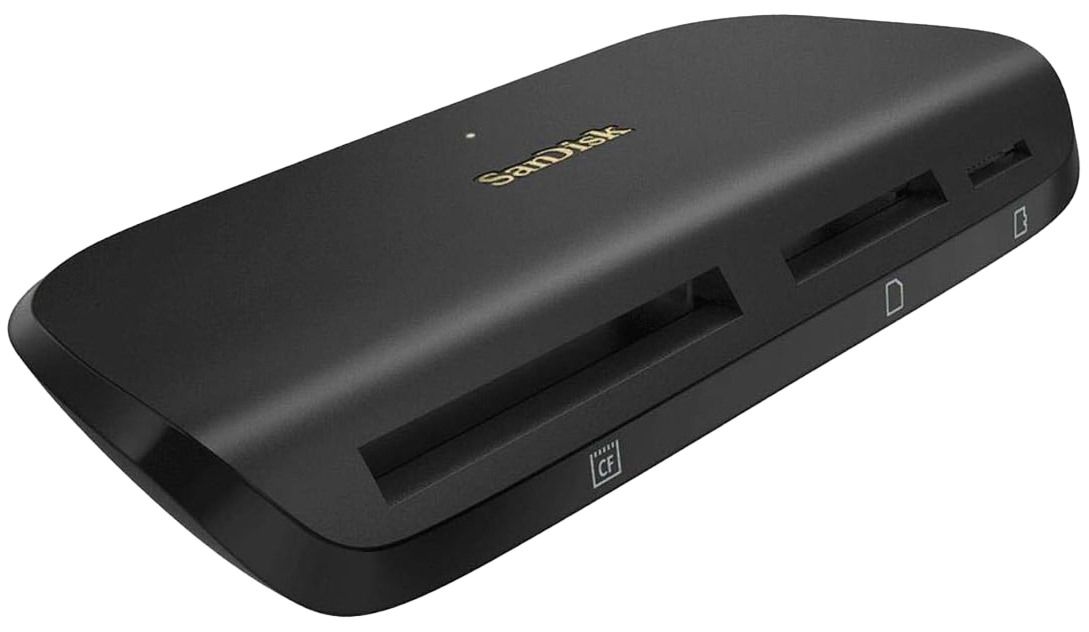
Acquire a SanDisk CompactFlash reader
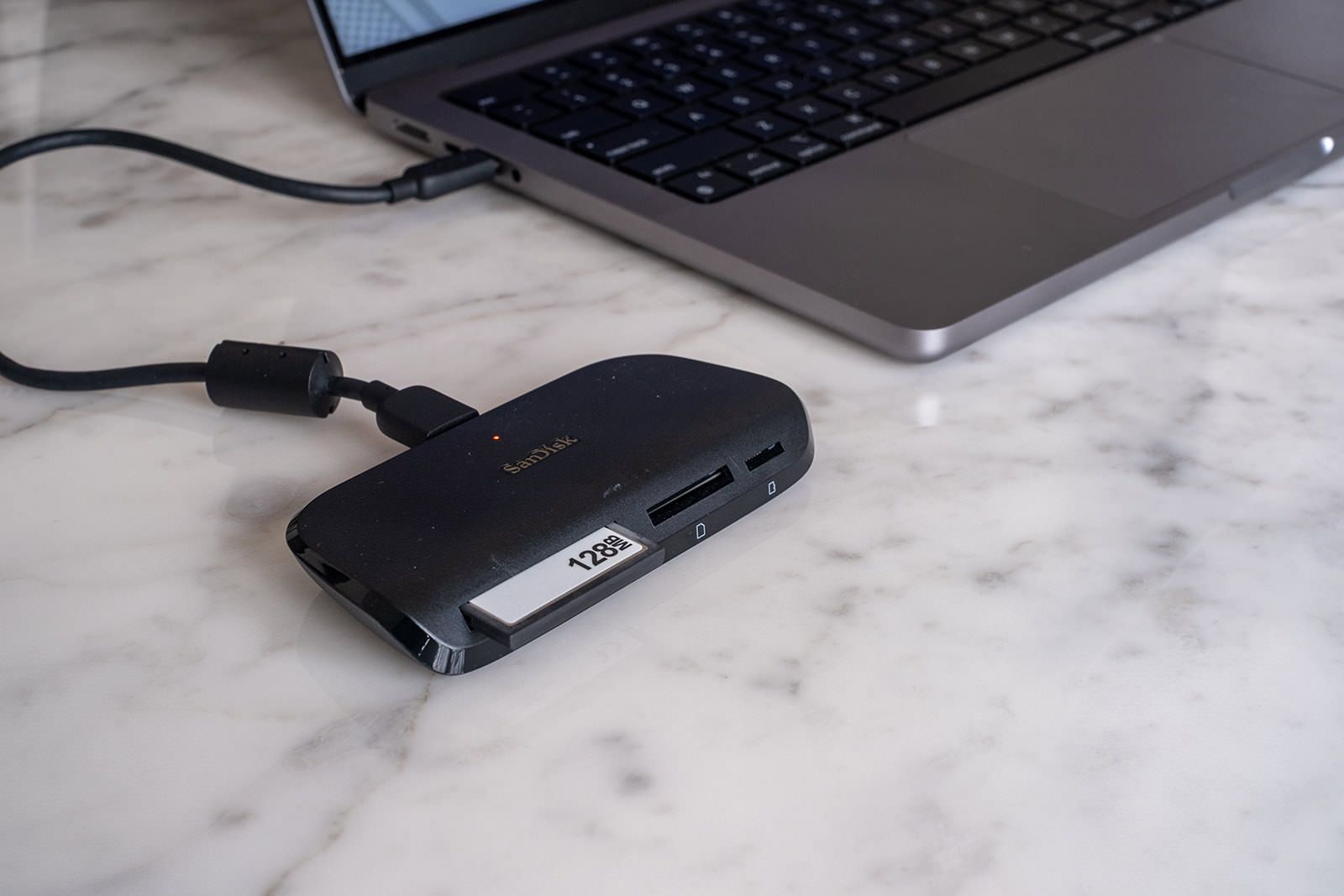
To connect a CompactFlash card to the modern Mac (in this case I’m using a M1 MacBook Pro) we need an external card reader with USB-C.
SanDisk ImageMate Pro USB-C Multi-Card Reader/Writer
I’m a long-time customer of SanDisk, and I was delighted to find an affordable, elegant solution.
Connect the reader to the modern Mac
Also insert the CompactFlash card that was included with the PCMCIA card into the reader.
Format the CompactFlash card
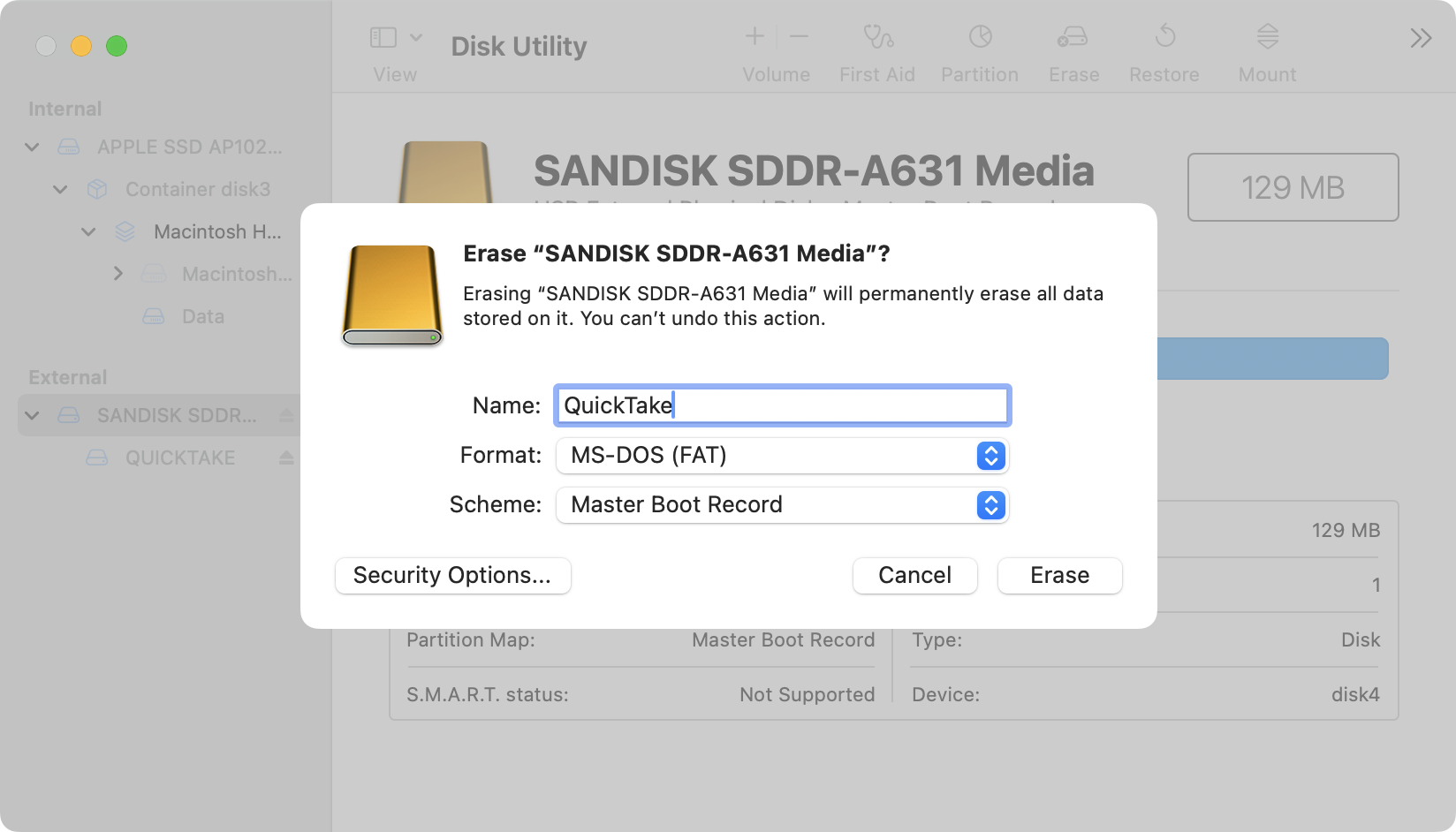
To ensure the CompactFlash card can be read on both the modern Mac and the PowerBook, use Disk Utility to format the card as “MS-DOS (FAT)” with Scheme “Master Boot Record.”
Download application installer files
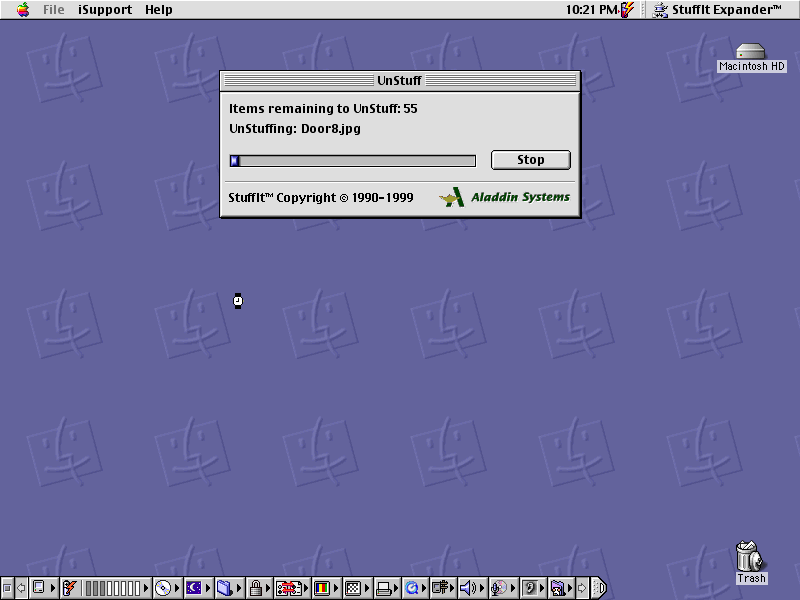
Both installer files will be .sit format meaning you get to use StuffIt Expander to uncompress them on the PowerBook. Are you having fun because I certainly am.
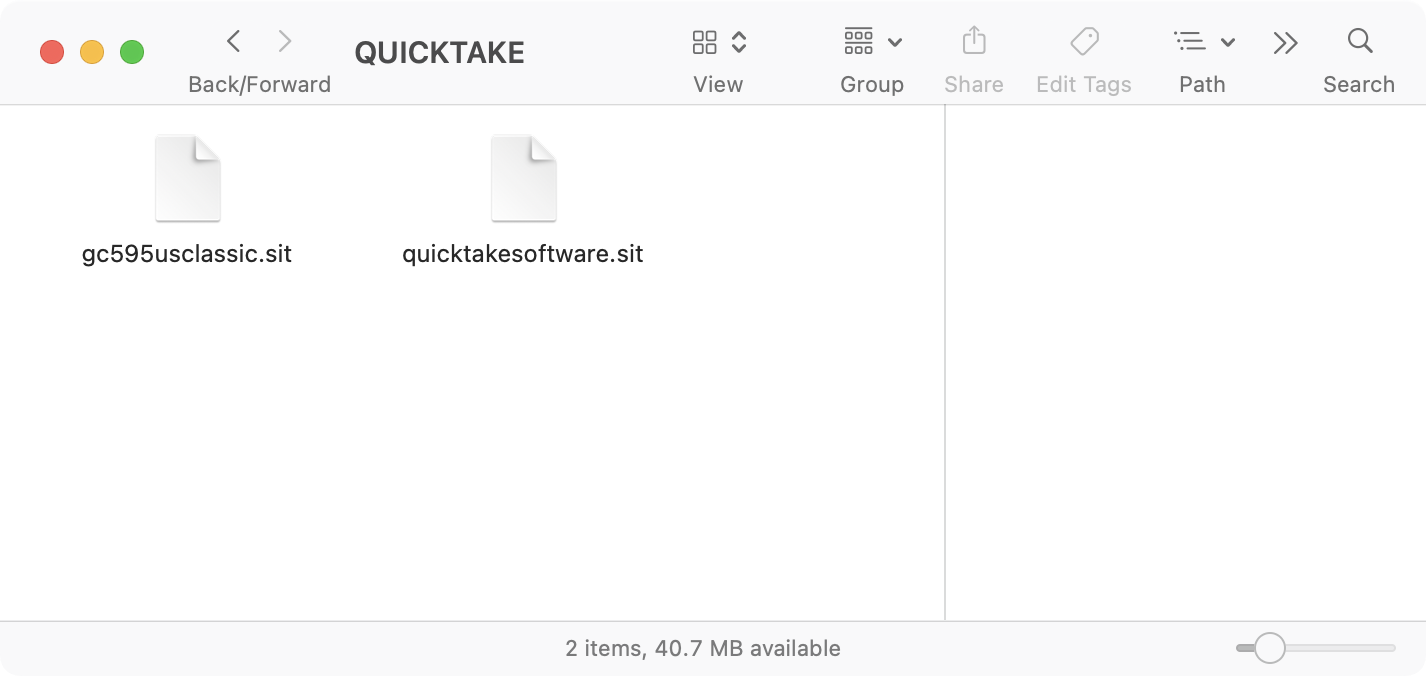
Download the GraphicConverter 5.9.5 installer and drag it onto CompactFlash card. This is required to convert the QuickTake’s photos into a modern format. Reminder: Converting formats can only be done on the PowerBook.*
Note: This is Dave from the future and I may have found another way to convert formats. We’ll get to that soon.
Eject the CompactFlash card
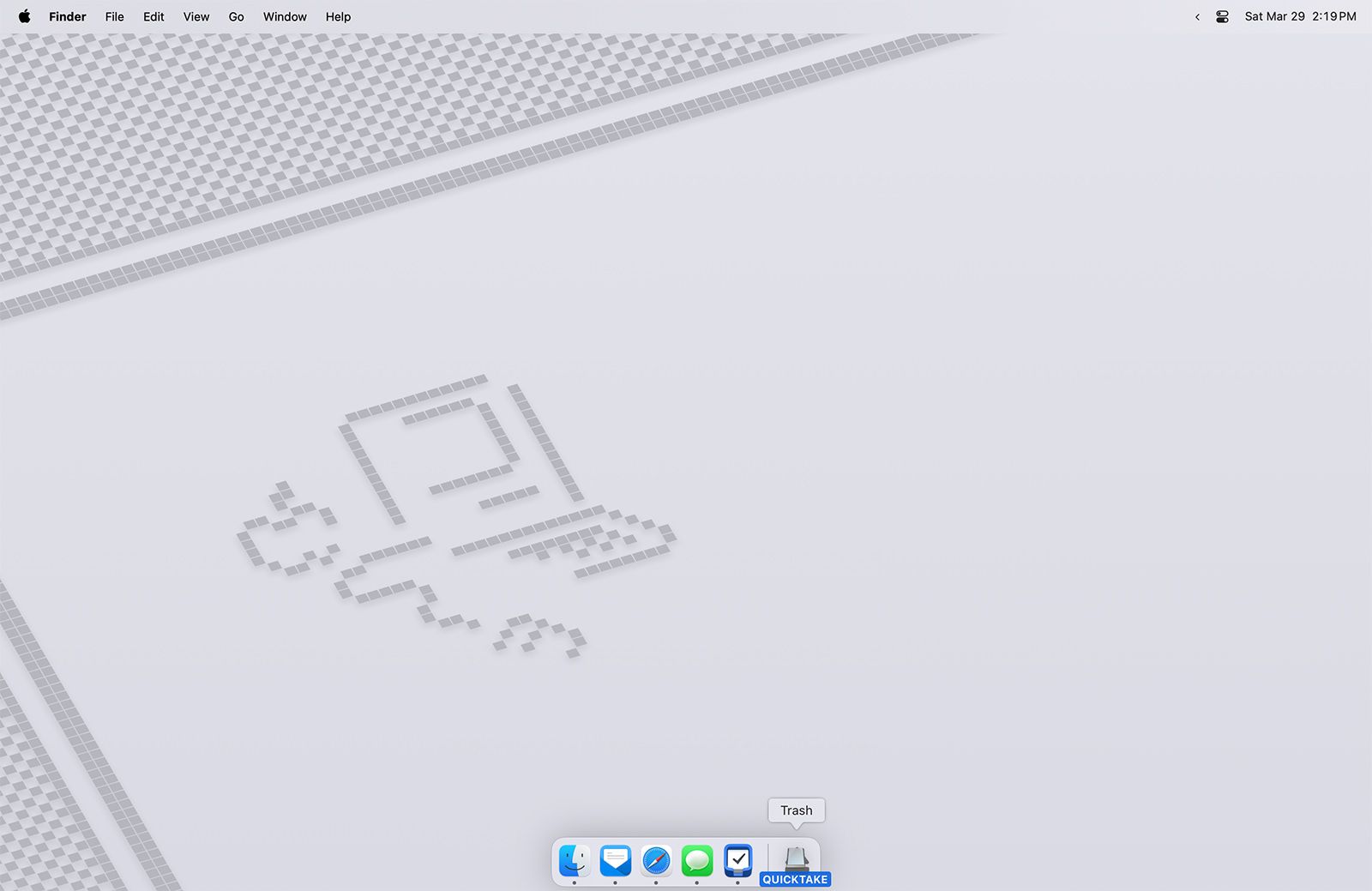
Can you believe dragging to the trash can is still one way to eject external devices? Also the “Macintosh” wallpaper option in macOS Sequoia is just delightful.
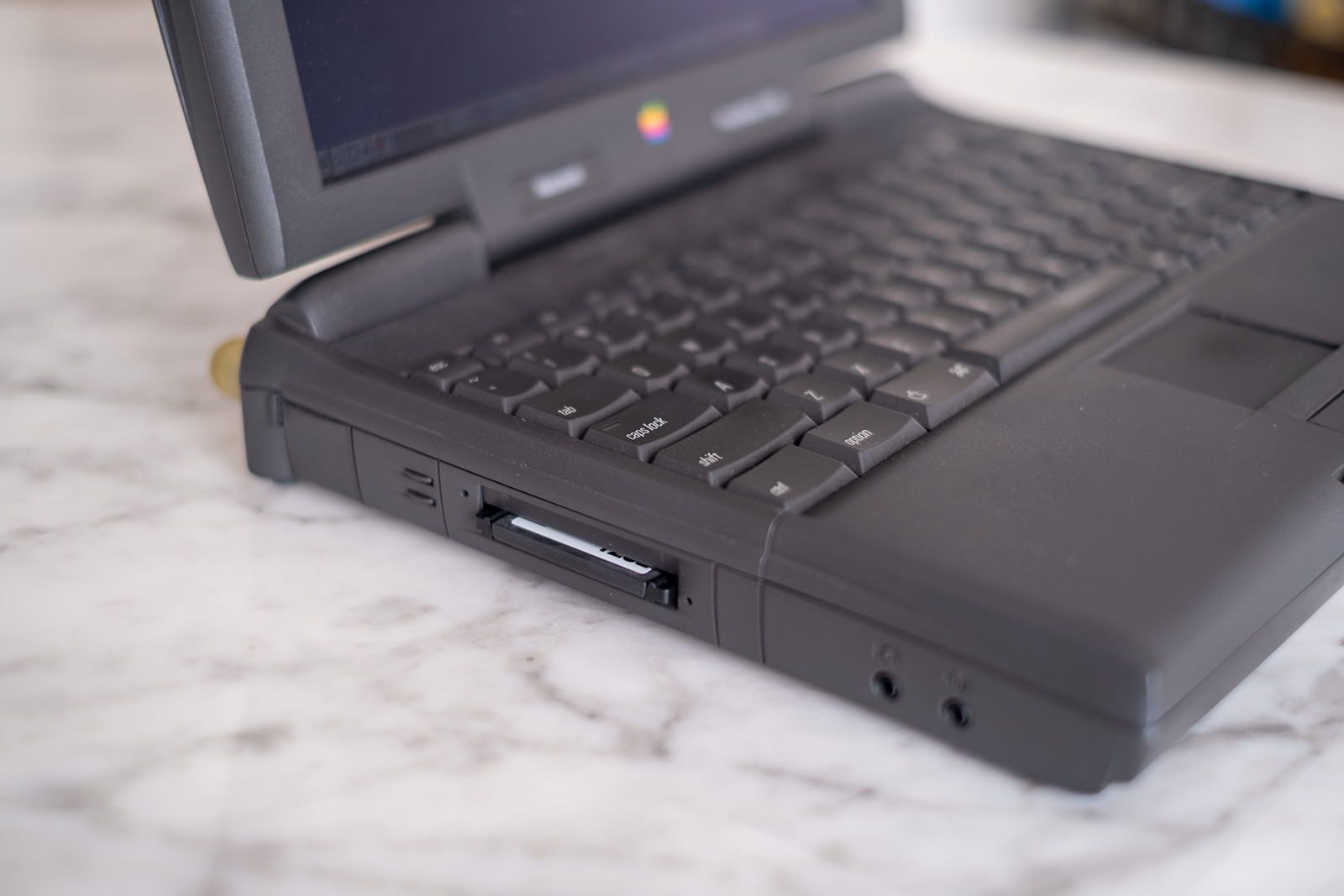
Slide the CompactFlash card into the PCMCIA adapter in the PowerBook
Remember when computers had moving parts and physical media? Quaint.
Pause
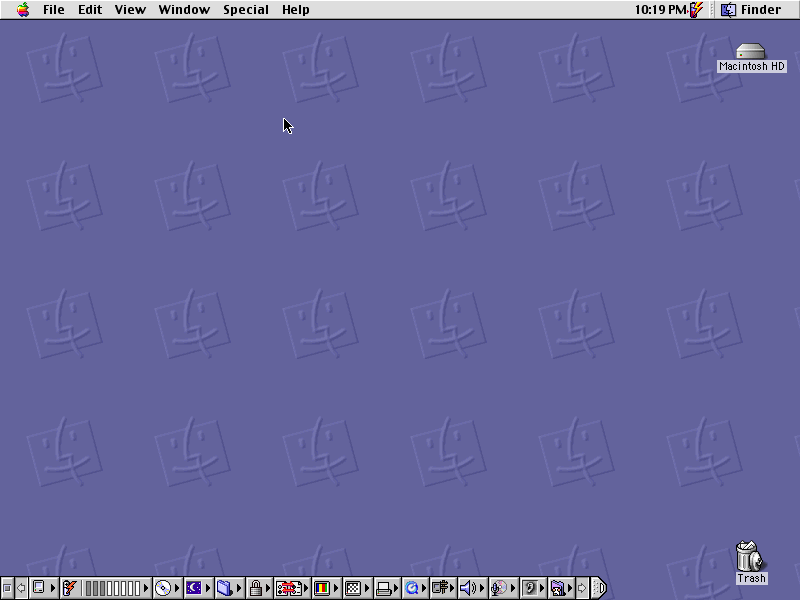
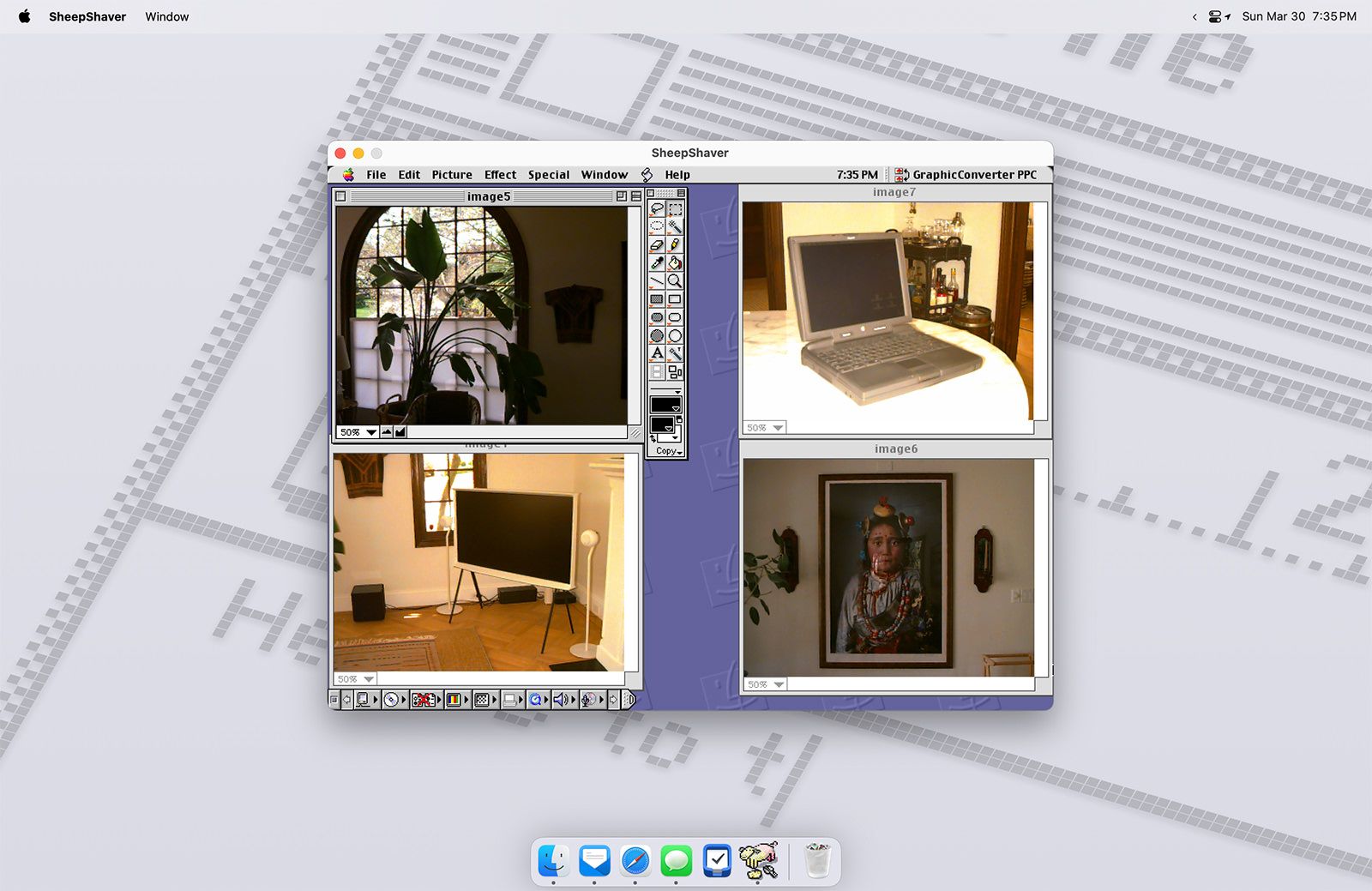
Let’s just take a moment to pause and reflect on the aesthetics of Classic Mac OS. The colors, typeface, Control Strip, etc. It’s all lovely even at its paltry 800×600 resolution.
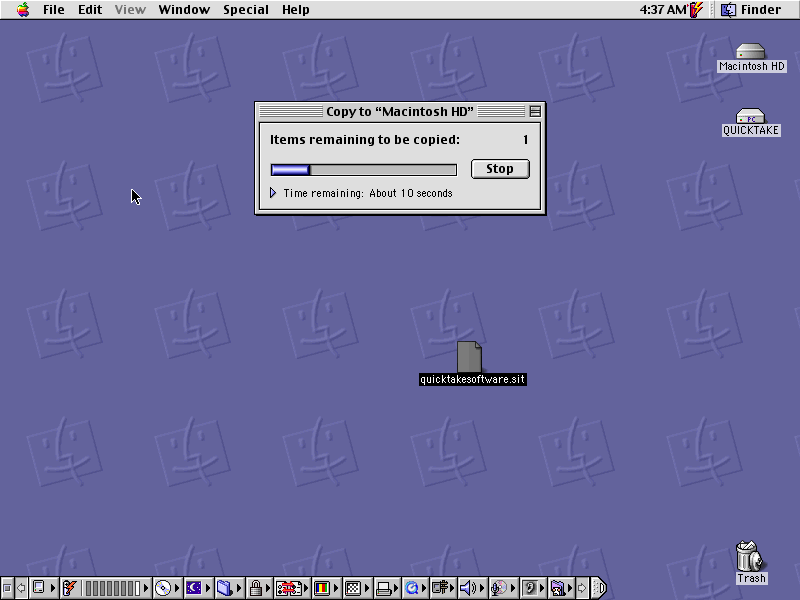
Drag the installer files onto the Macintosh HD folder
One detail I forgot about Classic Mac OS is dragging files from external disk onto the Desktop does not copy the files. You must drag the files into a folder before the “Copy to” dialog appears.
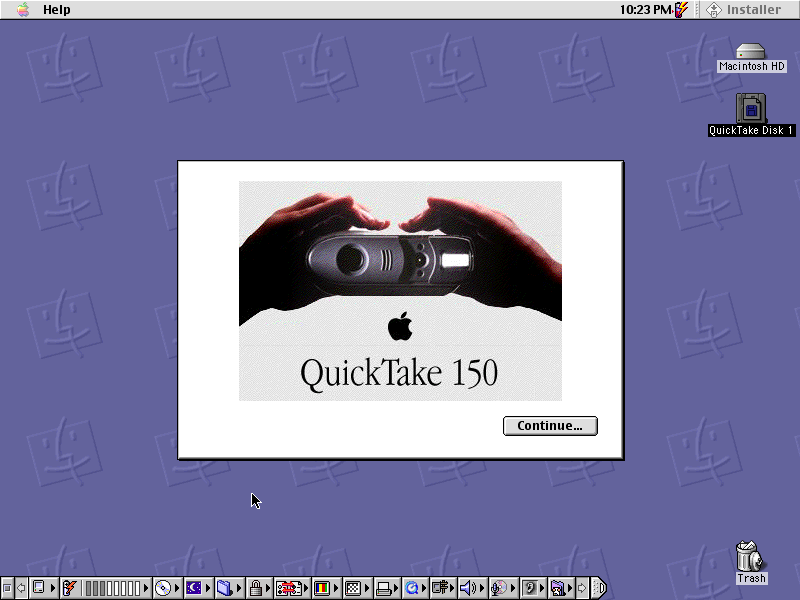
The disk image that was just uncompressed includes installers for the QuickTake 100, 150, and 200. If you have a 150 like I do then launch the 150 installer.
Easy install
Just leave everything as is and click the Install button.
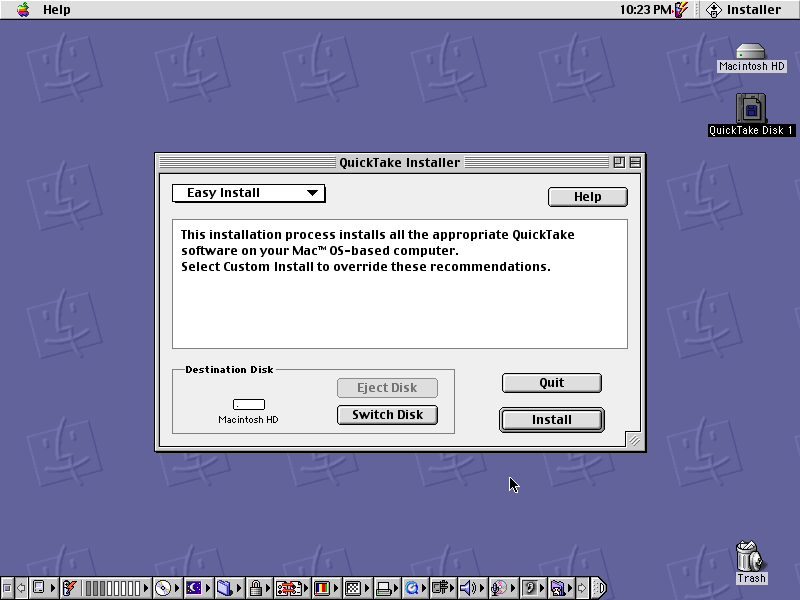
Installer installs the install disks
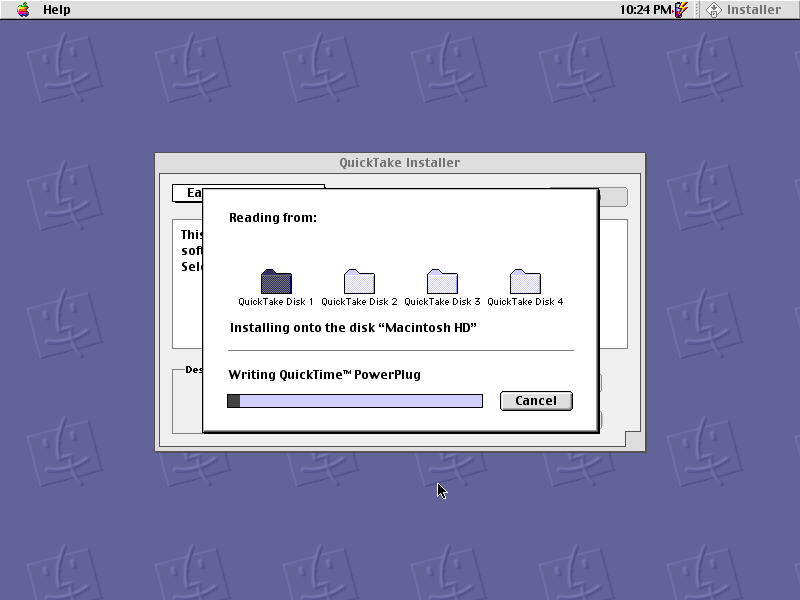
This only takes a minute. Notice in the screenshot that the current step is “Writing QuickTime PowerPlug.” When I tried this step on a slightly more modern iBook G4 in the Classic environment I ran into a problem with QuickTime PowrePlug. I kept seeing errors that it was already installed, and I could not figure out a way around the error. I even toyed with disabling and removing its extension without success. That frustration reassured me that the 3400c was best path.
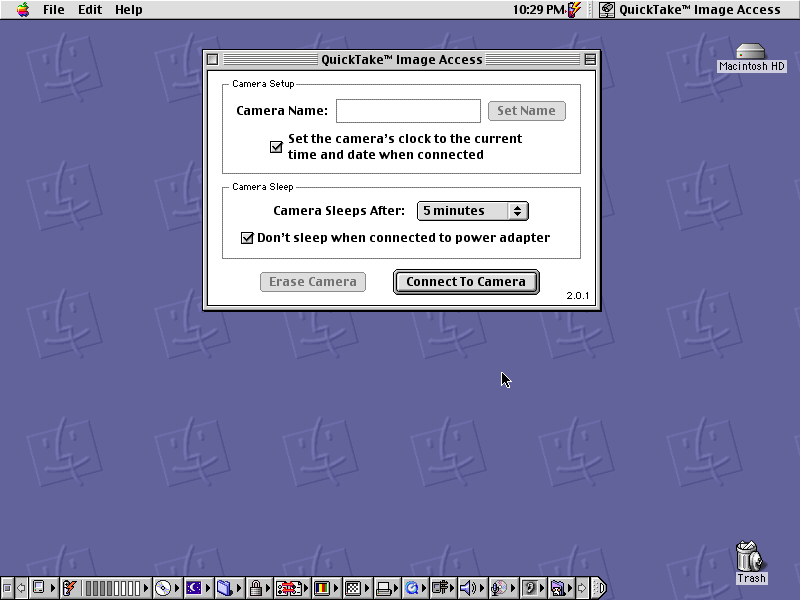
Launch QuickTake Image Access
After successfully installing the QuickTake software and GraphicConverter, go to the Apple menu, hover over Control Panels, and click on QuickTake Image Access. Yes, it is confusing that the QuickTake software is accessed through Control Panels instead of double clicking on an application in the Applications folder.
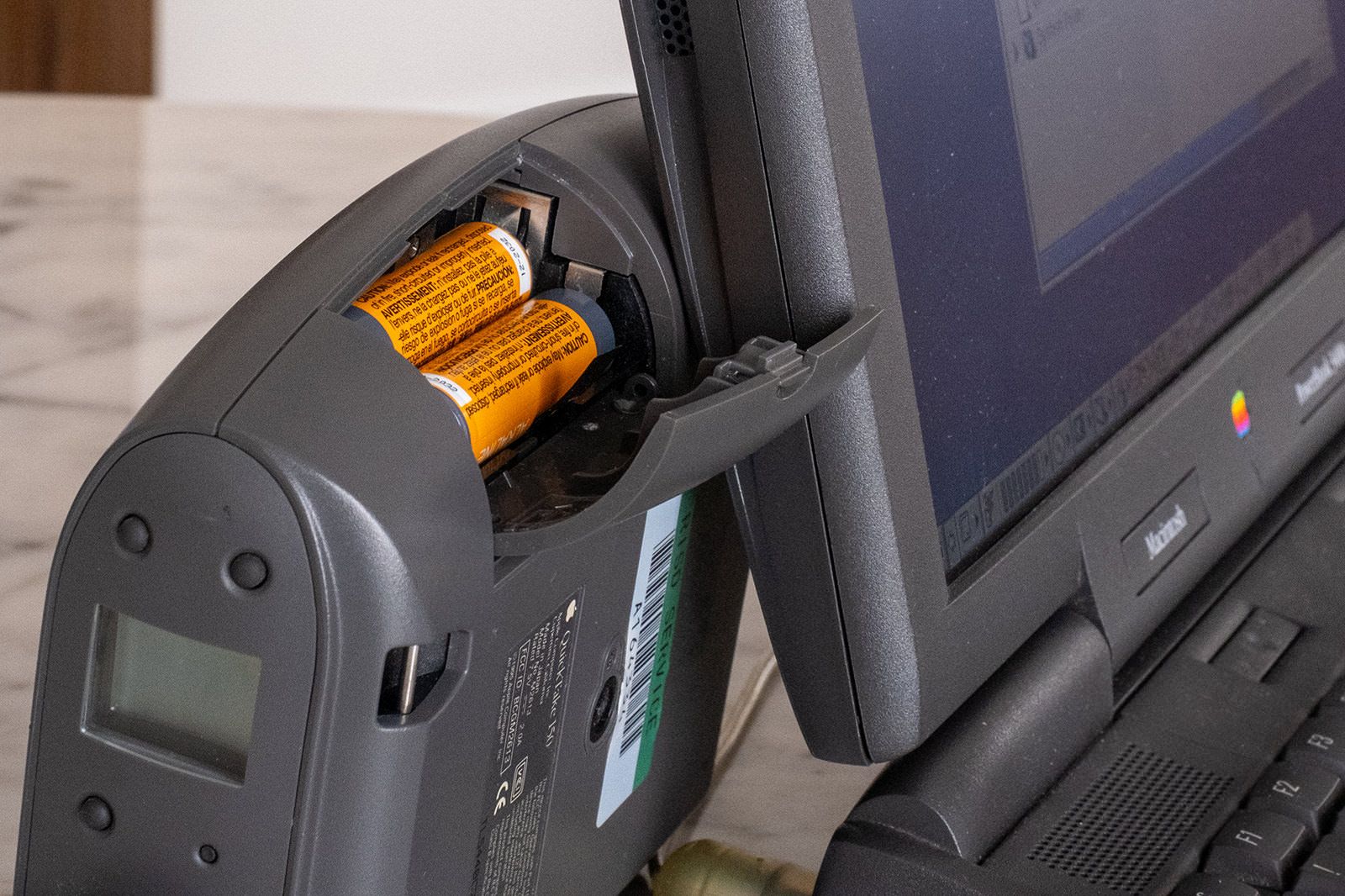
Insert AA batteries into the QuickTake
A side door opens to reveal a bay for batteries. The photo of 2 AA batteries is deceiving because deep in the bay is a spot for a third battery. The batteries are also not perfectly aligned; each is placed at a slightly different angle which I find comical.
Slide open the lens cover and shoot
No power button. No switch. The lens cover is used to power on the camera. My gut reaction to this behavior was, “Oh I suppose that’s clever.” However after using the camera for a bit this design became frustrating. The camera automatically powers off after a few minutes if idle which means you have to close and reopen the lens cover to use the camera again. It is not a smooth mechanism nor is it easy to grip. My finger slides off of the grooves more often than I would like. If you look closely at the animated gif above I use multiple fingers to ensure the cover opens on the first attempt.
With batteries and an open lens cover you’re ready to shoot! Enjoy pressing what may be the largest shutter button in the history of digital cameras.
Connect the QuickTake to the PowerBook
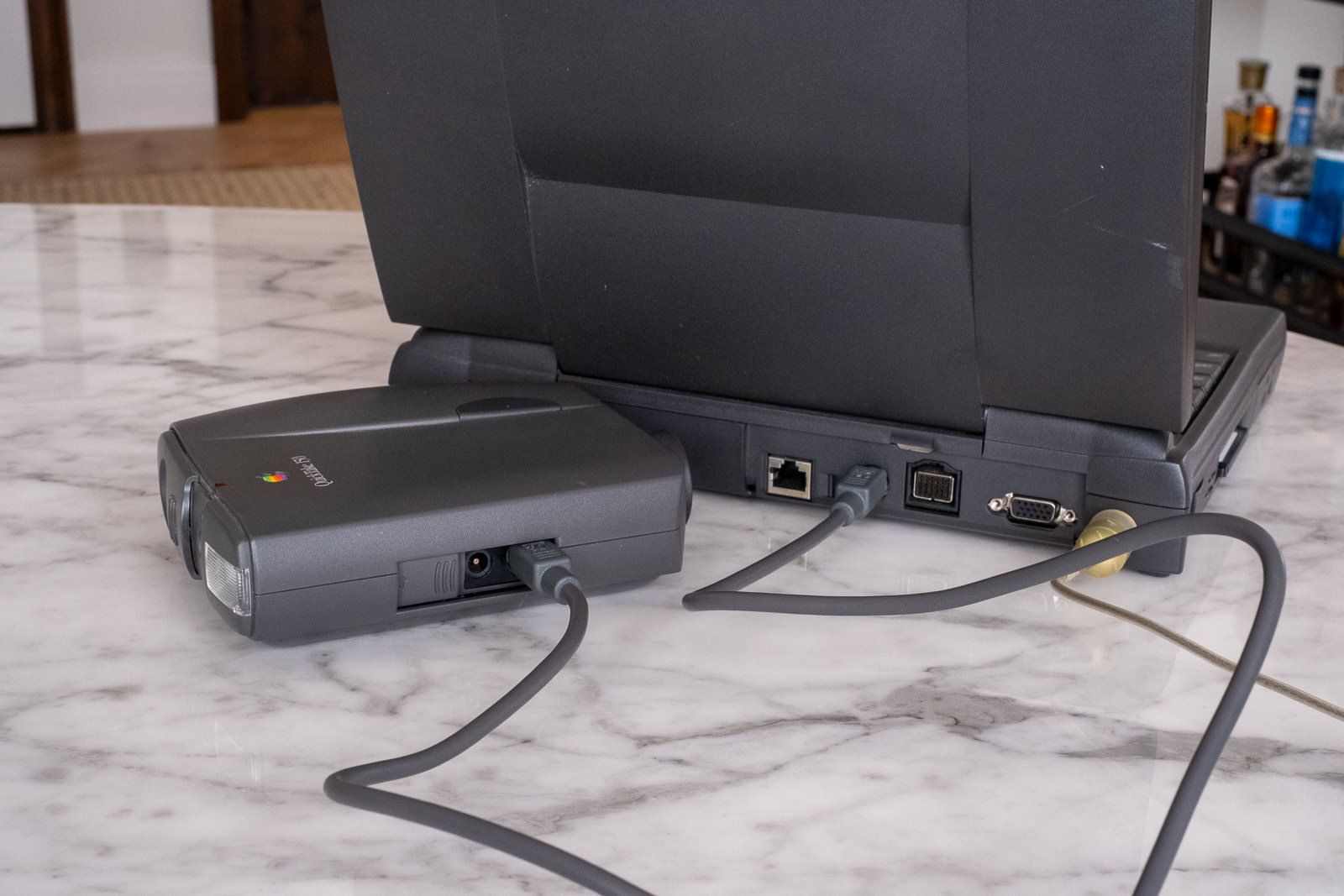
After you’ve snapped a few photos connect the QuickTake to the PowerBook’s serial port using the cable that was included with the camera. Ensure that you slid open the lens cover within the last couple of minutes so the camera is powered on and ready to communicate with the computer.
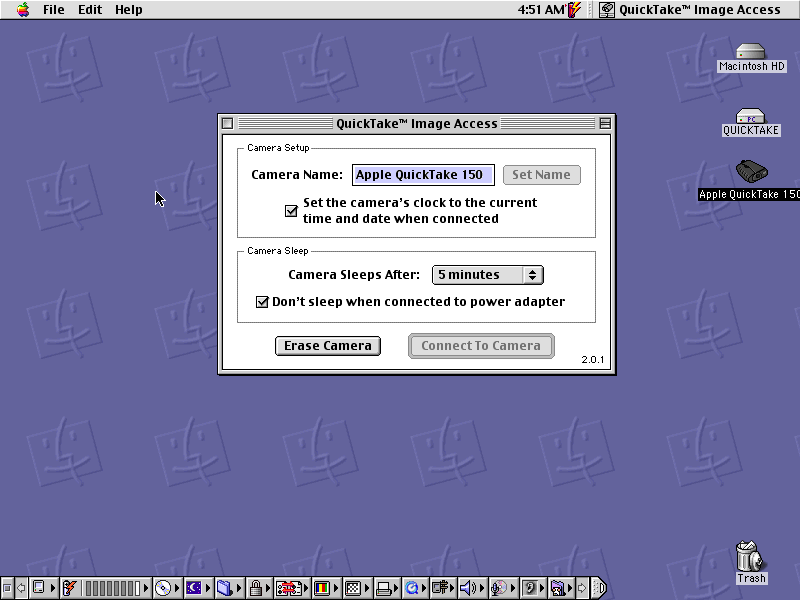
Click “Connect to Camera” in QuickTake Image Access
A couple seconds later the Connect to Camera will appear disabled, the Camera Name field will be populated, and the camera will mount on the desktop just like a disk. This is all extremely intuitive.
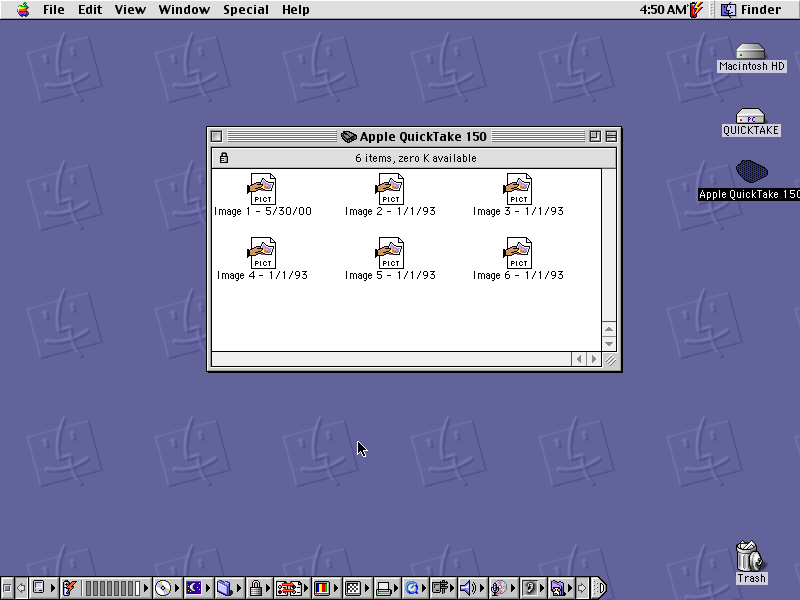
Double click on the camera’s disk image
There are your photos! Don’t get too excited. We still need to convert them into a more useful format.
Launch GraphicConverter
Double click on Macintosh HD. There you will find the GraphicConverter folder that we installed. Open it and double click on the GraphicConverter app icon.
Alright, team. It’s time for a confession. I had this all working beautifully on my PowerBook 3400c. When it came time to document the workflow something happened to the laptop. When I launch applications I now get error type 1 or 2. Remember those? I sure forgot. I tried everything I could think of to resolve the errors. Fortunately a friend provided an alternative: SheepShaver. This software allows me to run Classic Mac OS on a modern Mac and convert the files. Unfortunately it cannot communicate with the camera, but at least I documented those steps before the PowerBook got into its bad state.
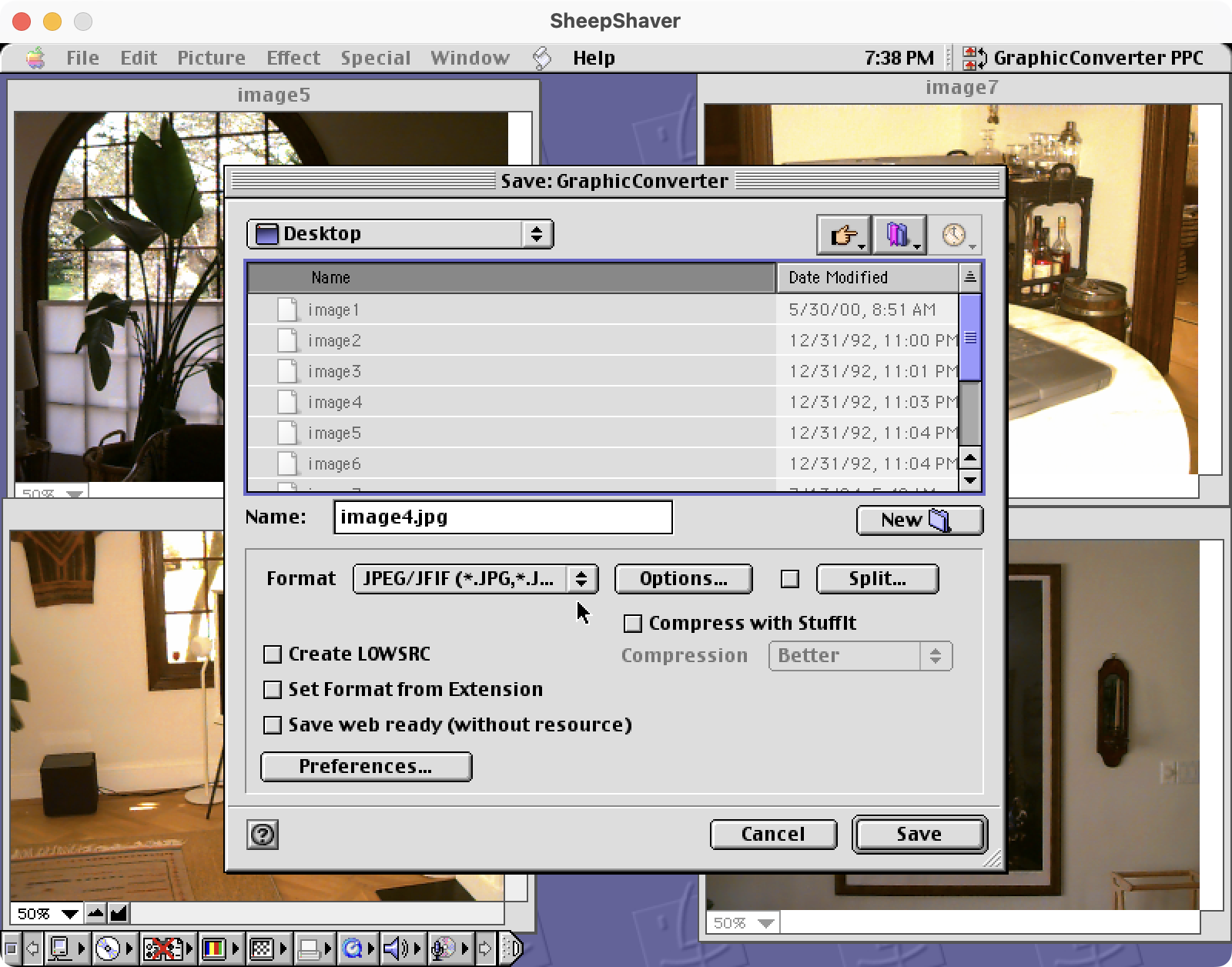
File → Save as
In the Save dialog select your CompactFlash card as the save destination and select JPEG as the format.
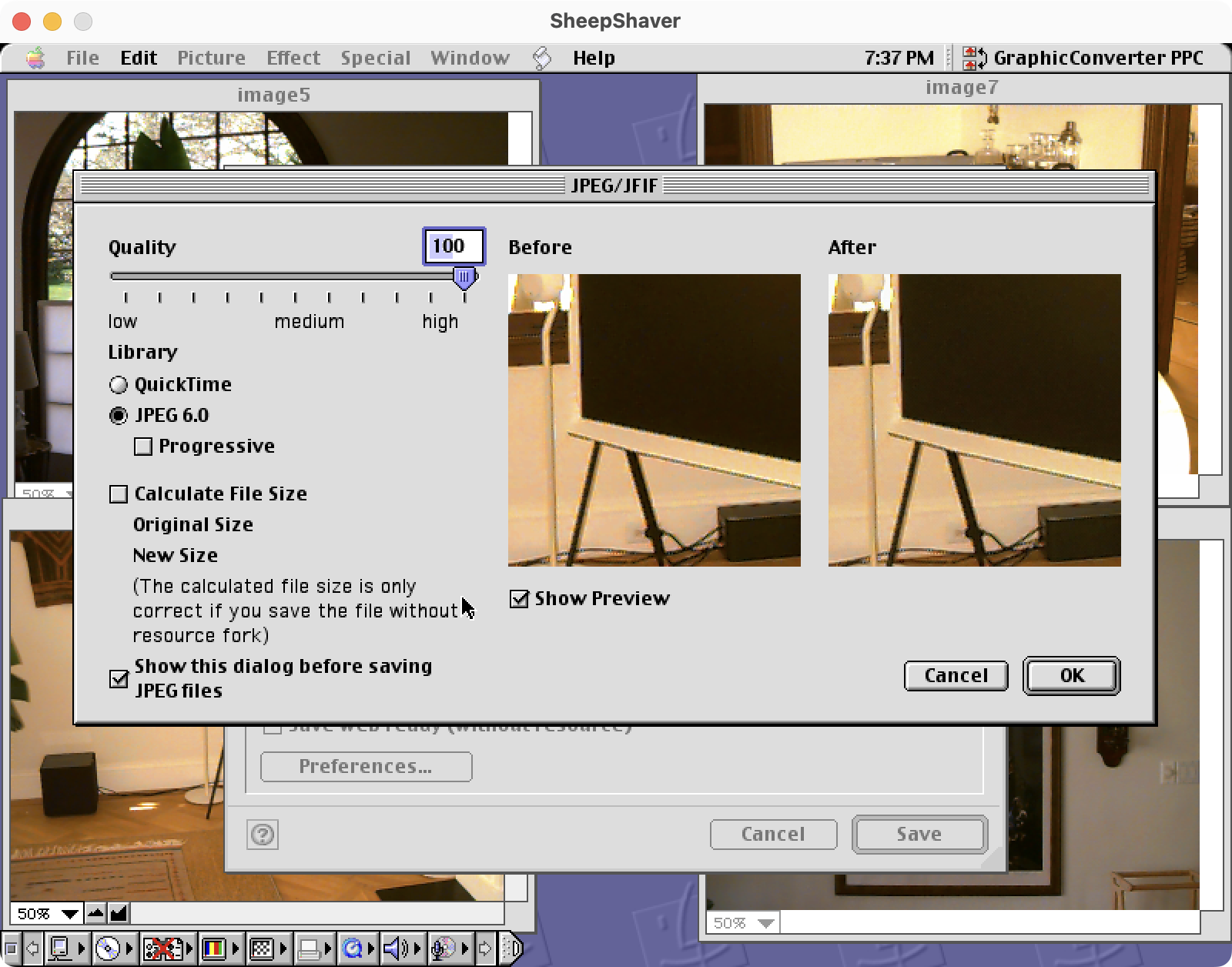
File → Save as → Options
If you want to get fancy click on “Options” in the Save dialog to choose the JPEG quality and see a preview.
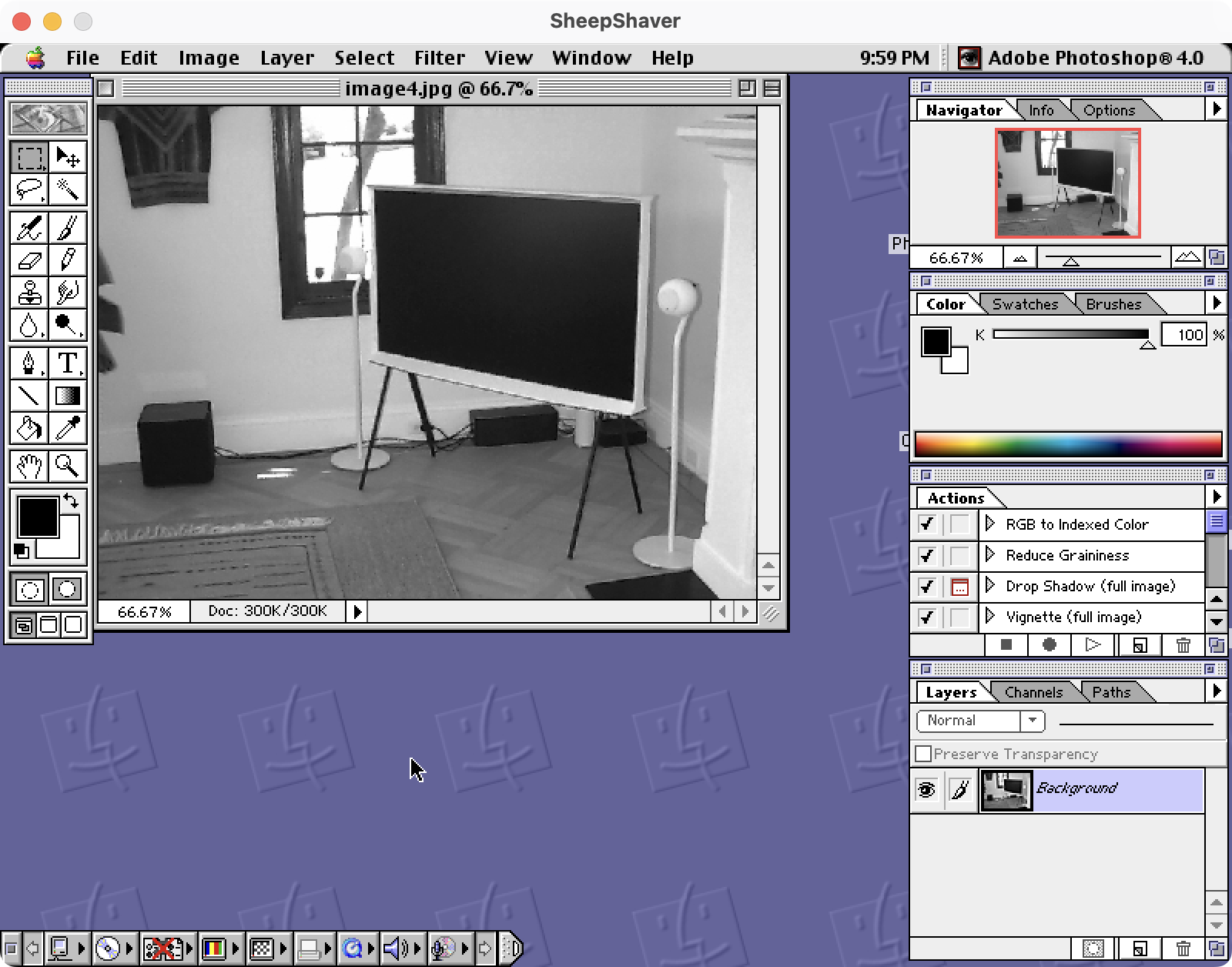
Photoshop 4.0
And if you want to get even fancier try downloading and installing Adobe Photoshop 4.0 to tinker with your photos like it’s 1996.
Eject the CompactFlash card
Again, it’s wild that the user experience of dragging a mounted drive to the trash can to eject it is still used in 2025. Also I was pleasantly surprised to hear and see the PCMCIA card pop out of the slot.
Enjoy your photos
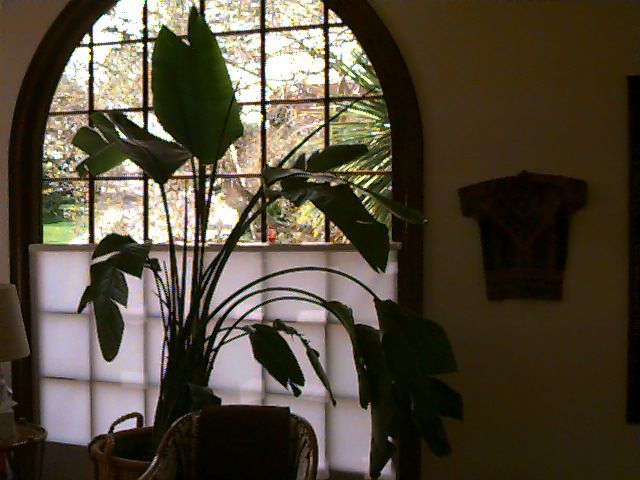
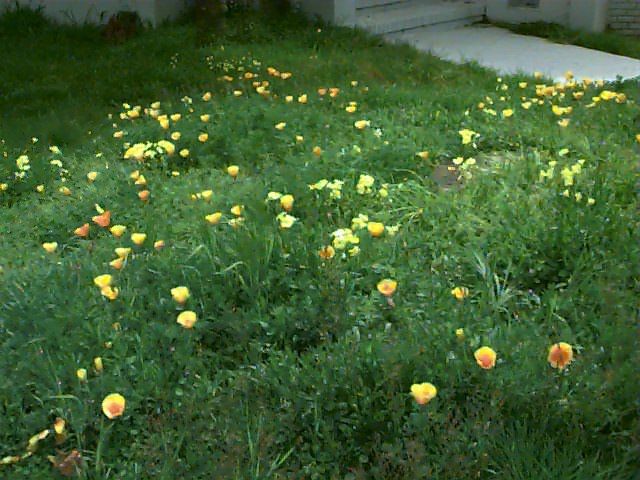
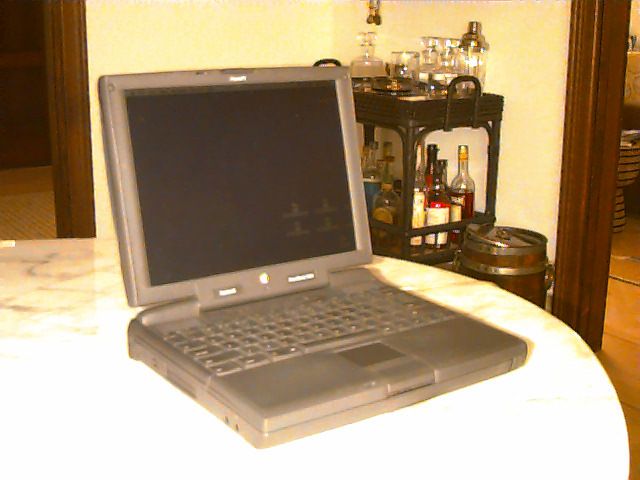
Insert the CompactFlash card into the SanDisk reader and transfer your photos to the modern Mac. Let’s take a look at some unedited photos I took with the limited 640×480 resolution.
Interior shots are quite dark.
Standing next to a window helps.
Outdoor light is clearly ideal.
Of course I must include a shot of the 3400c. The flash is brutal.
A fun side effect of purchasing a used QuickTake is discovering the previous owners’ photos still stored on the camera. Clearly someone who owned this particular camera was a fellow collector.
This collector loves compact Macs.
Closing platinum thoughts
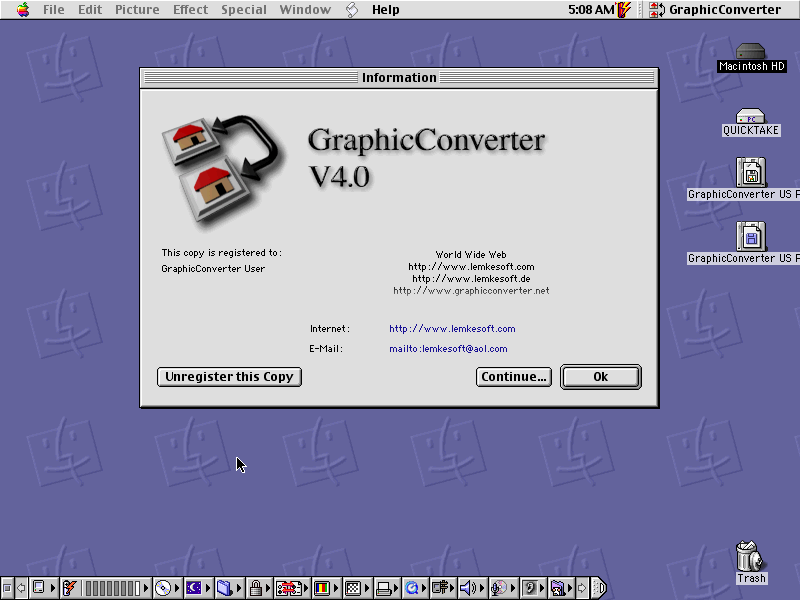
I am clearly a fan of Apple and its products. I attended Macworld conferences in middle school, sold Macs at Computerware in high school, led the Mac User Group in college, interned at Infinite Loop, and sold stacks of iPhones at the Palo Alto store after graduating. Somehow I never noticed until writing this post that the Platinum design language was incorporated outside of the user interface. Take a close look at top of the Graphic Converter About window below.
How dare they use “Ok” in a button instad of the stadard “OK.”
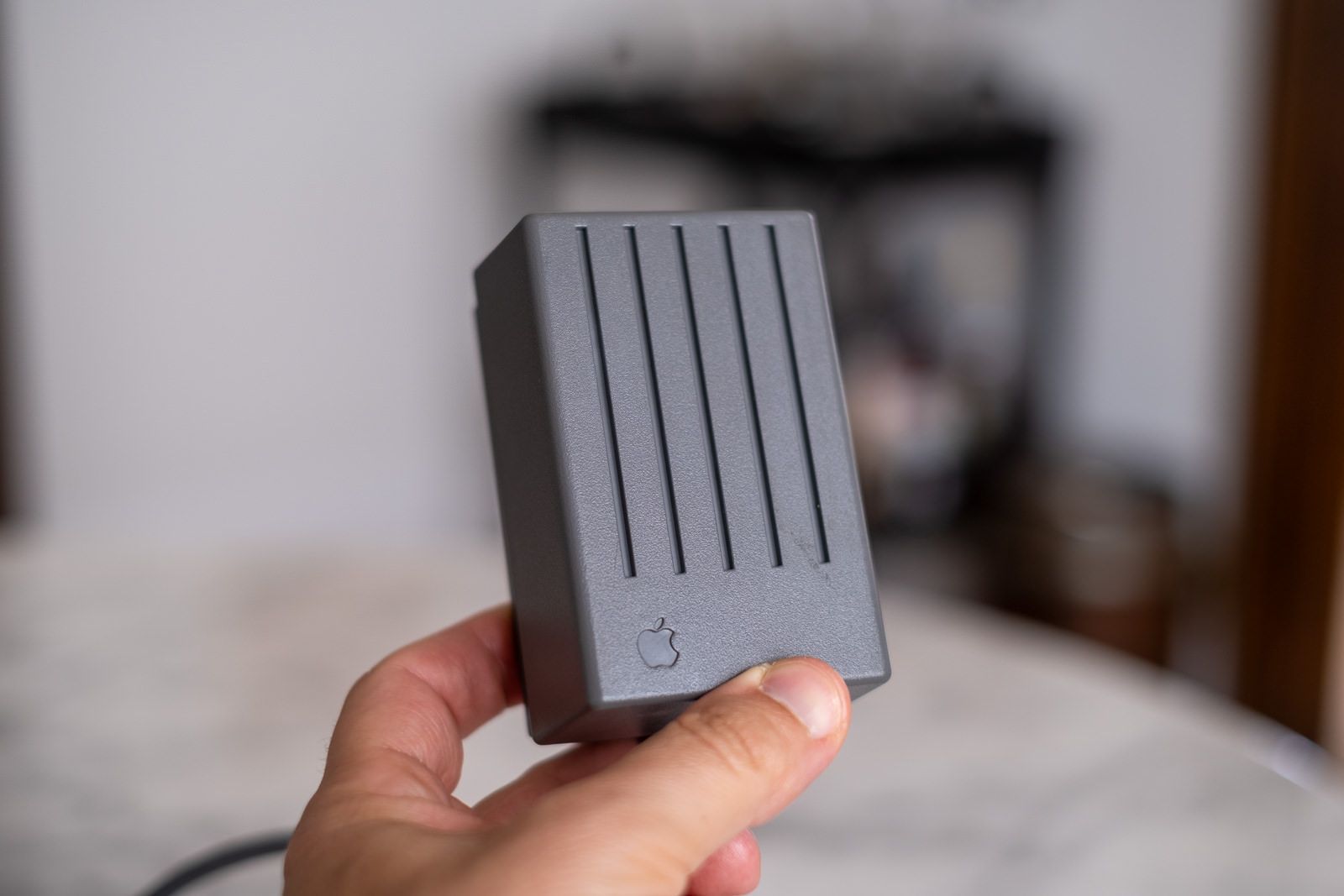
Do you see the horizontal bars at the top of the window? The bars feel like they are sticking out of the window by creating tiny shadows. As a user you feel encouraged to grab that area with the mouse and drag it around the screen. Well take a look at the QuickTake’s AC adapter.
Look at that! The bars are grooves in the AC Adapter instead of bars that protrude to create shadows, but it feels like a direct connection to the operating system’s design. I can’t believe it!
Thank you for joining me on this hardware odyssey, and I hope you feel inspired to purchase some vintage Apple prdoucts.
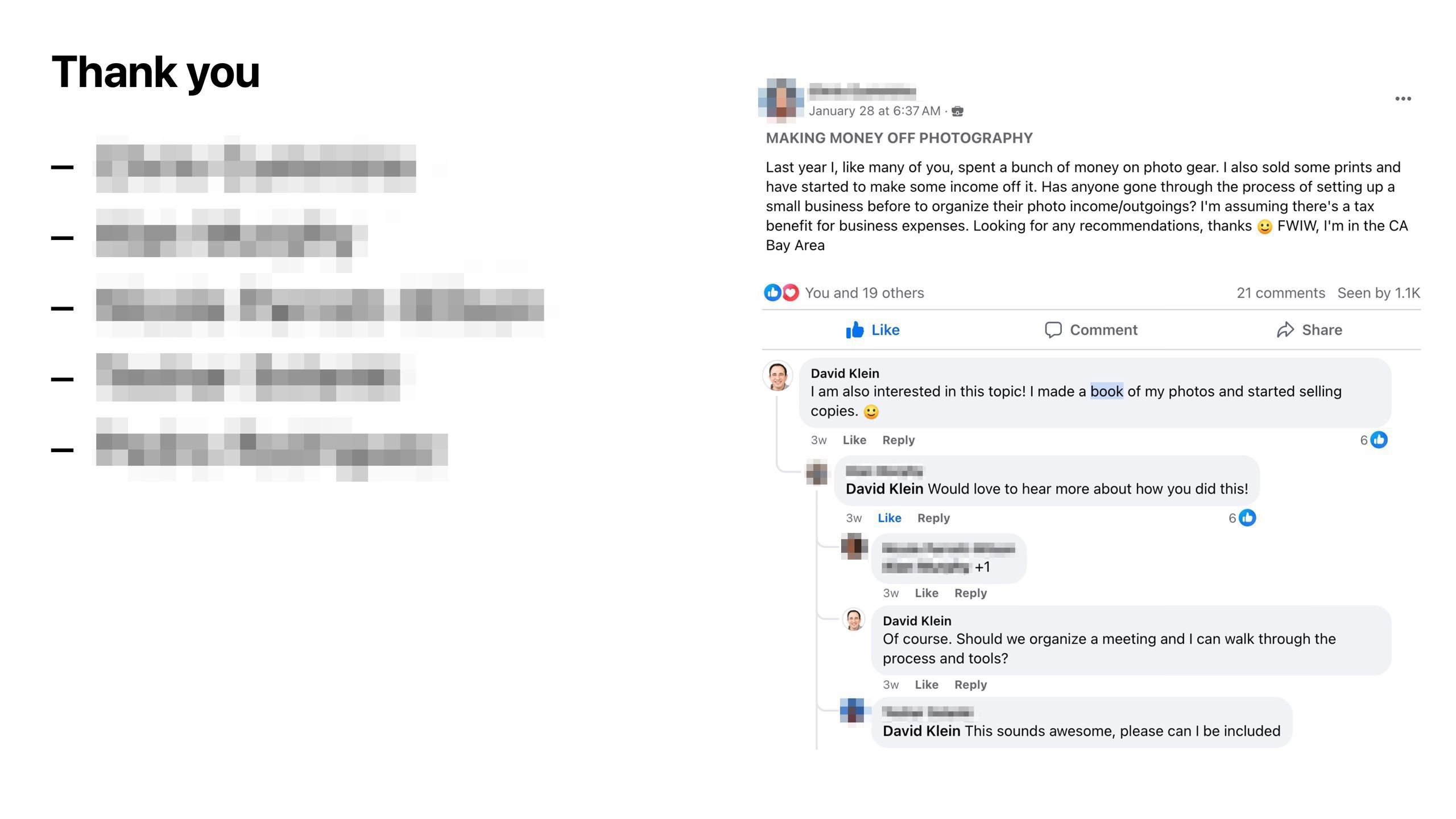
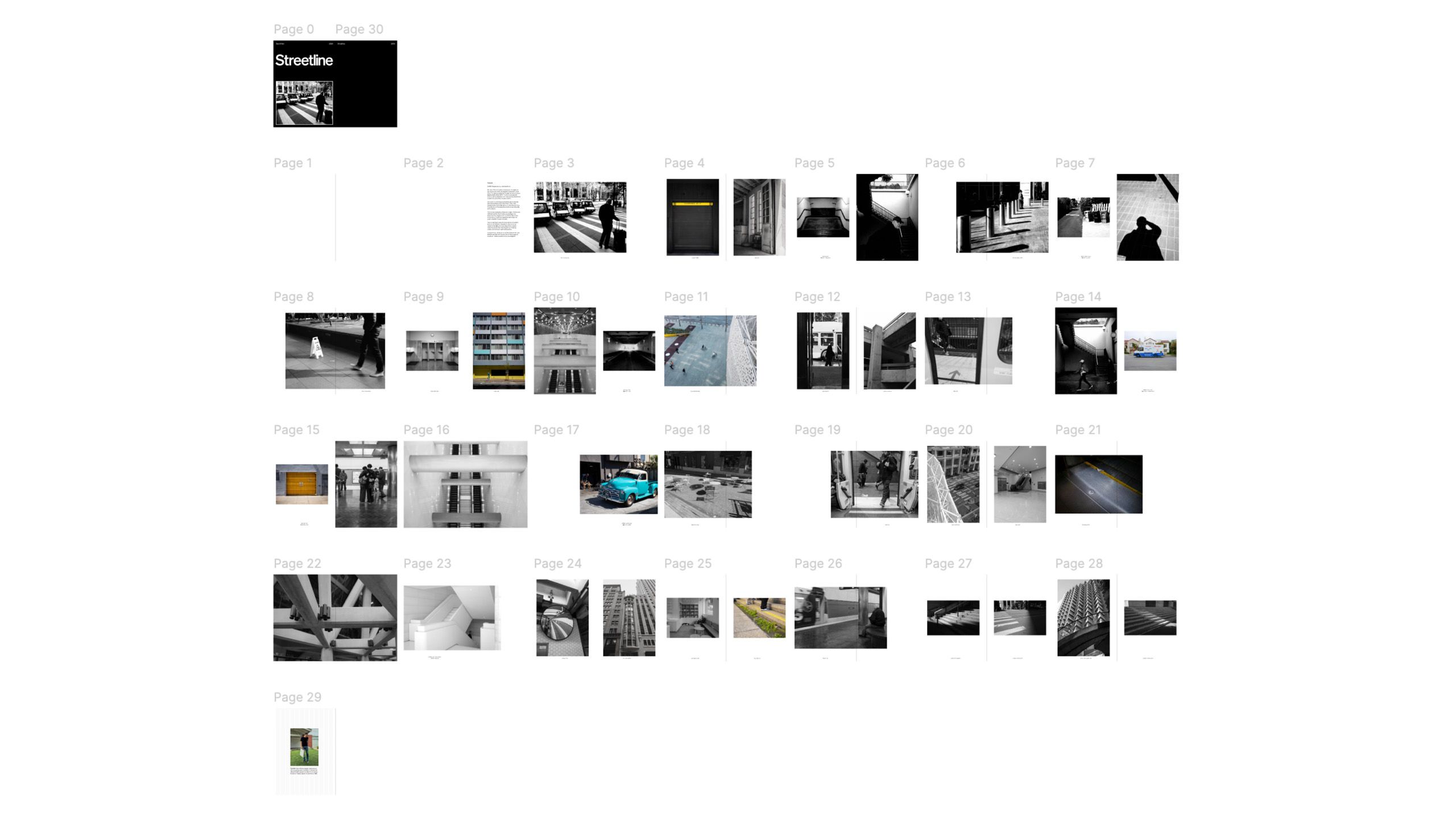
At work there was a discussion about making money from photography. I chimed in to say I recently designed and printed a book, and a few coworkers encouraged me to make a presentation to explain how I did it and what I learned. Below are my slides, animations, and talking points. Enjoy and feel free to contact me with any questions.
My goal for the presentation was to demonstrate how I designed and printed a book vs. uploading photos to a service that automatically generates one. That’s why I’m leaning heavily into the word “make.”
I provided a very brief introduction about myself including that I recently joined Meta in January as a product designer in the Enterprise Products group.
An important lesson I learned from my time at Salesforce is to thank people at the beginning of a presentation. I listed and thanked the people who encouraged me to talk about my book.
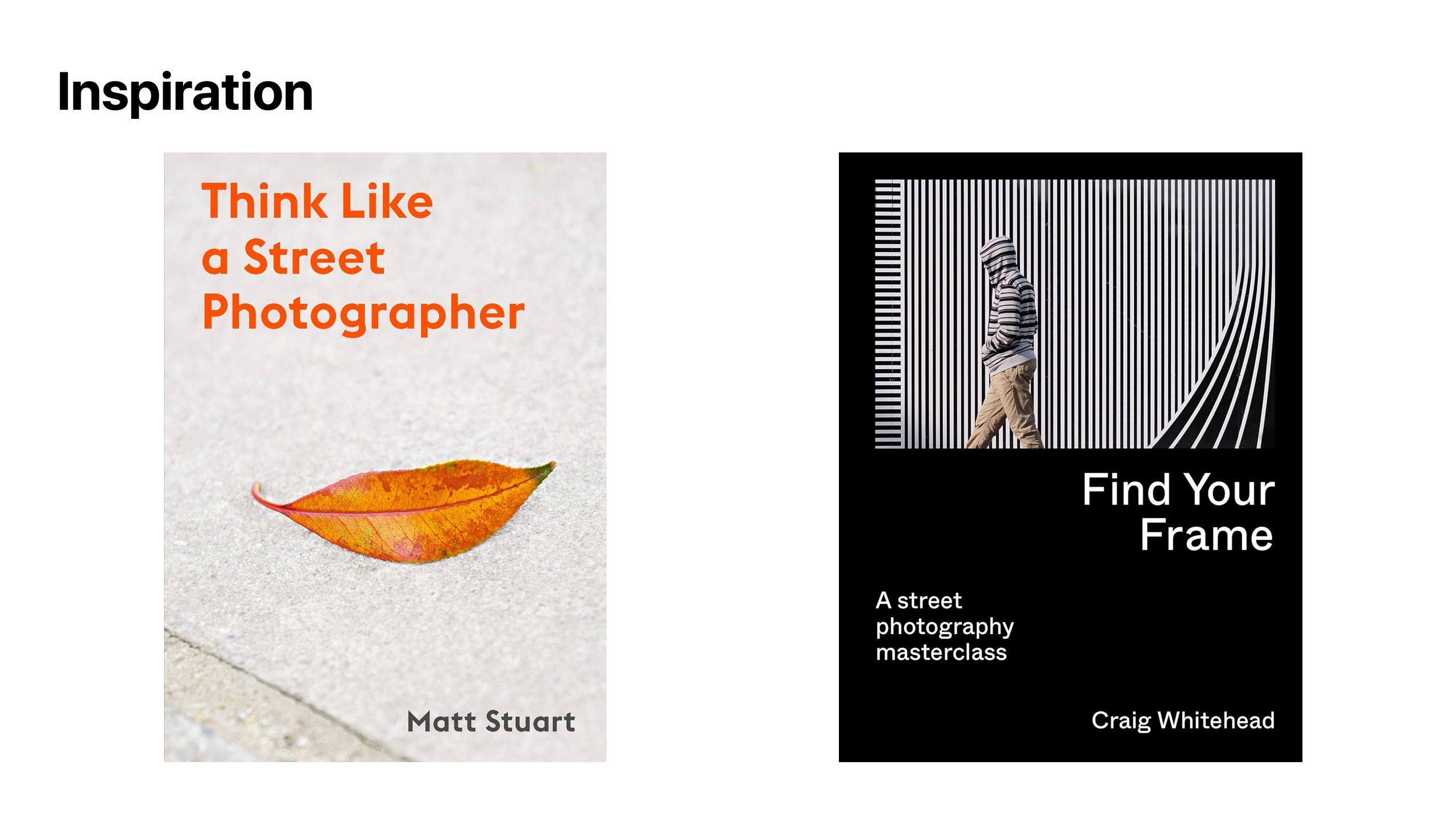
Getting photos offline was important to me. I wanted to make something tangible. Also I thought it would be fun to design a book! My entire career has focused on software.
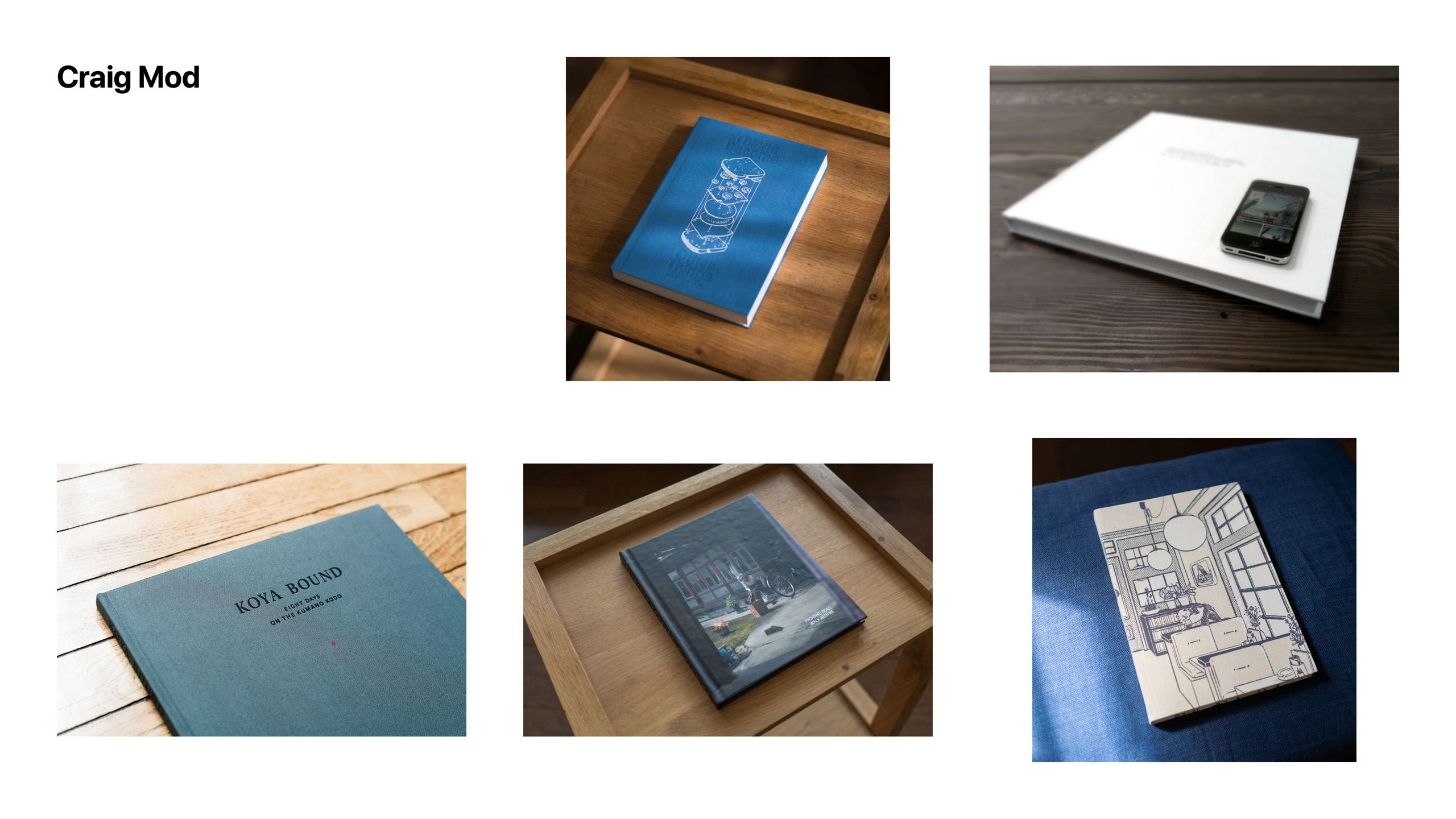
Craig Mod is also a huge inspiration. His newsletters and books are beautifully written and feature dazzling photos. I can’t wait for Craig’s latest book to ship: Things Become Other Things.
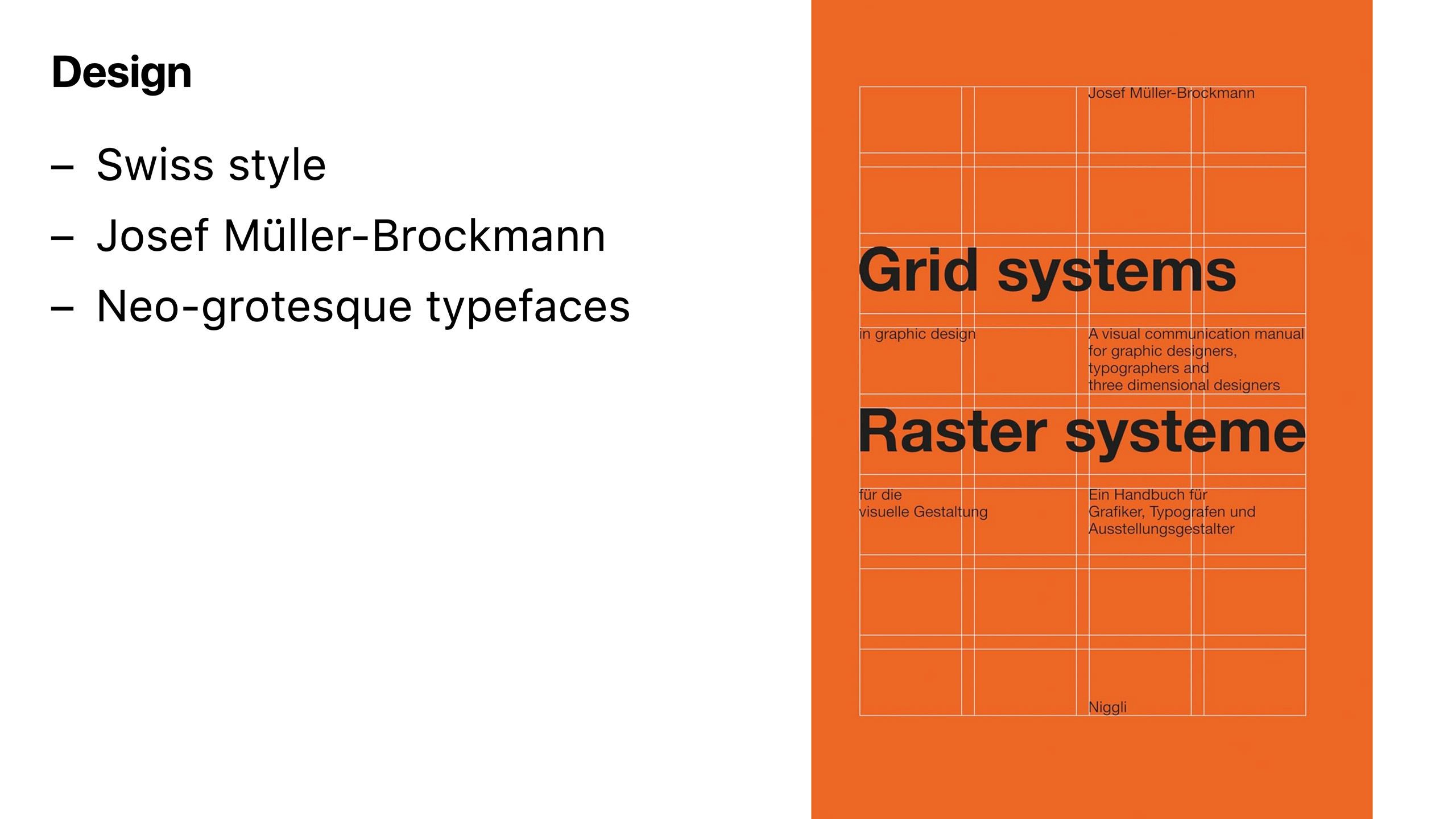
For the book’s design I aimed for a Swiss aesthetic with a strict grid and minimal elements. I consistently return to Josef Müller-Brockmann’s Grid Systems in Graphic Design for inspiration. I also deemed a corresponding neo-grotesque typeface to be ideal.
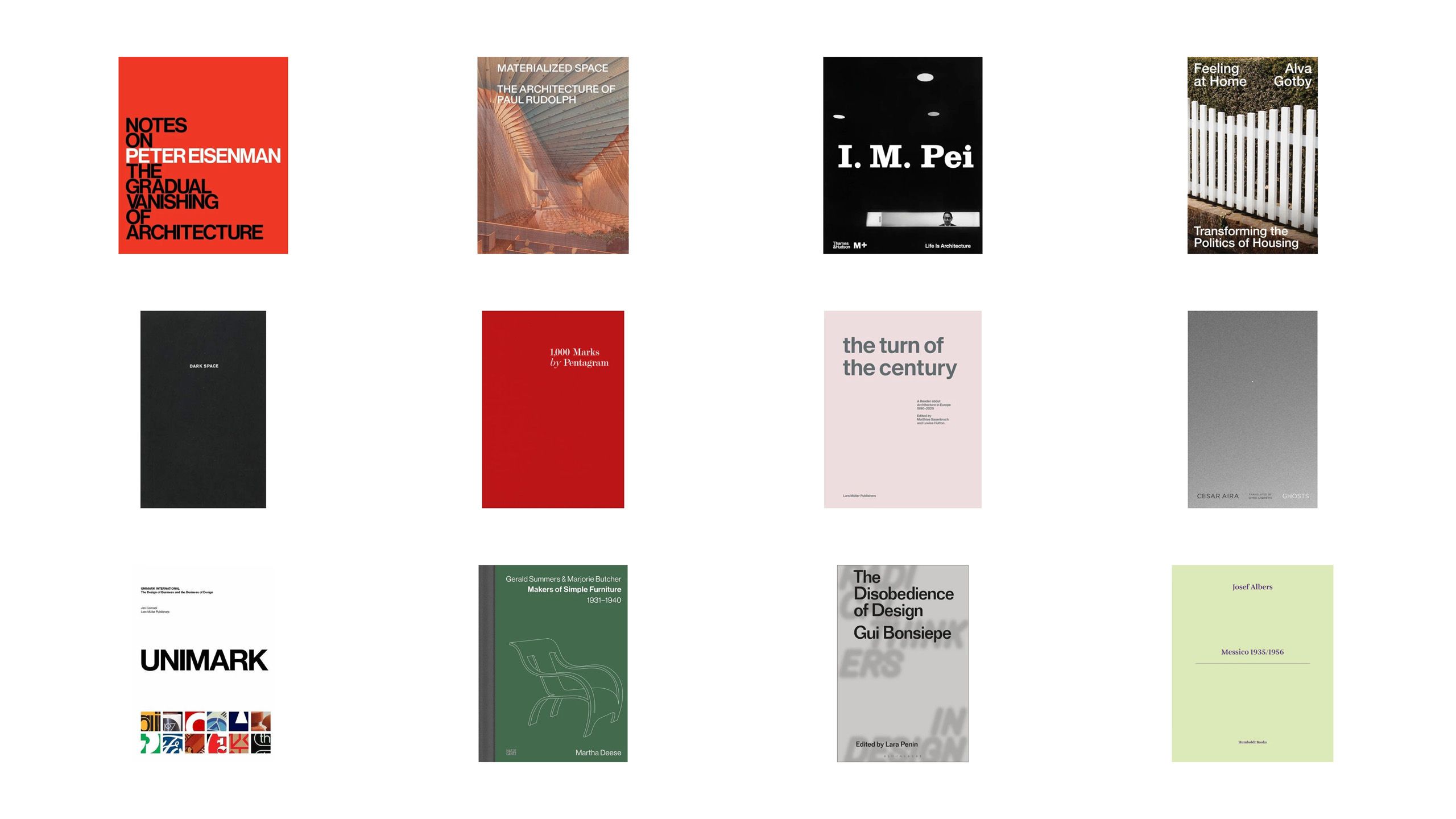
I’m in awe whenever I visit my favorite book store in San Francisco: William Stout Architecture Books. I adore browsing the aisles and dissecting the various cover designs.
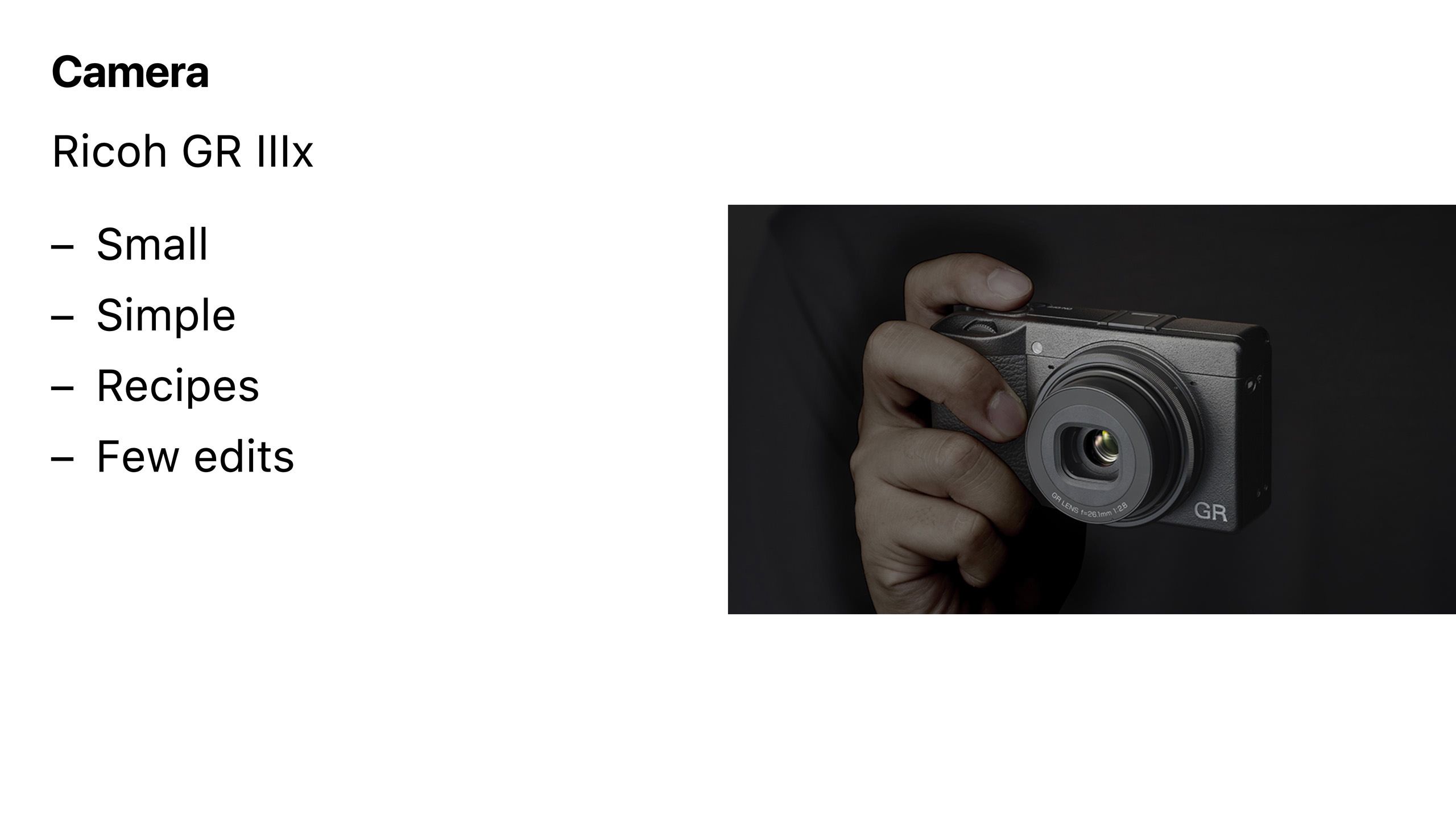
I forced myself to carry a dedicated camera for this project and after extensive research decided to purchase a Ricoh GR IIIx. It’s small, has limited controls, supports creating custom recipes, and I find myself making minimal edits to the photos. With a dedicated camera there are no distracting push notifications, no ability to quickly edit, and,
most importantly, no ability to instantly share.
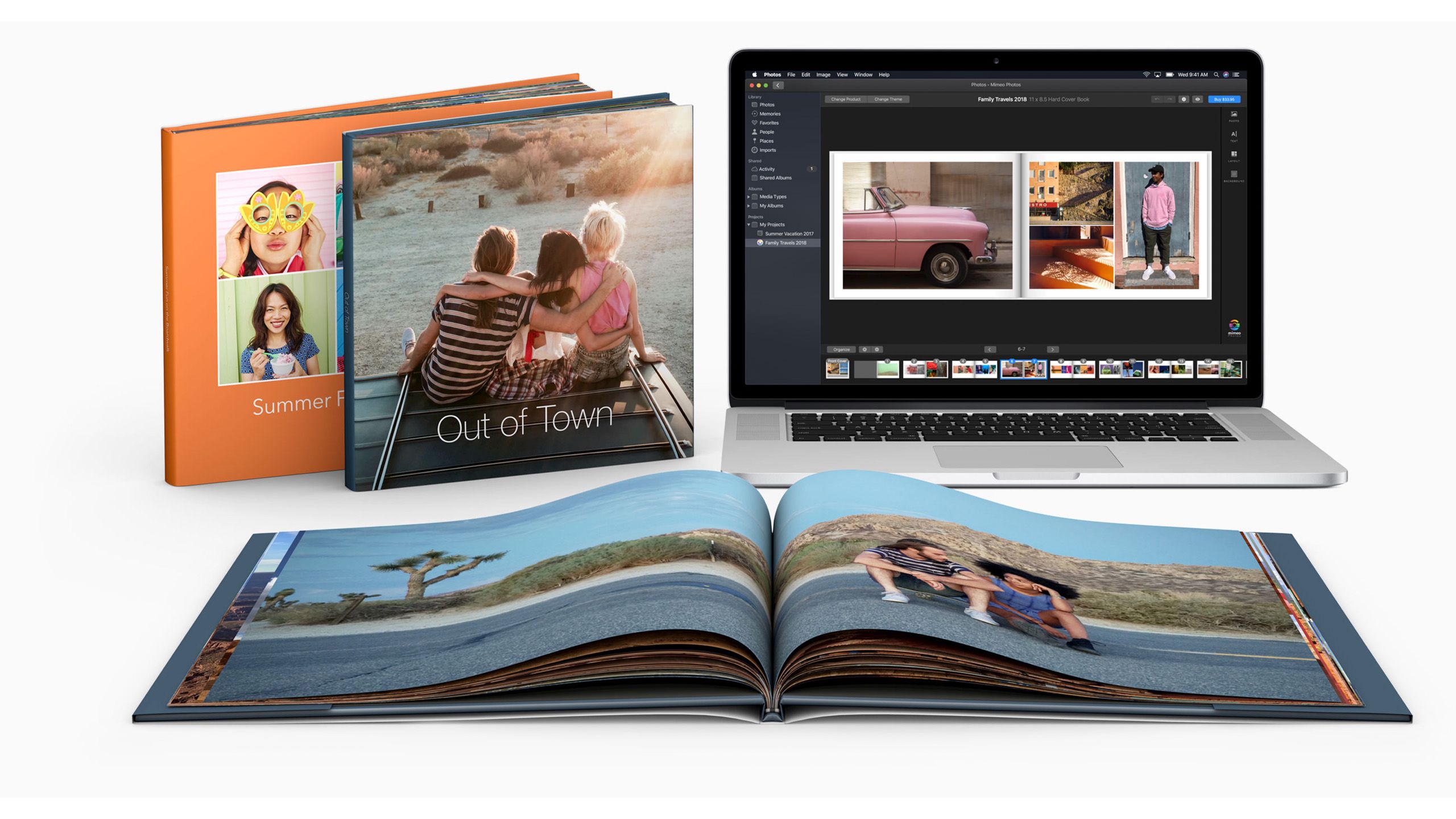
I mentioned that there are plenty of services that are built for simply uploading photos, clicking a few options, and printing books. But, again, I wanted to challenge myself and have total control over the design.
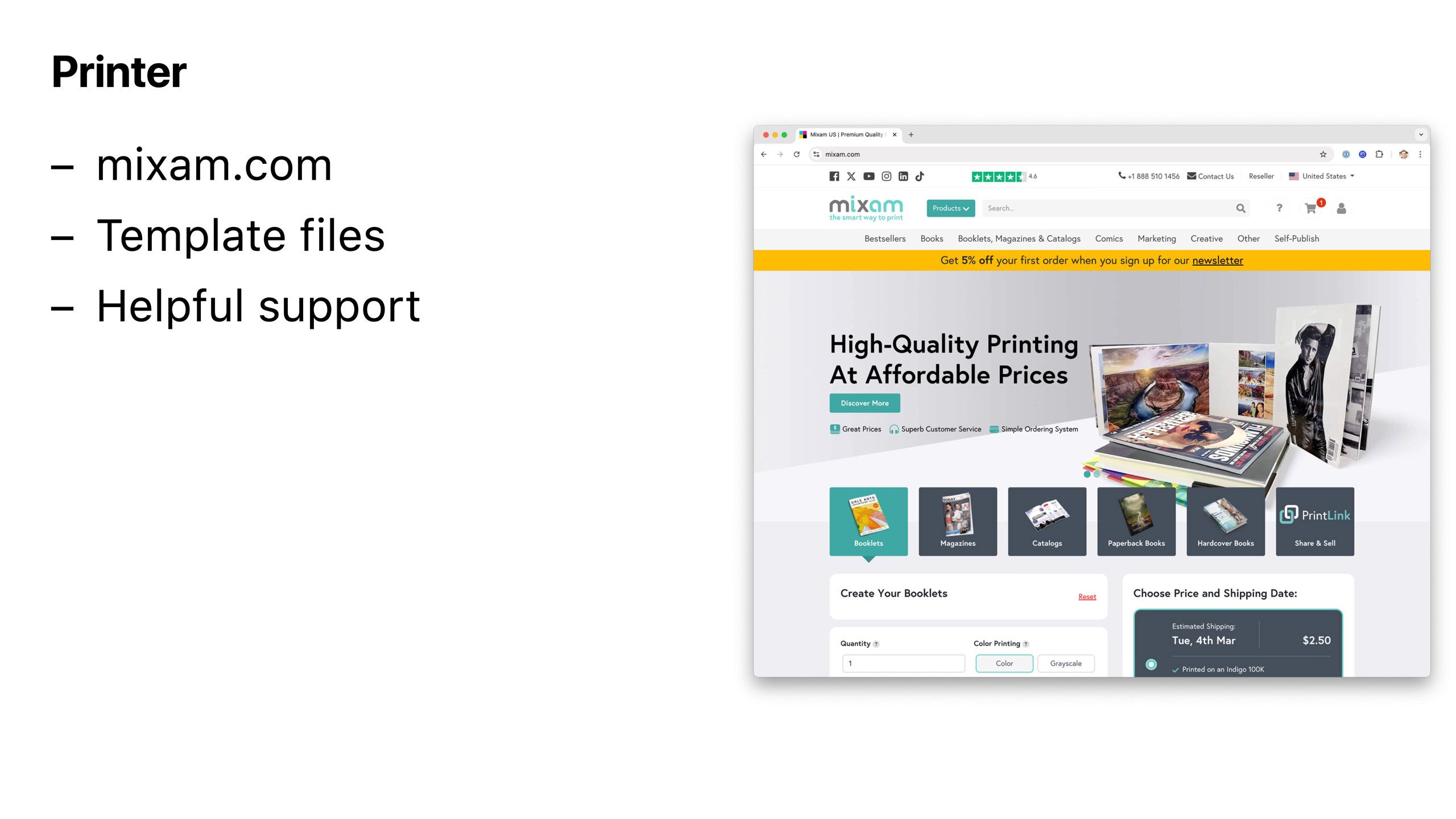
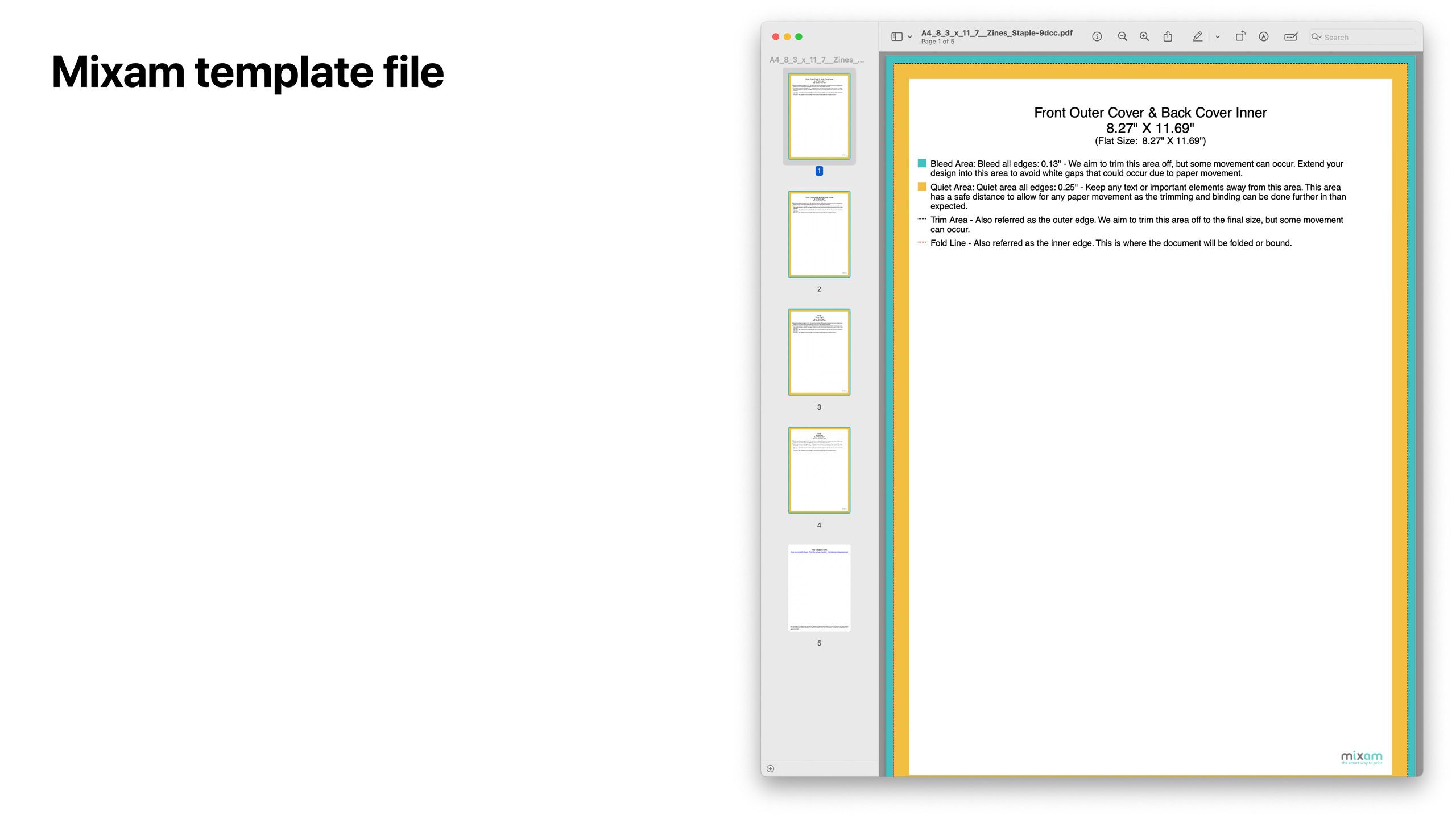
When I saw that fellow photographer Daniel Gynn made a book I immediately reached out to ask a bunch of questions including, “What company did you use to print?” That is how I learned about mixam.com which provides helpful template files and extremely patient customer support.
Template files taught me how to approach incorporating bleed, quiet, and trim areas when designing each page. I simply entered the provided values into Figma.
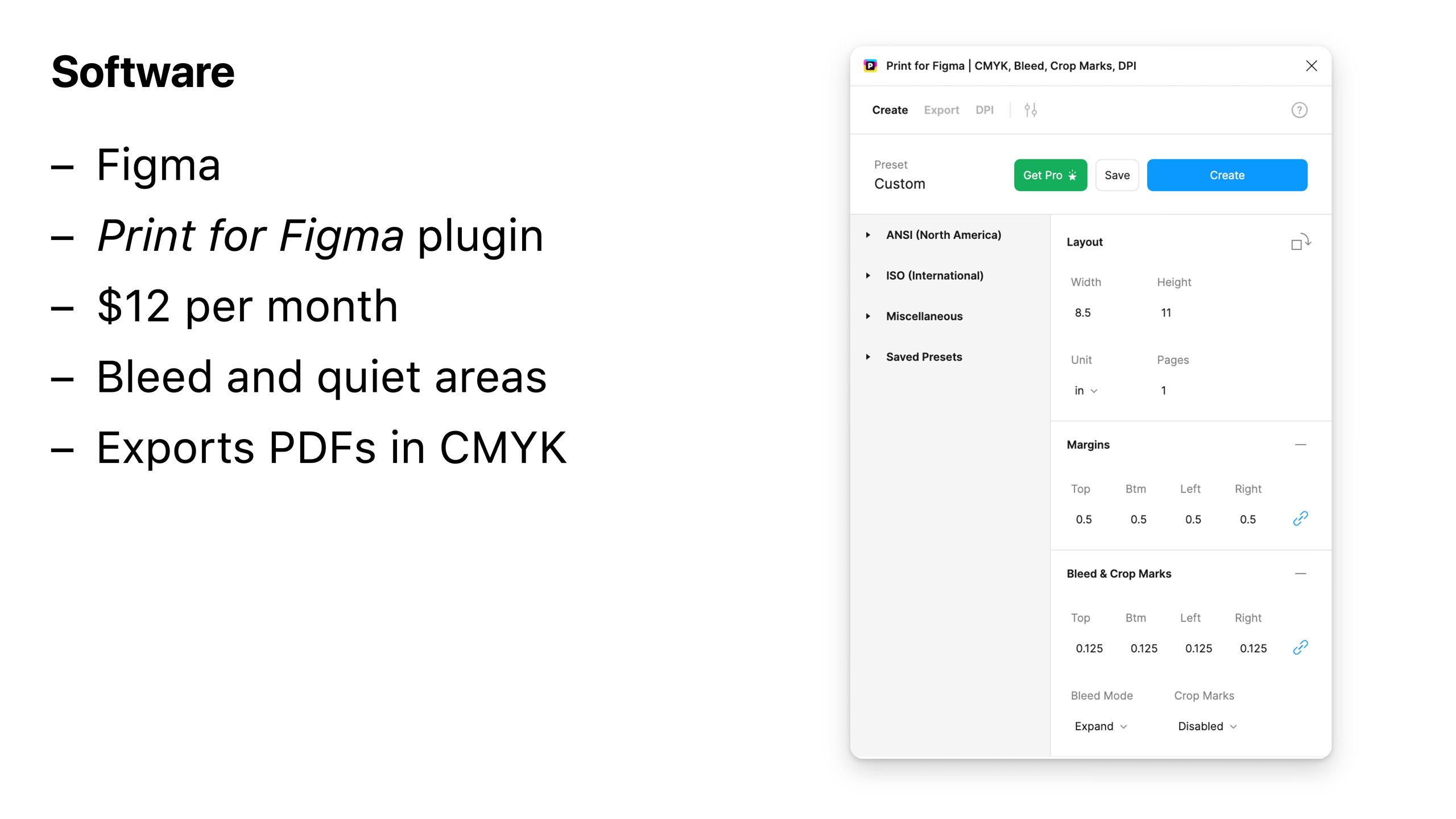
I quickly learned that Figma is unfortunately not suited for printing books due to some limitations including the inability to export in the CMYK color model which is required when professionally printing. Fortunately, for $12 per month, one can use a plugin called Print for Figma which helps set up guides and properly export PDF files.
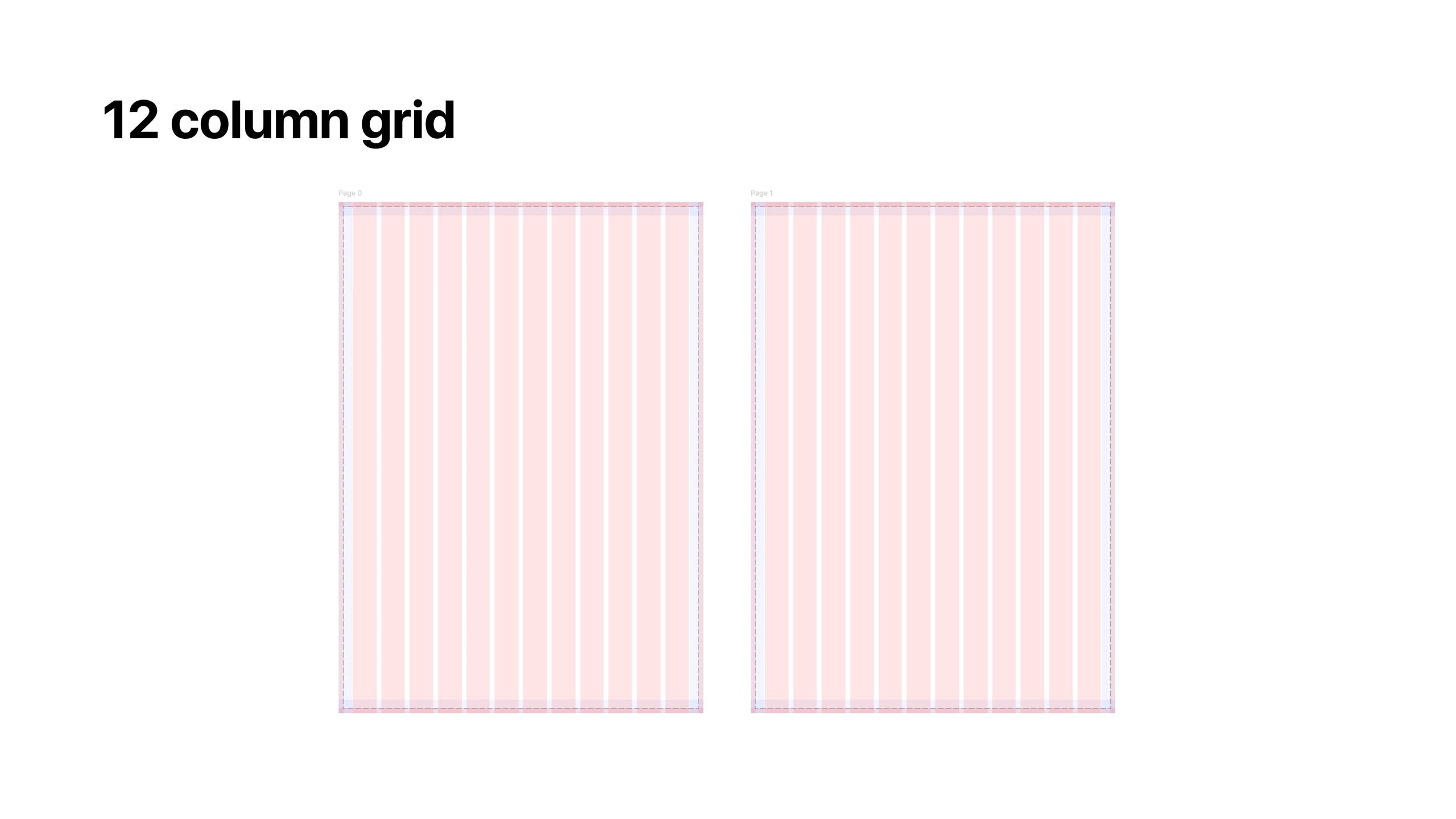
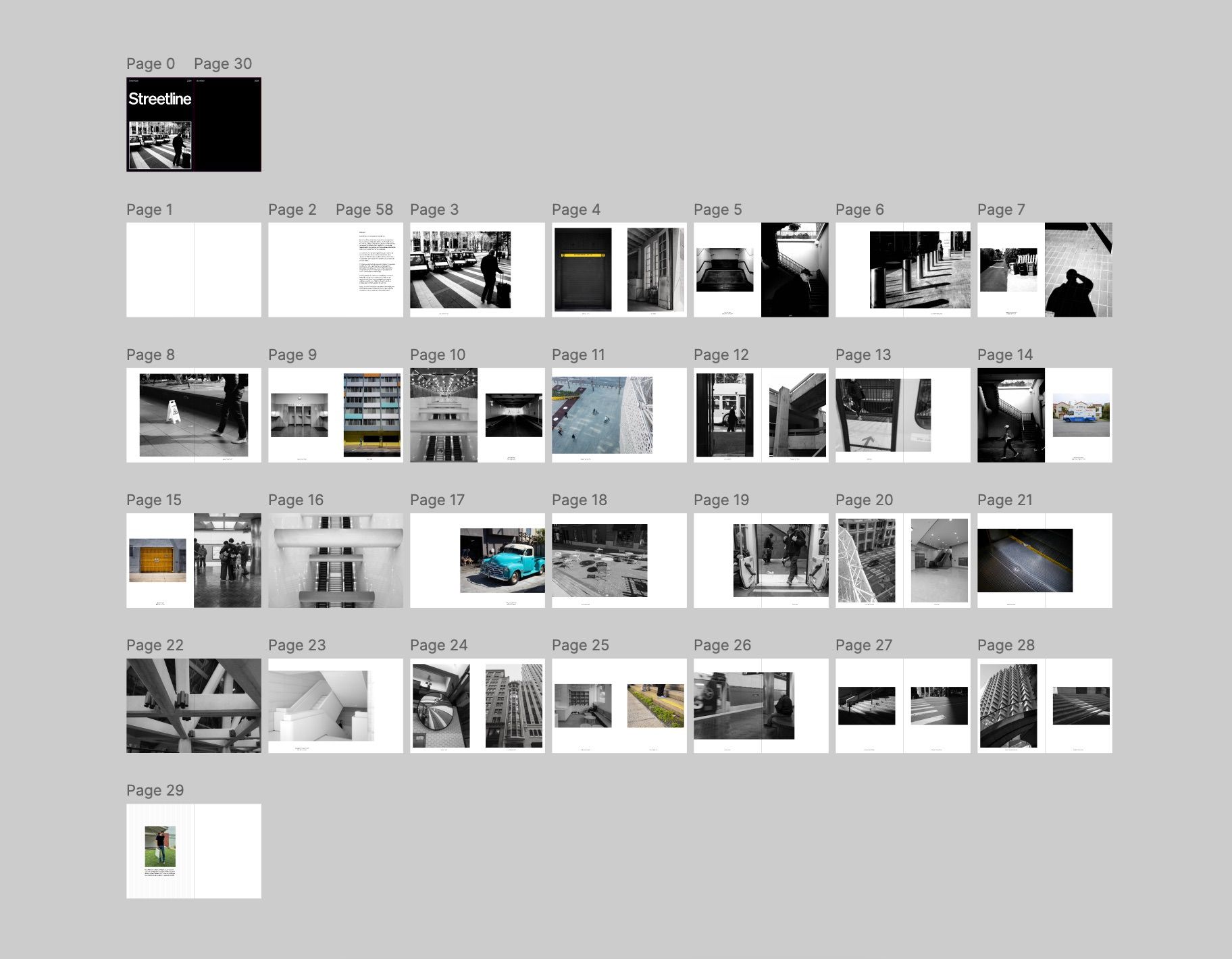
For the layout I went with a conservative 12 column grid that allowed me plenty of flexibility.
I started experimenting using wireframes and arrived at 8 possible layouts that provided me the flexibility to select arrangements that maximized the attributes of each photo.
When I apply photos to the final list of layouts the book begins to come to life.
I continued to experiment with layouts and order until I was confident that the book was ready to print.
Creating wireframes and laying out a series of photos across dozens of pages is just the start. The ultimate goal is communicating your photographic style to the reader.
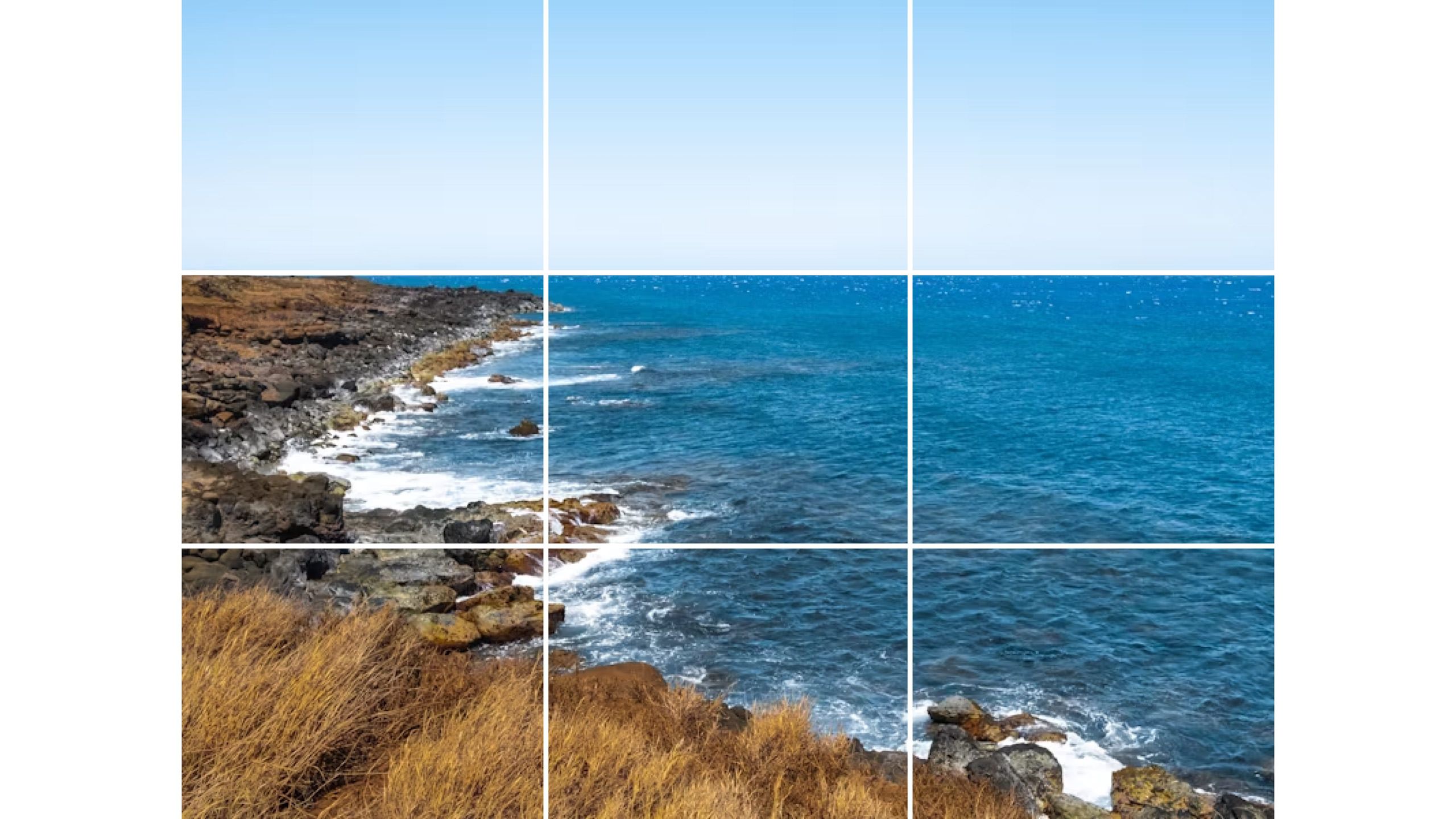
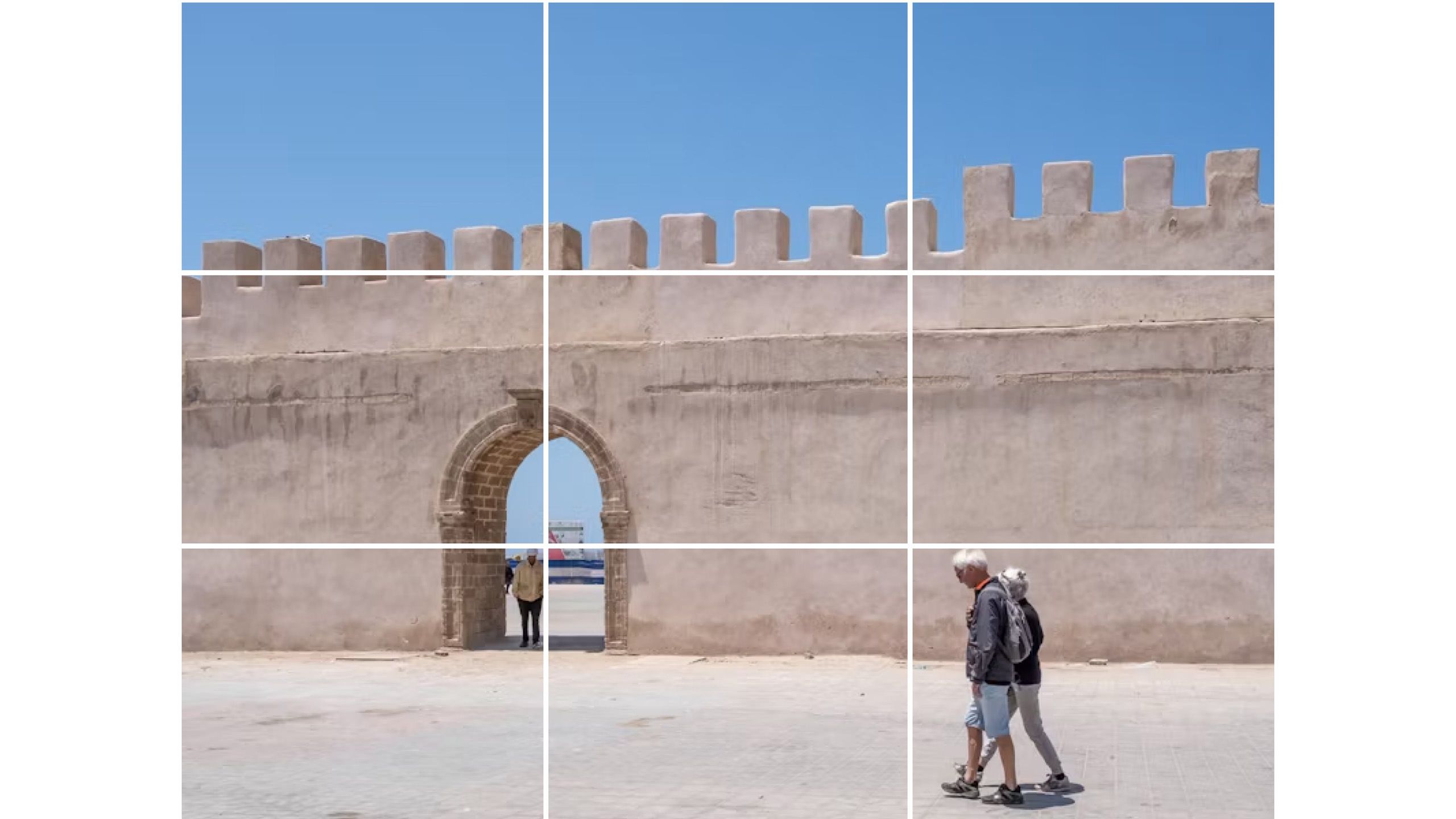
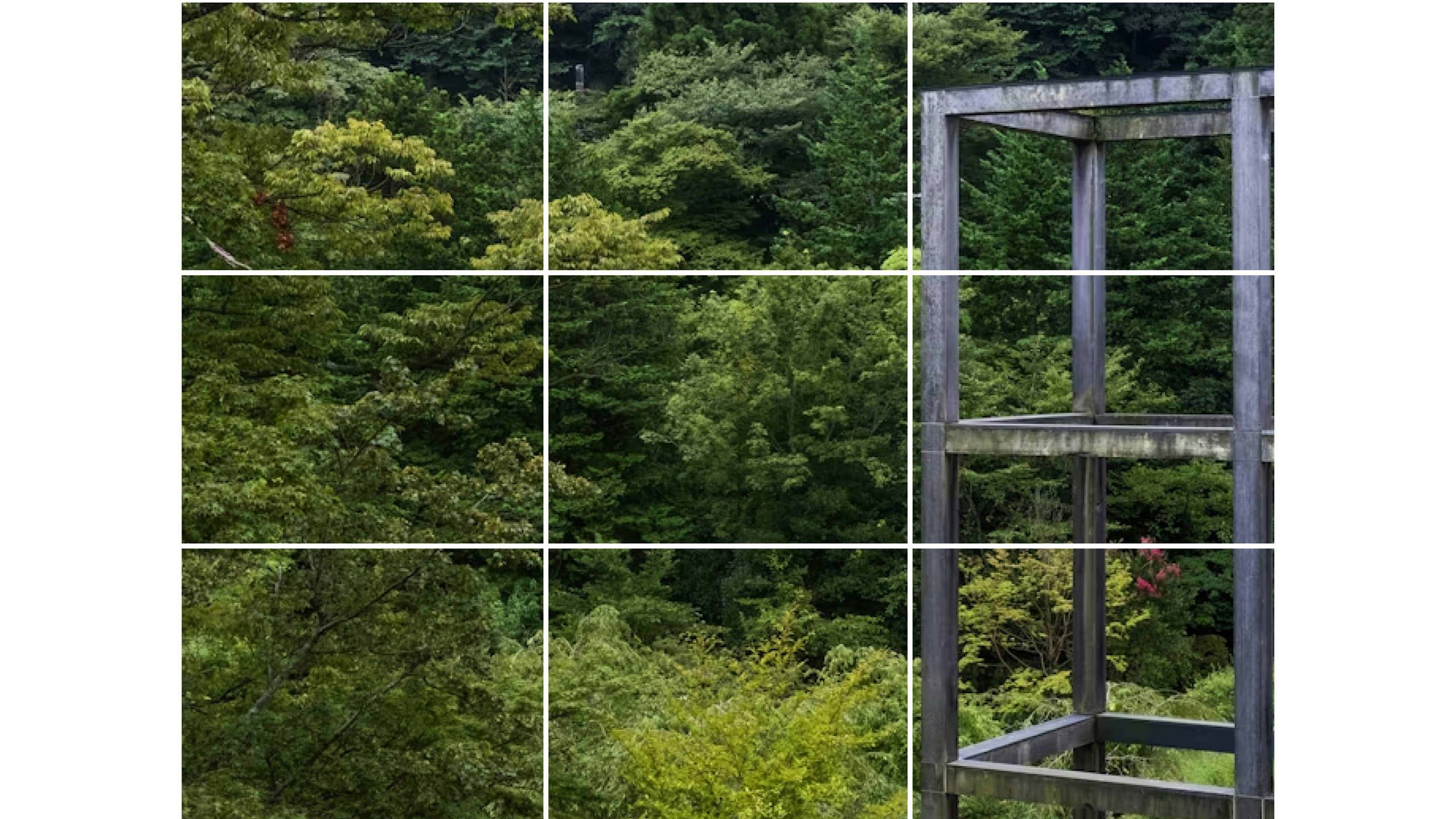
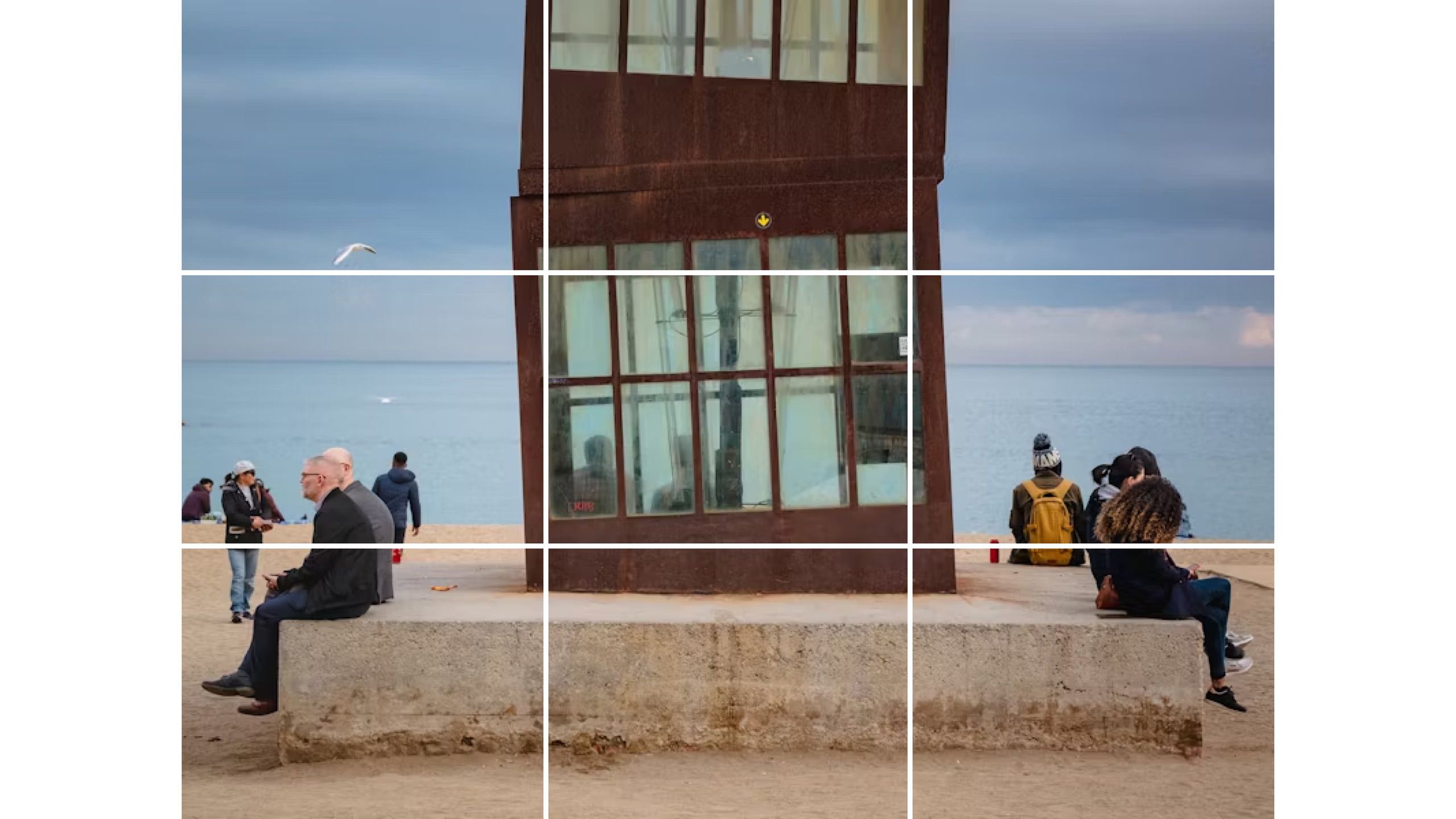
When I pick up a camera I naturally gravitate towards capturing subjects and scenes using the rule of thirds. I always have a 3×3 grid overlay in my viewfinder or on the camera’s screen.
Here is an example photo demonstrating the rule of thirds. I love how the sky perfectly fills the top third, land fills the bottom third, and the land slightly emerges into the middle third.
Here is a photo I took in Essaouira, Morocco. The sky fills the top third. People are walking through the bottom third. A wall fills the middle third. And, for my favorite detail, an arch is placed at an intersection point.
Here is a photo I took in Hakone, Japan. Gora Kaden is embedded in nature, but a metal structure juts into the frame filling one third of the photo.
Here is a photo I took in Barcelona. I love this photo because there are people sitting in the left and right thirds separated by a structure that fills the middle third.
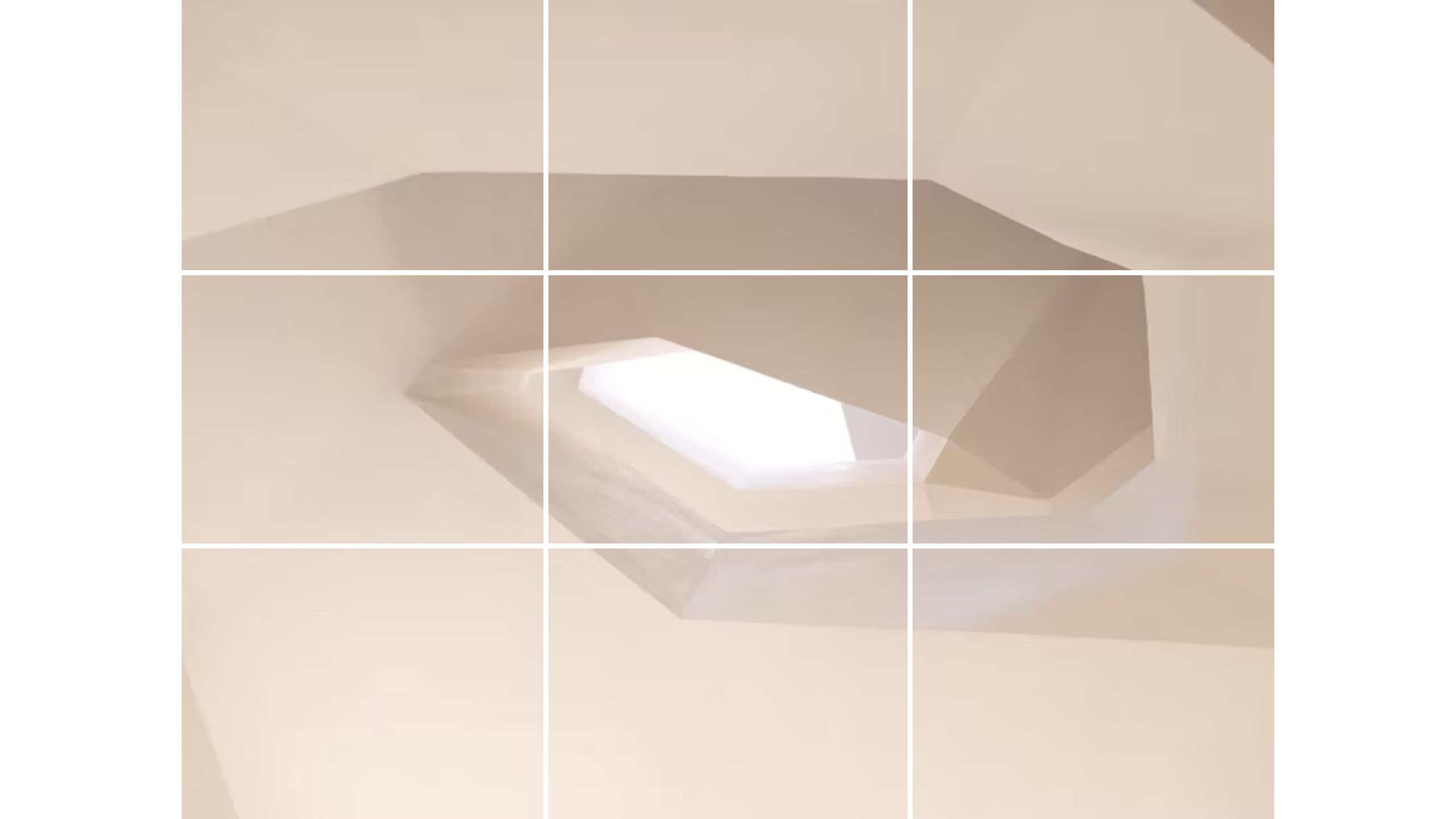
Lastly, this photo was taken at Casa Vicens in Barcelona. I stood at the bottom of the most incredible staircase, pointed my retired Fujifilm X-T2 up, and snapped. This is by far the best photo I’ve ever taken.
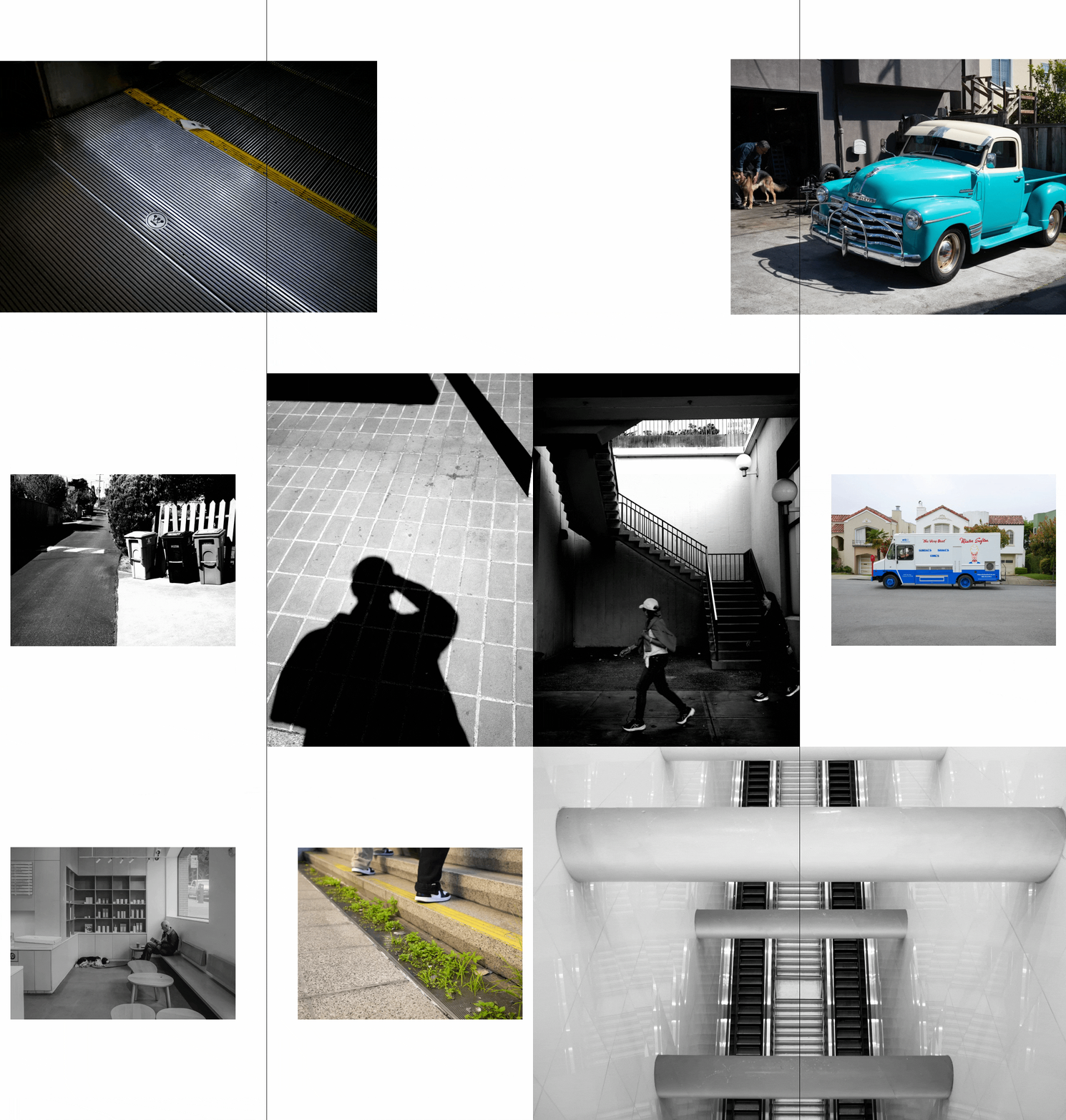
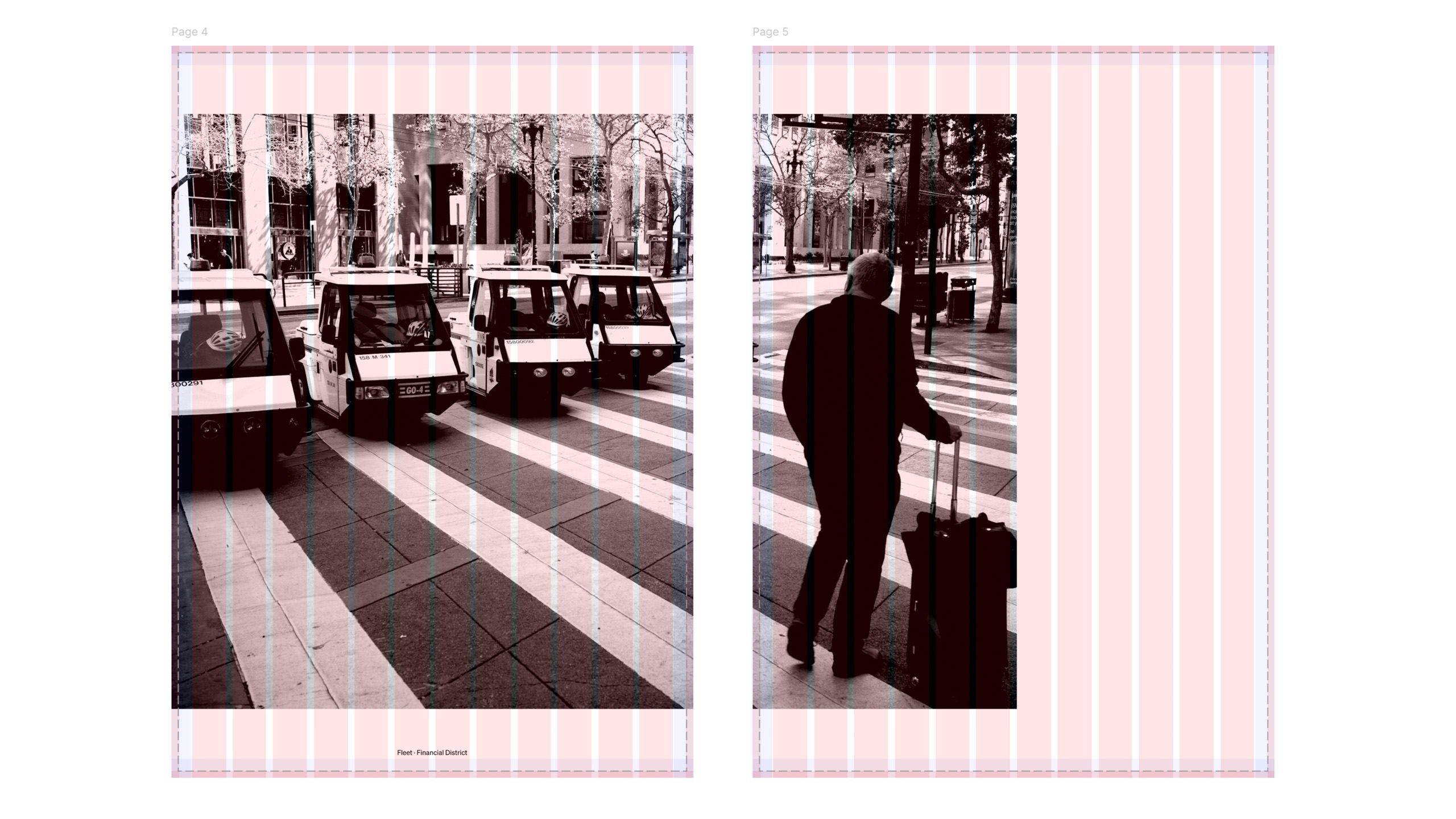
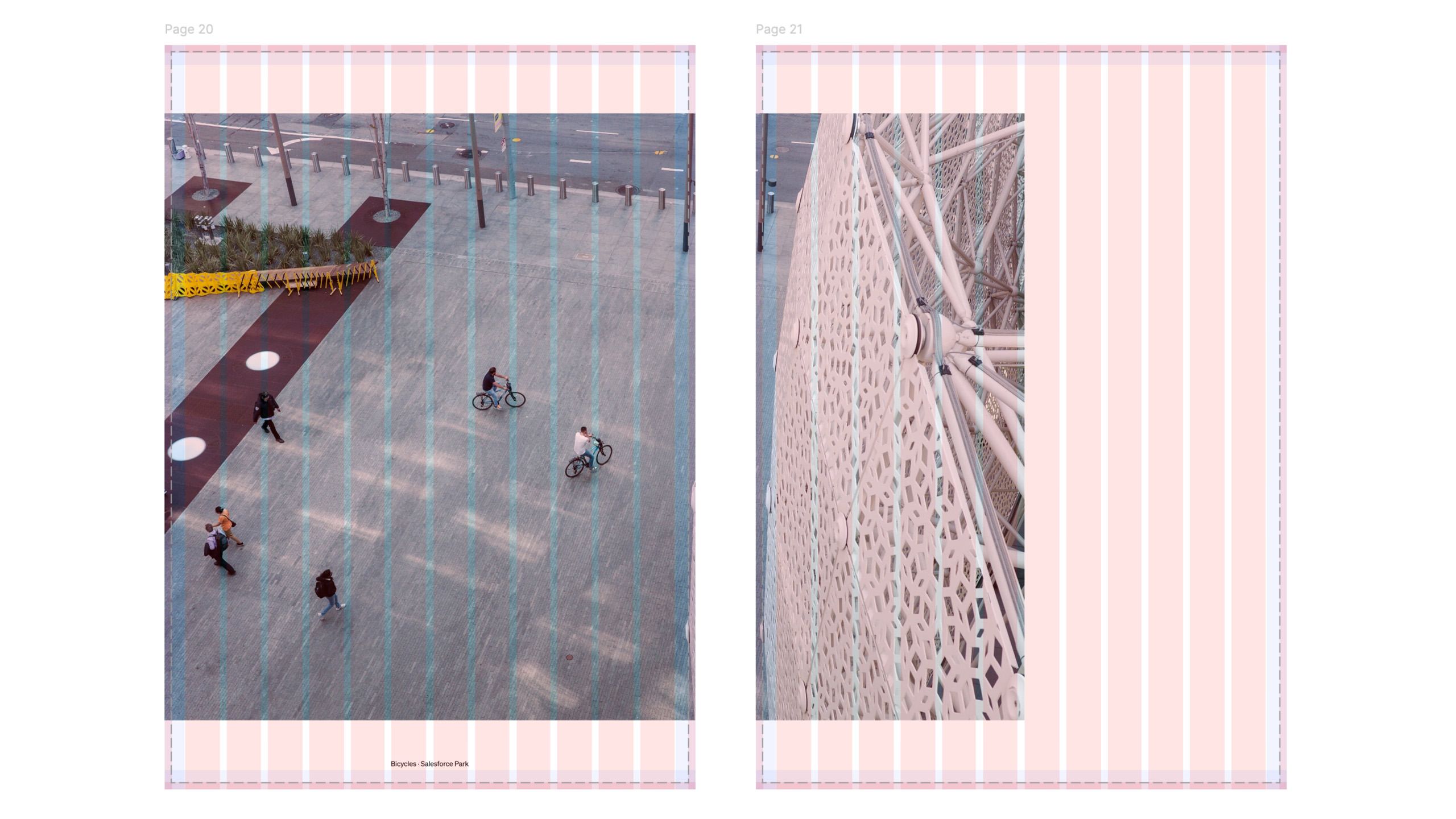
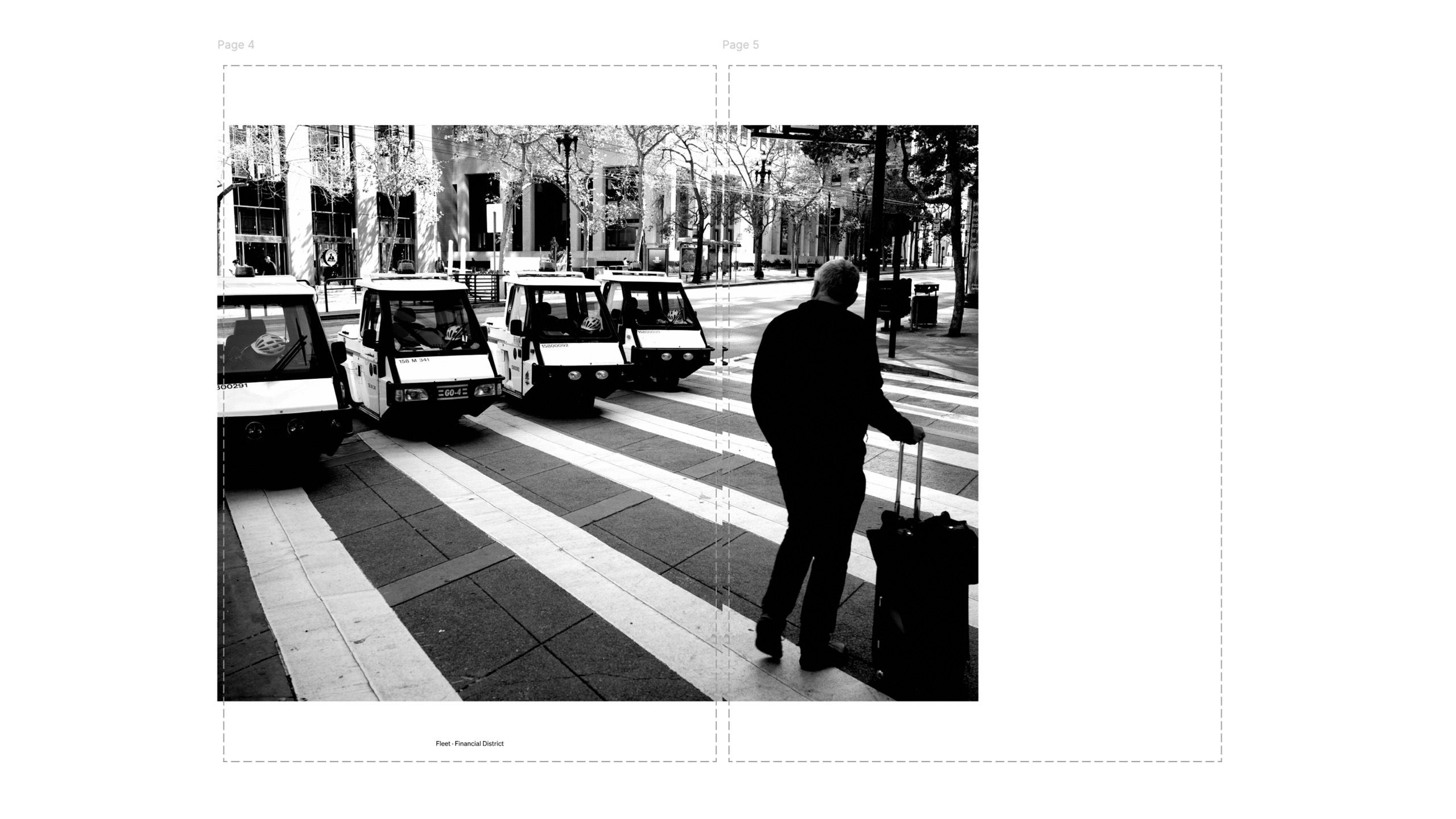
Now this is where I started to really cook with the design. I combined a few photos that particularly exude rule of thirdness, and laid them across two pages along the grid. This creates a neat effect where one photo can act as two. In this photo a man enters a crosswalk and looks across the book towards the parking meter cars.
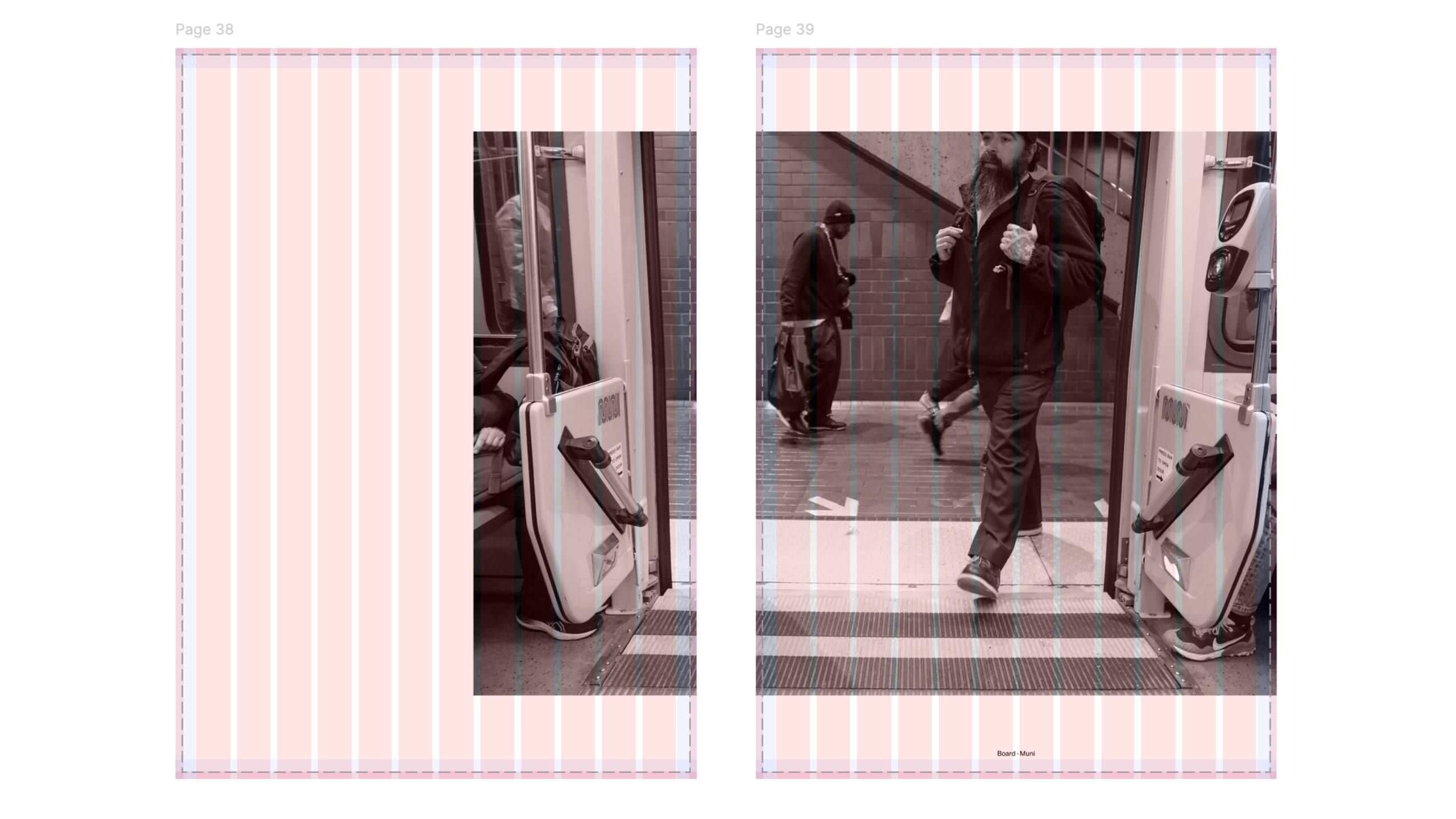
Here is another example where I split a photo into one third on one page and two thirds on the other page. A man enters the train car on one page and on the other is part of a person sitting on a chair.
The last example where I split a photo across pages features people walking and biking outside of Salesforce Tower on one page, and Salesforce Transit Center’s webbing on the other page.
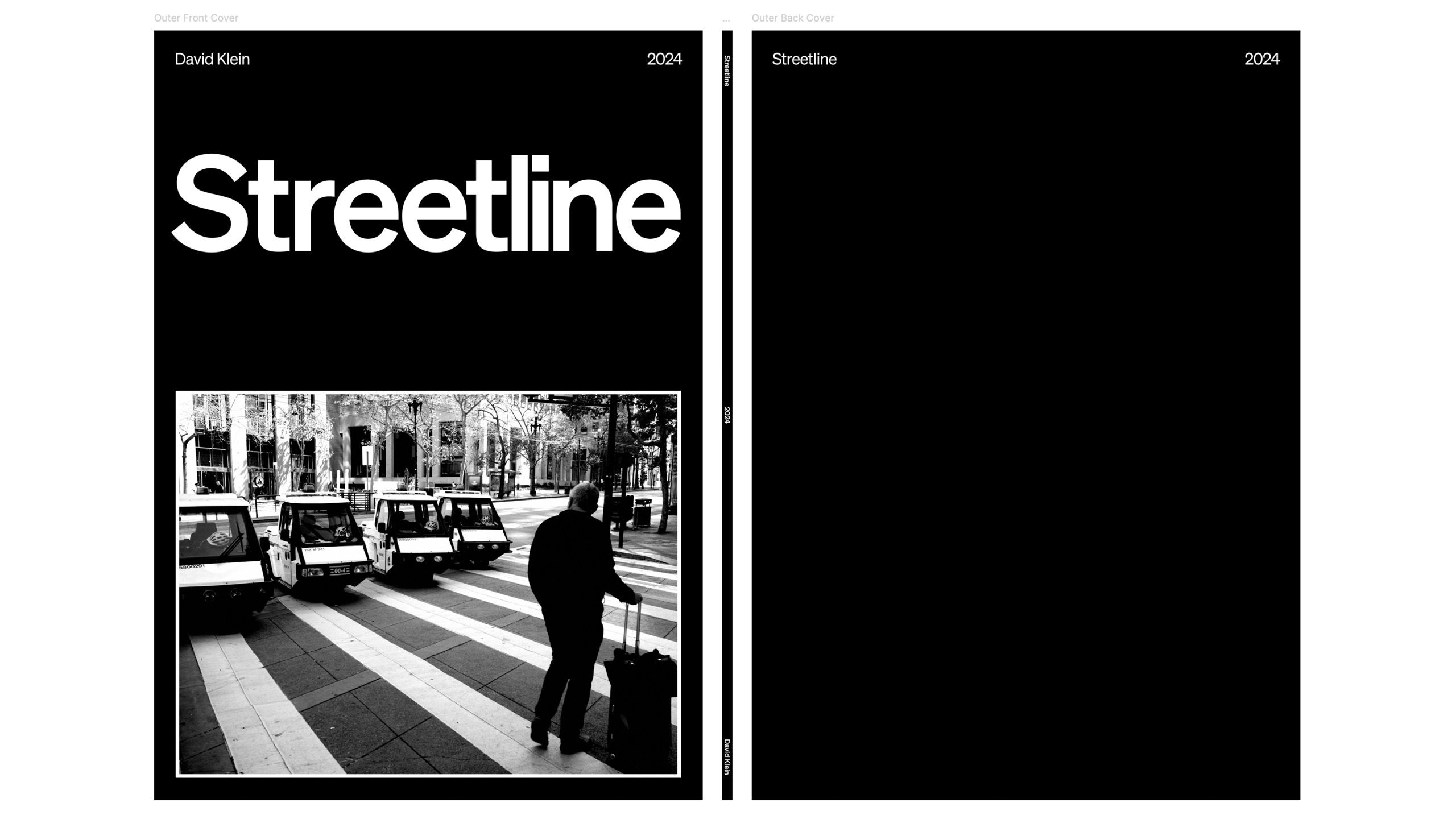
After finishing all of the pages I had to consider the book’s exterior including the front cover, back cover, and spine. This is where I had some fun.
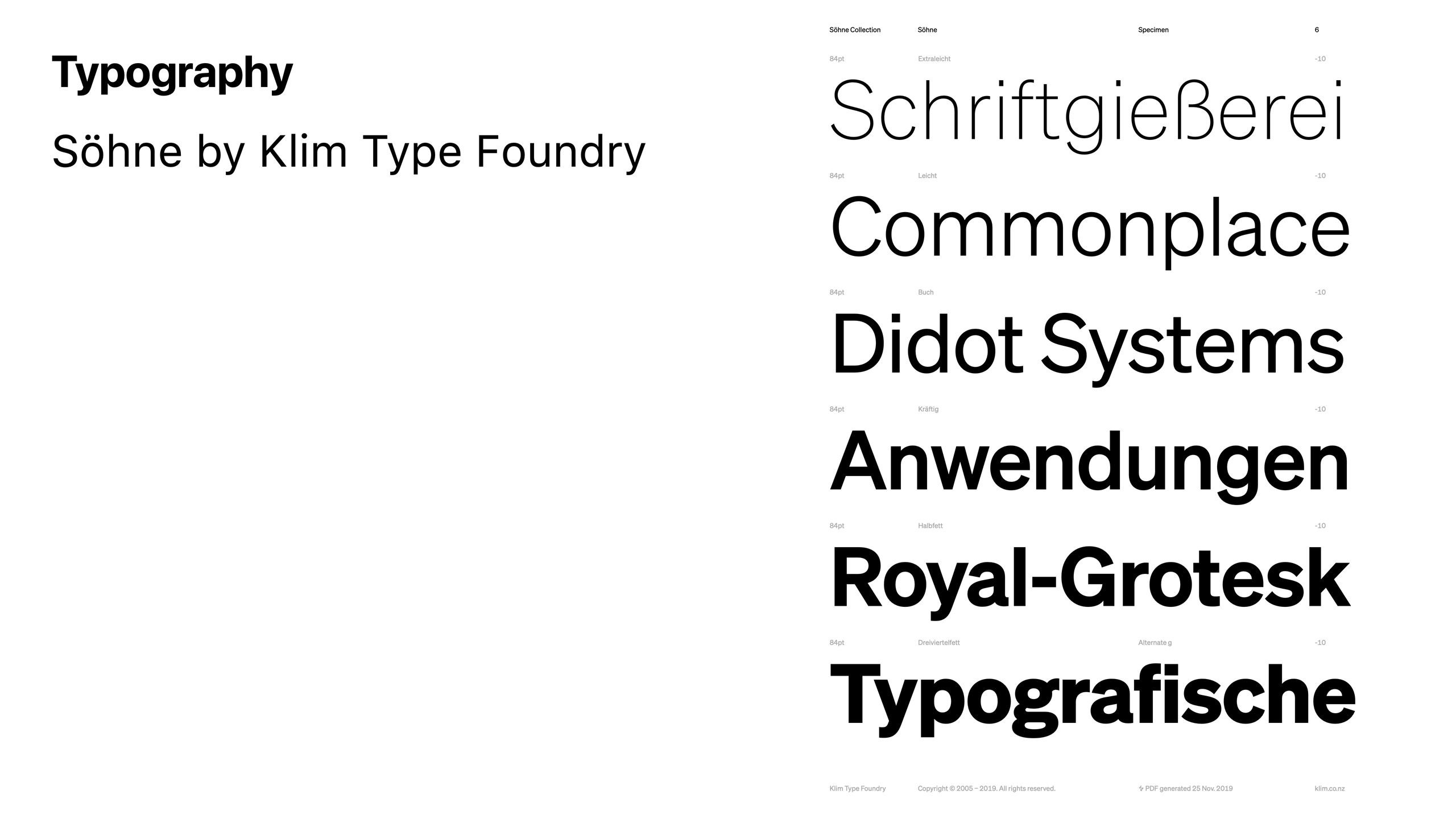
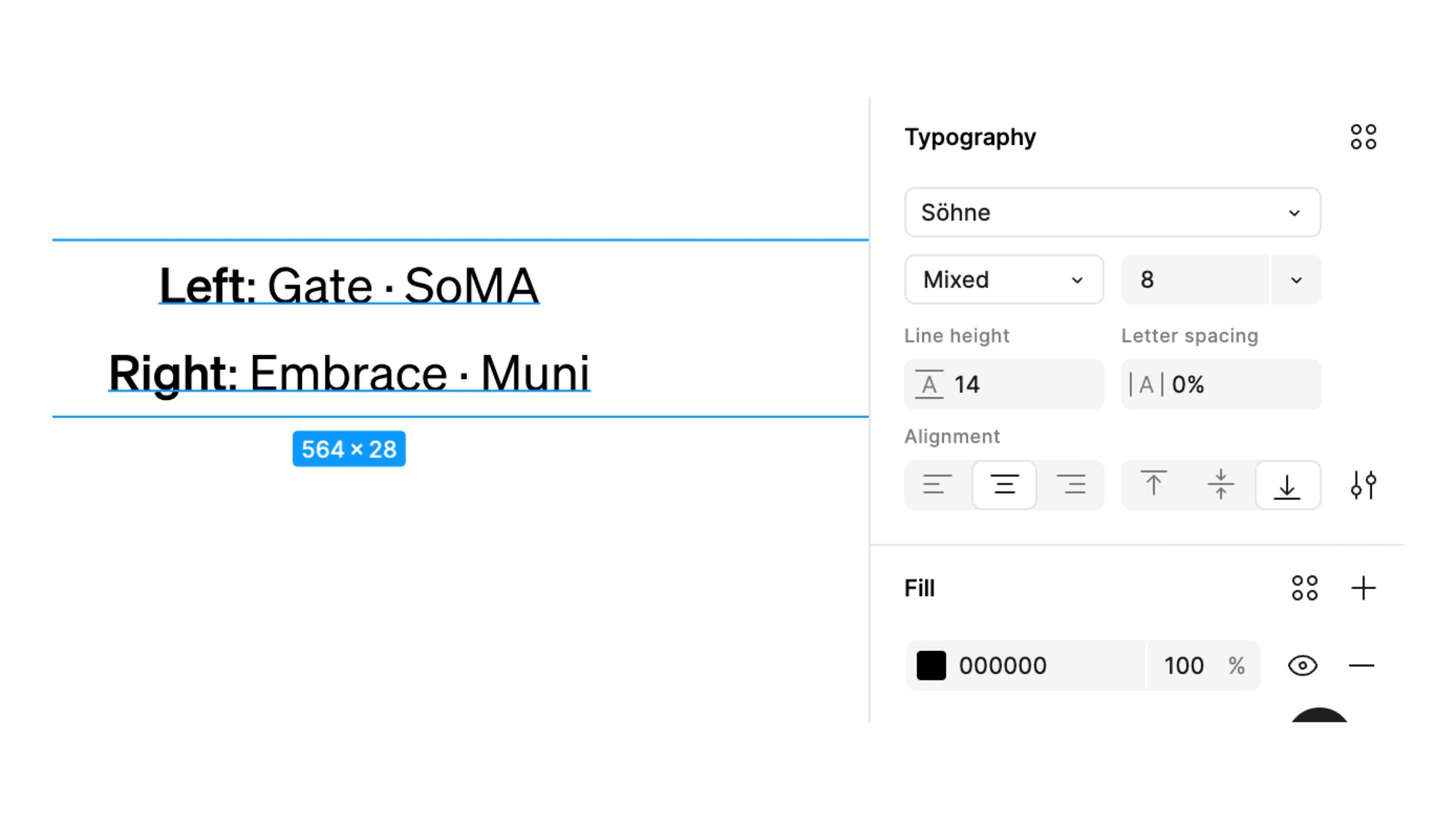
I adore the typeface I use on my website so it felt right to grab it for the book as well. It’s Söhne by Klim Type Foundry.
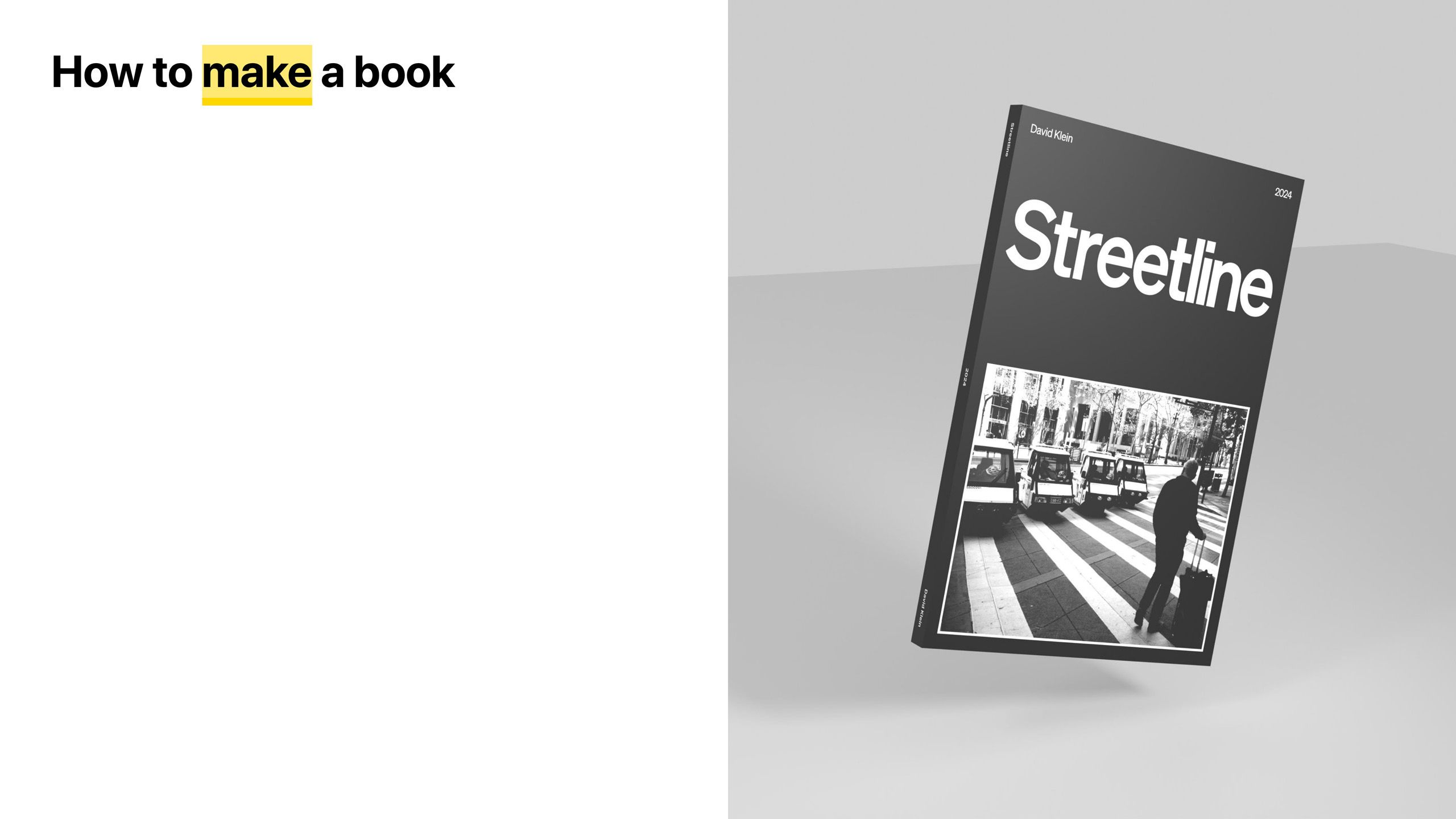
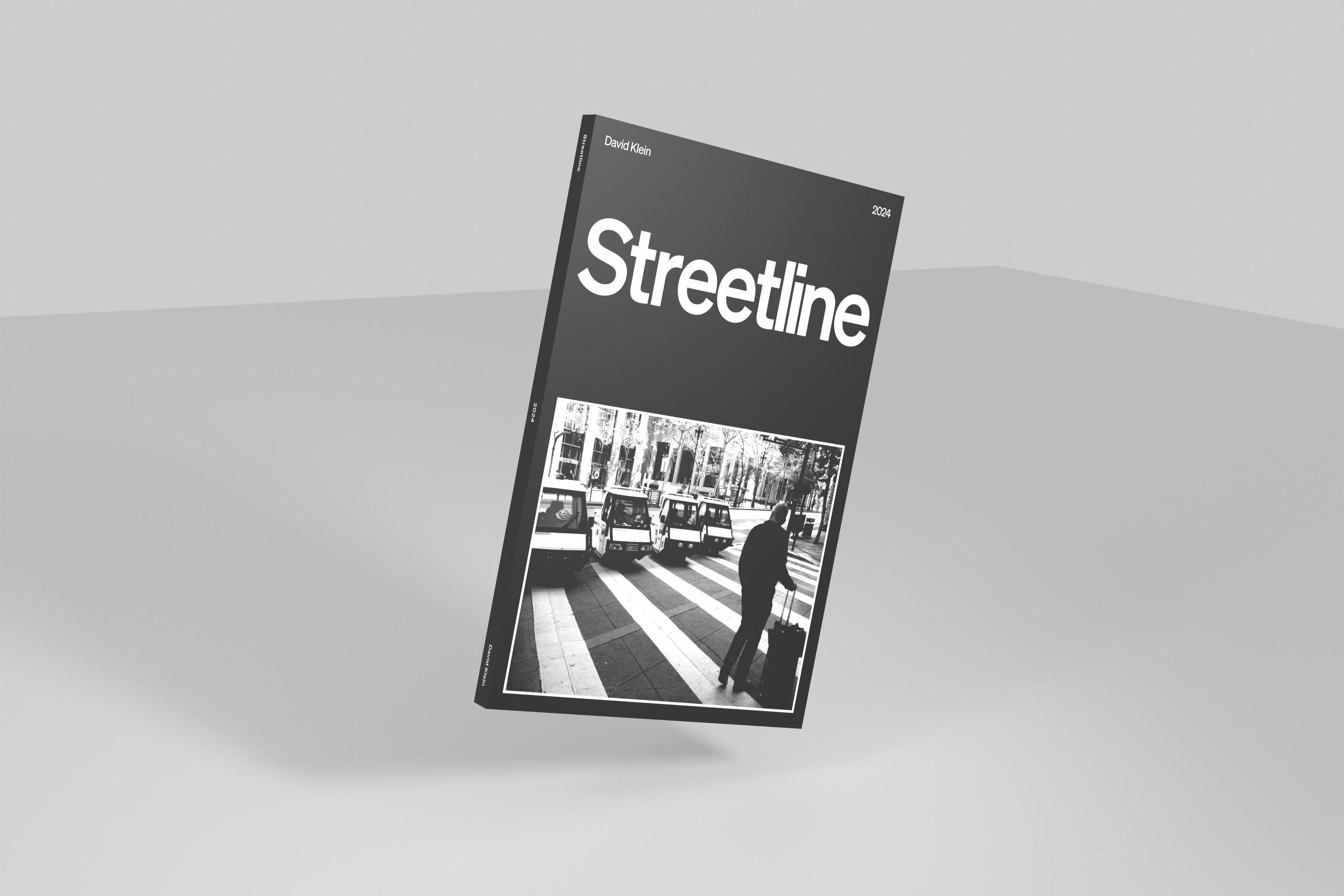
My goal for the front and back cover was to be minimalist and strong. My name, the year, the book’s name, and my favorite photo in the book. Streetline came to me while I was brainstorming. I said out loud something like, “street photography, lines, leading lines, street, lines. Streetline. Boom.” I intend to continue using this layout for my next book.
I spent an inordinate amount of time thinking about what the reader should see upon opening the book. One large photo? “Streetline” again?
I followed Marcin Wichary’s journey for literally years as he wrote his book, Shift Happens. His newsletter was so entertaining and I thought maybe there was a lesson he learned along the way that could guide me.
I recalled reading in Marcin’s newsletter about a booklet he designed for an event at the Computer History Museum. By placing the same content in identical positions he created a neat effect as the book is opened.
I decided that the best way for the reader to experience my book was to open to blank pages. I wanted the reader to feel enticed.
Each page of a book slightly increases its cost, so I had to pay extra to achieve this design. It was worth it.
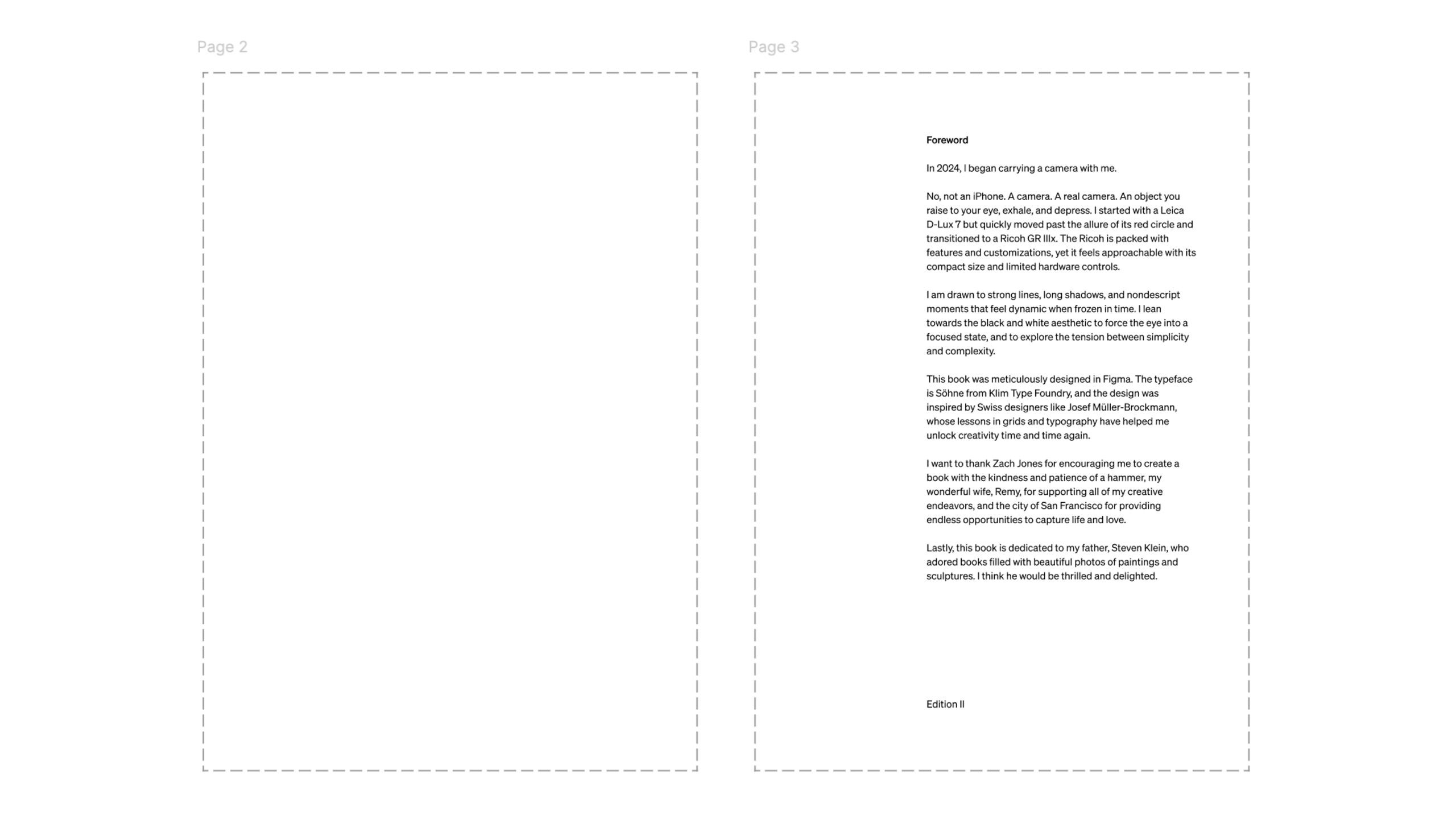
I continued to delay the reader from seeing photos by briefly explaining the design and purpose of the book.
The foreword discusses why I chose the Ricoh GR IIIx, a few design details, and some people I wanted to thank in writing including my late father, Steven Klein.
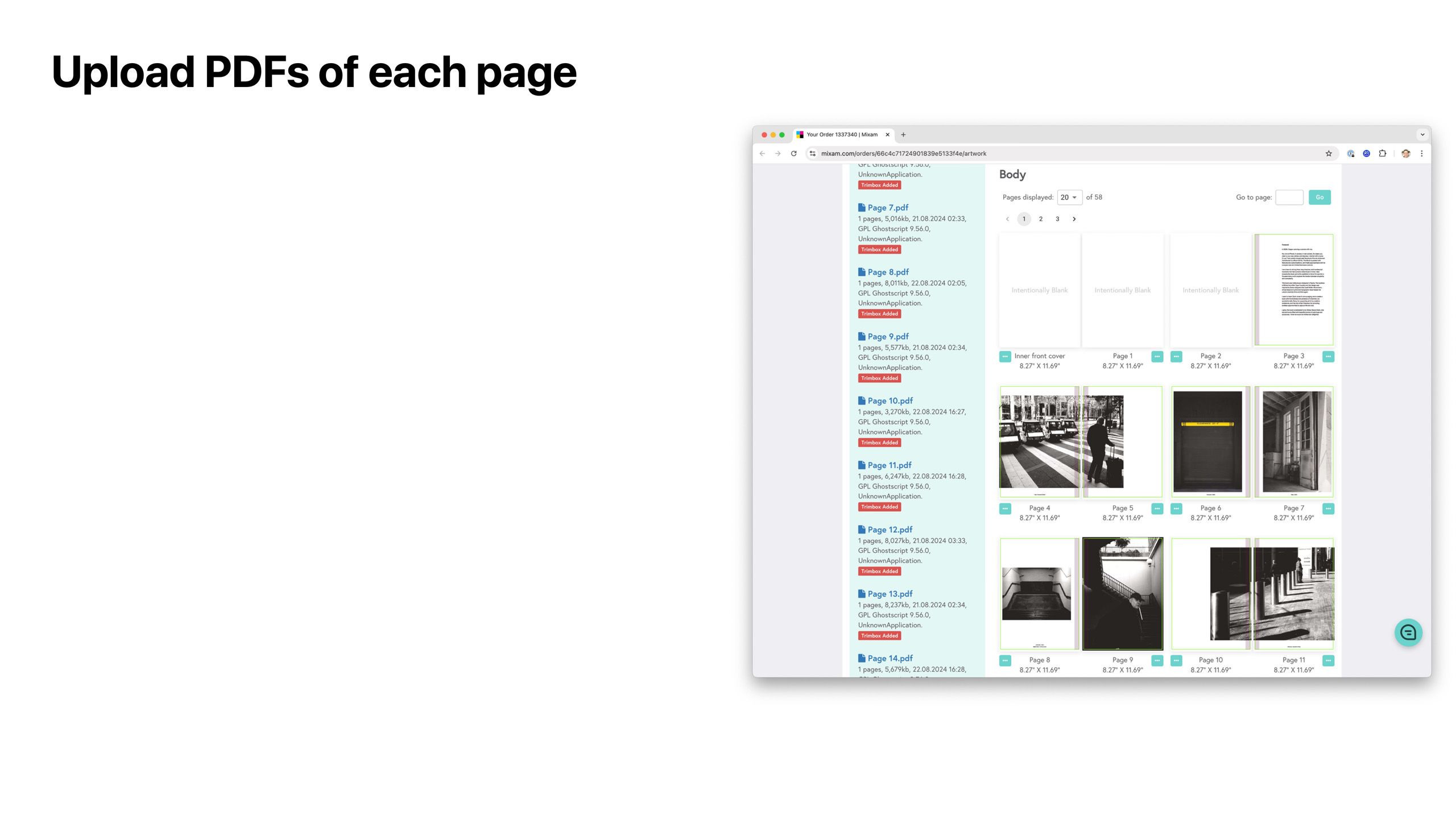
Once all of the pages, front cover, back cover, and spine were ready, I exported PDFs using the Print for Figma plugin and uploaded them to mixam.com.
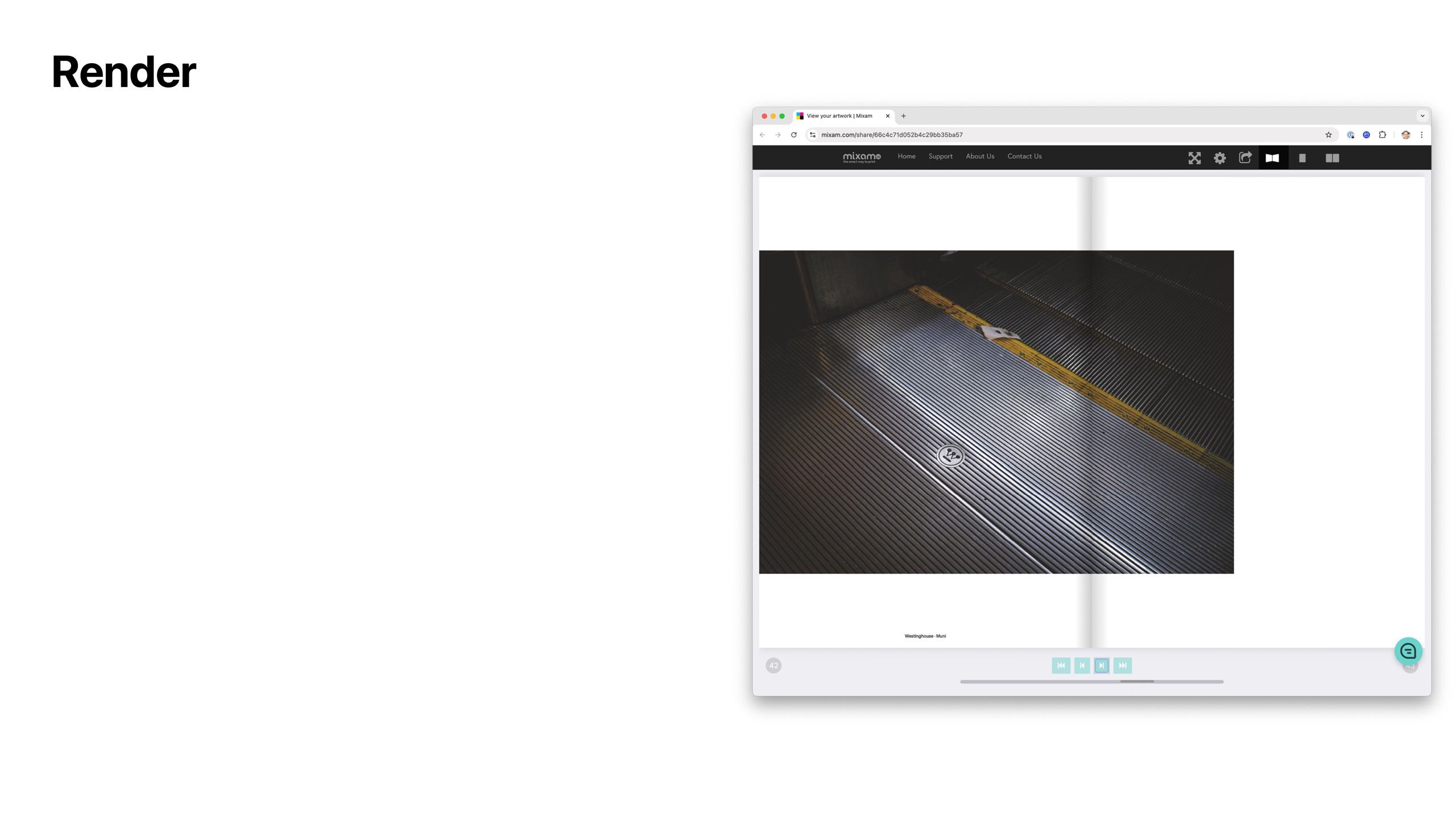
Mixam has a fun preview feature that allows you to expereince flipping through the book with a page turning animation. This feature is particularly helpful to understand how your photos interact with the center of the book.
One topic that I felt was especially improtant to discuss was how to ensure photos would not lose any data when spread across two pages.
When a photo is spread across two pages I repeat a bit of data near the book’s hinge. For example my goal for this photo was to ensure the crosswalk lines align perfectly across the two pages after the paper is cut during the bookmaking process.
It is important to note that this method worked as desired when using Mixam’s rendering feature, but was inconsistent in the book. Sometimes photos align perfectly; sometimes there are mistakes. I will need to figure out how to get this right for my next book.
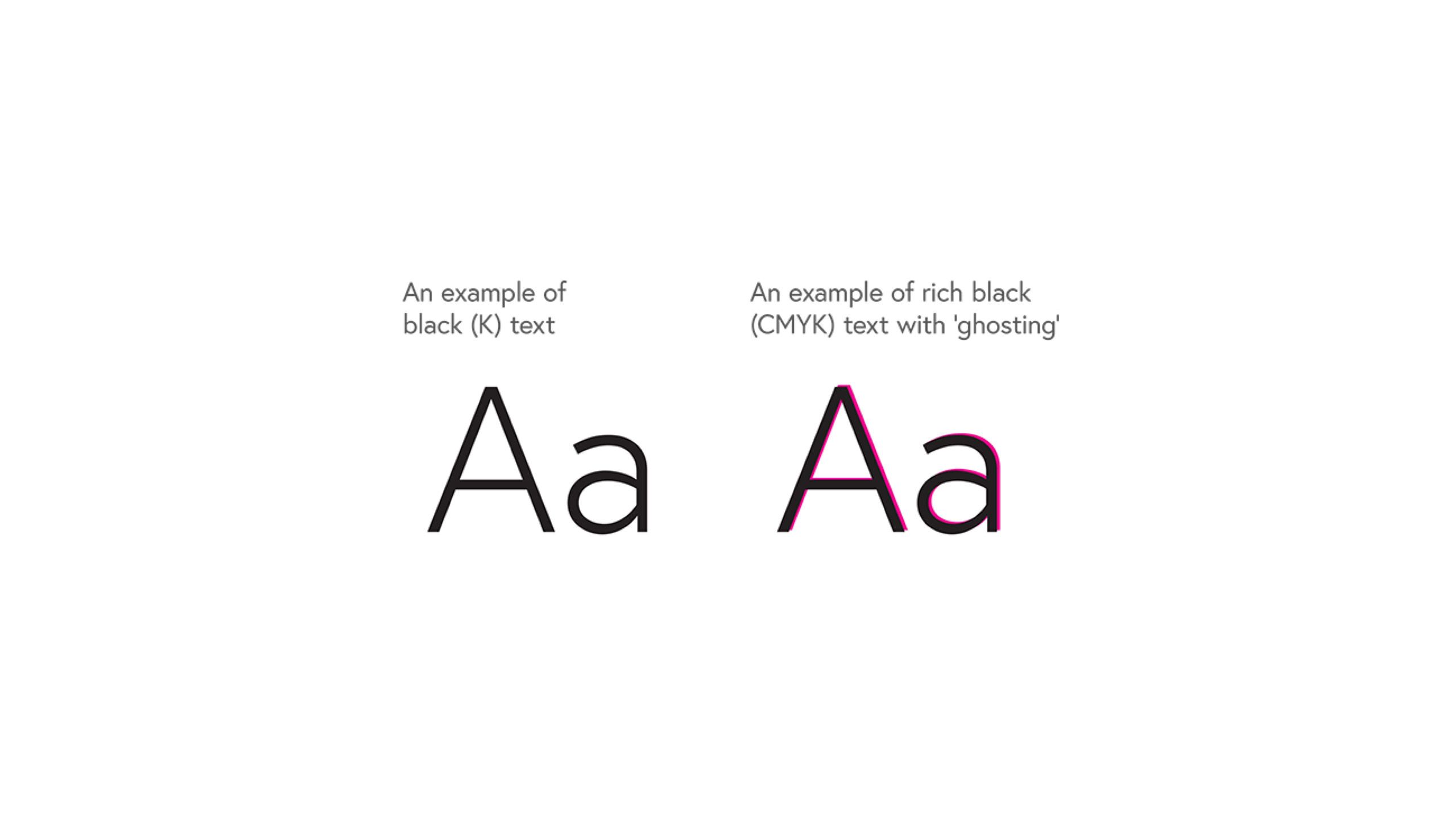
One lesson I unfortunately learned the hard way was the difference between standard black and rich black.
In Figma I assumed that setting the text to black and using the Print for Figma plugin to export would result in black text in the book. I was wrong. Thoroughly wrong. If you have experience with printing you are probably shaking your head right now reading this.
If you look very closely you can see that the black text in the book actually has a schtickle of color in it. Infuriating.
Alas, Mixam has a support document that demonstrates the difference between standard black text and rich black text which has ghosting in it. If only I had known!
I included one subtle easter egg for my own entertainment. On the last page the 12 column grid is slighlty present using gray vertical bars. Also I adore my Macintosh Portable. It’s one of the top 5 items in my Apple collection.
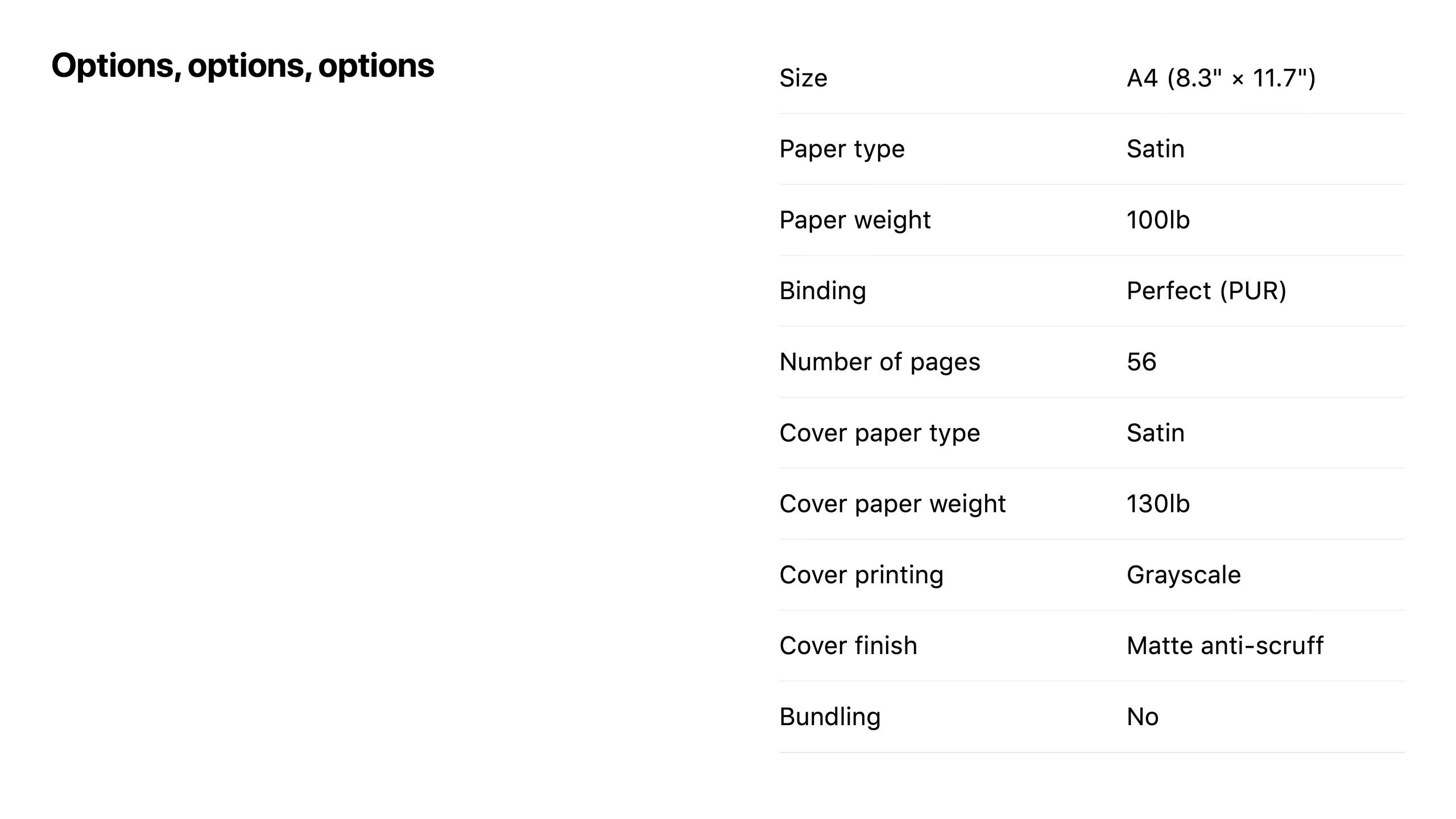
For size I wanted the book to feel like holding a stack of typical pritner paper so I chose A4 for the size. The rest of the options were somewhat randomly selected based on Mixam’s descriptions. I chose thick paper (100lb with a 130lb cover) to make the book feel sturdy.
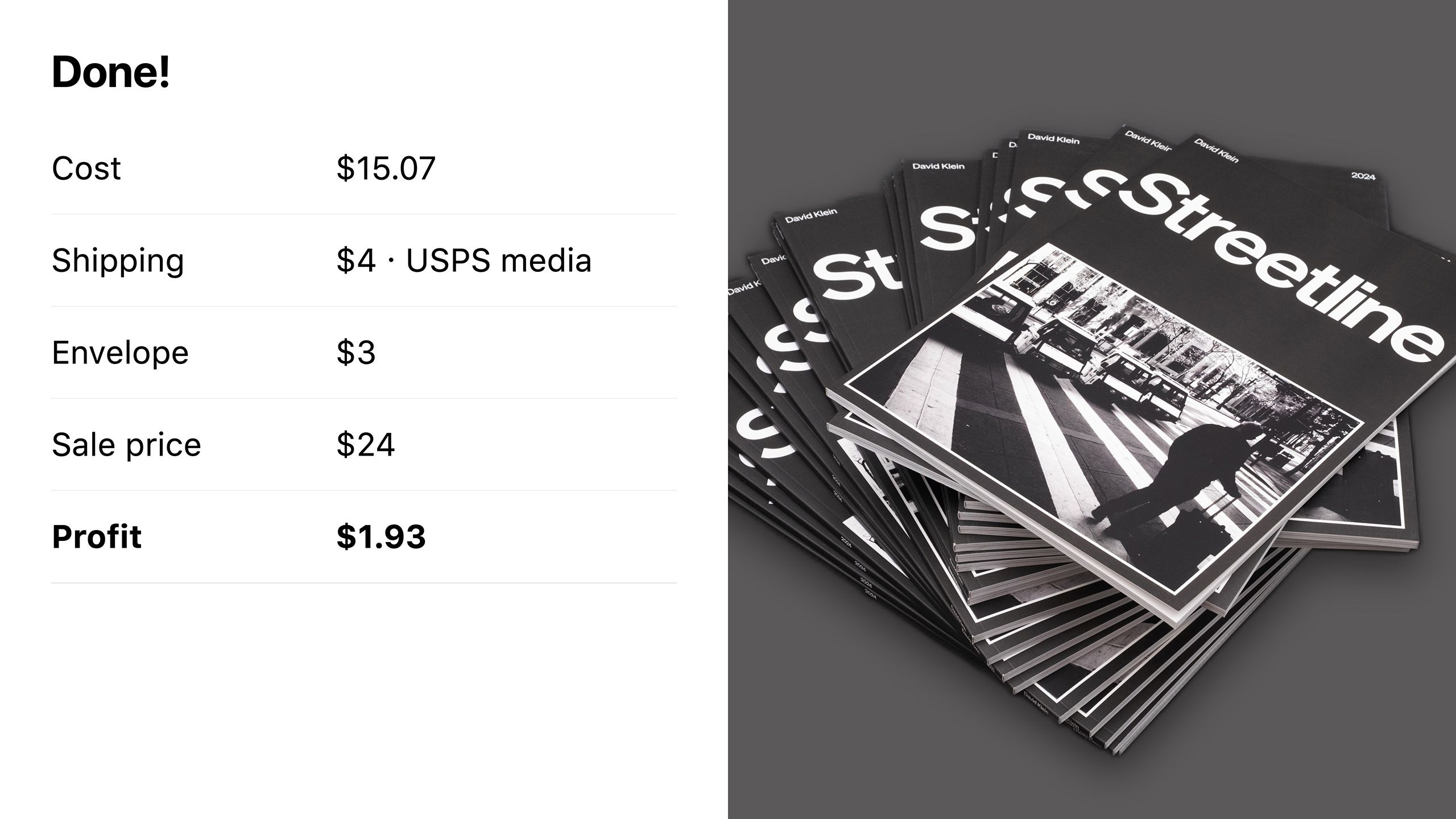
Each book costs $15.07 to print, and I decided to list them for $24 each. $25 sounded too high. Yes, that is how I decided the book’s cost. After paying $4 for USPS media mail and $3 for a padded envelope my profit is $1.93.
That isn’t a lot of money, but I never intended to make a profit. Breaking even is fine with me. I just feel so much joy knowing that people have my book in their homes. As of March 14, 2025 I am proud to say that I have sold 31 copies.
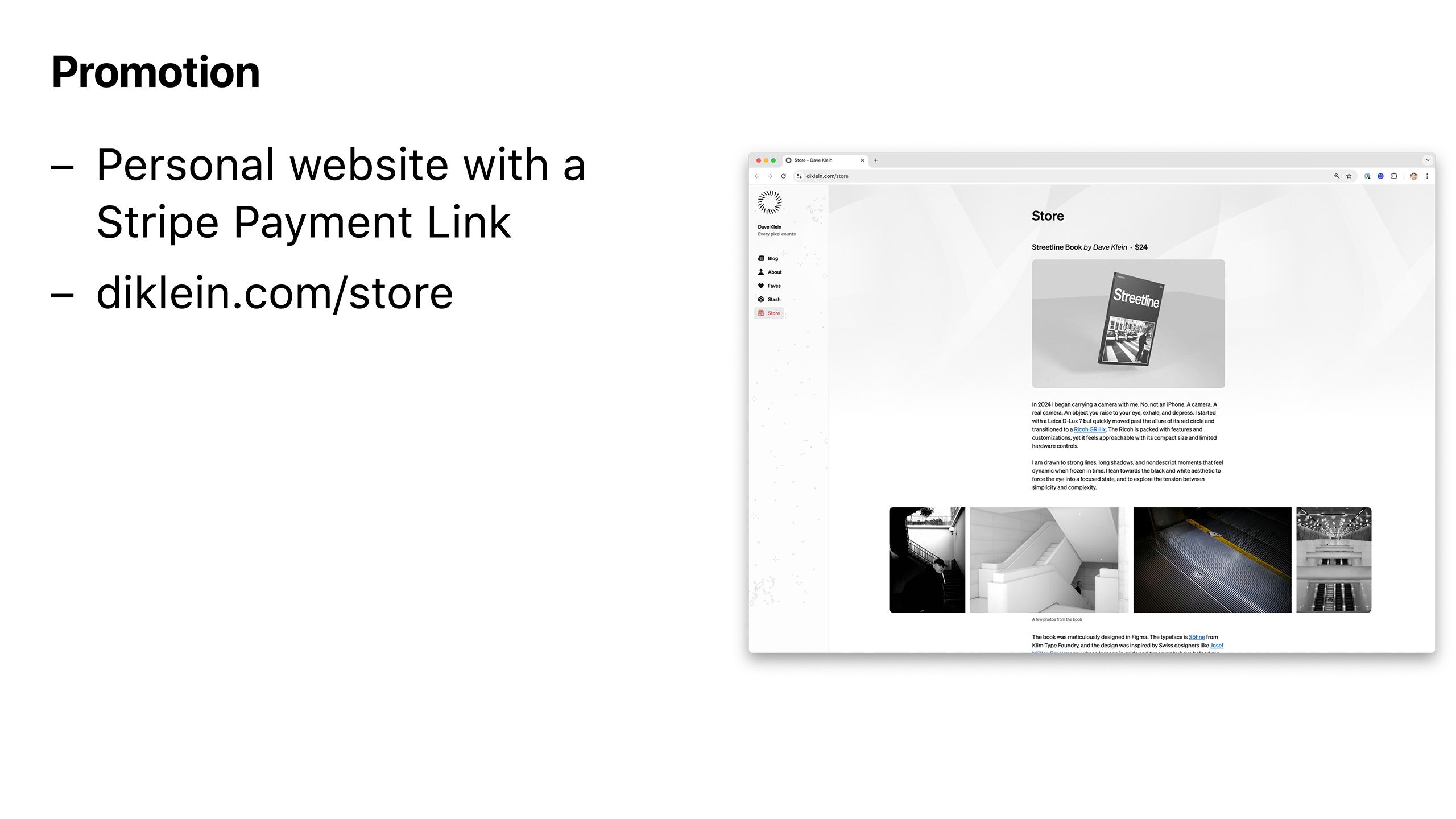
Streetline is the first of many products. My goal is to start selling prints that I can produce from my home. To accomplish this I created a new page on my website simply named Store. All products will be sold using Stripe Payment Links. I highly recommend Stripe for an easy and elegant way to accept payments and gather customer data.
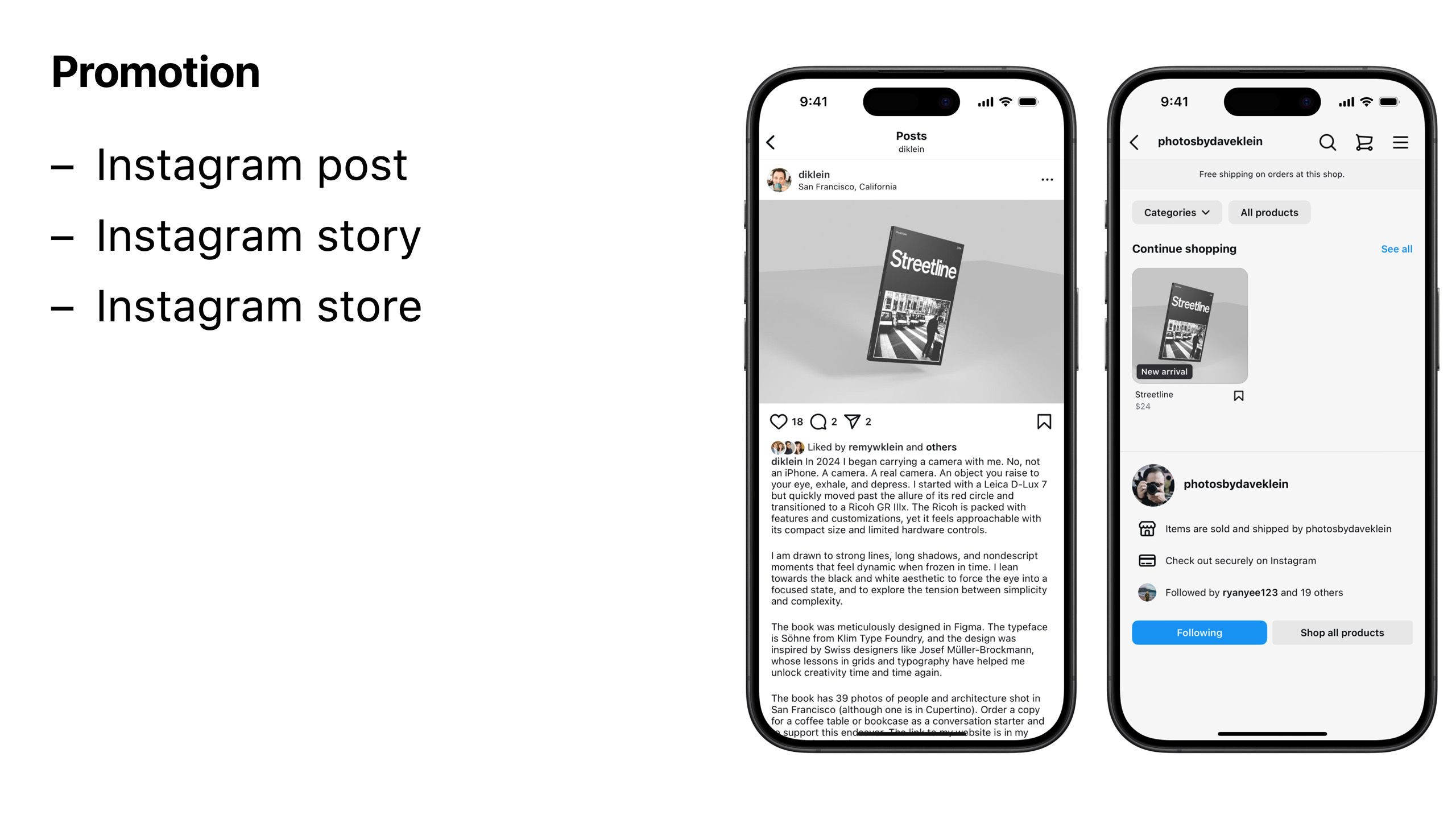
To promote Streetline I posted both on my Instagram feed and a story. While poking around Instagram’s settings I recalled that anyone can set up an Instagram store and thought that would be a fun challenge as well.
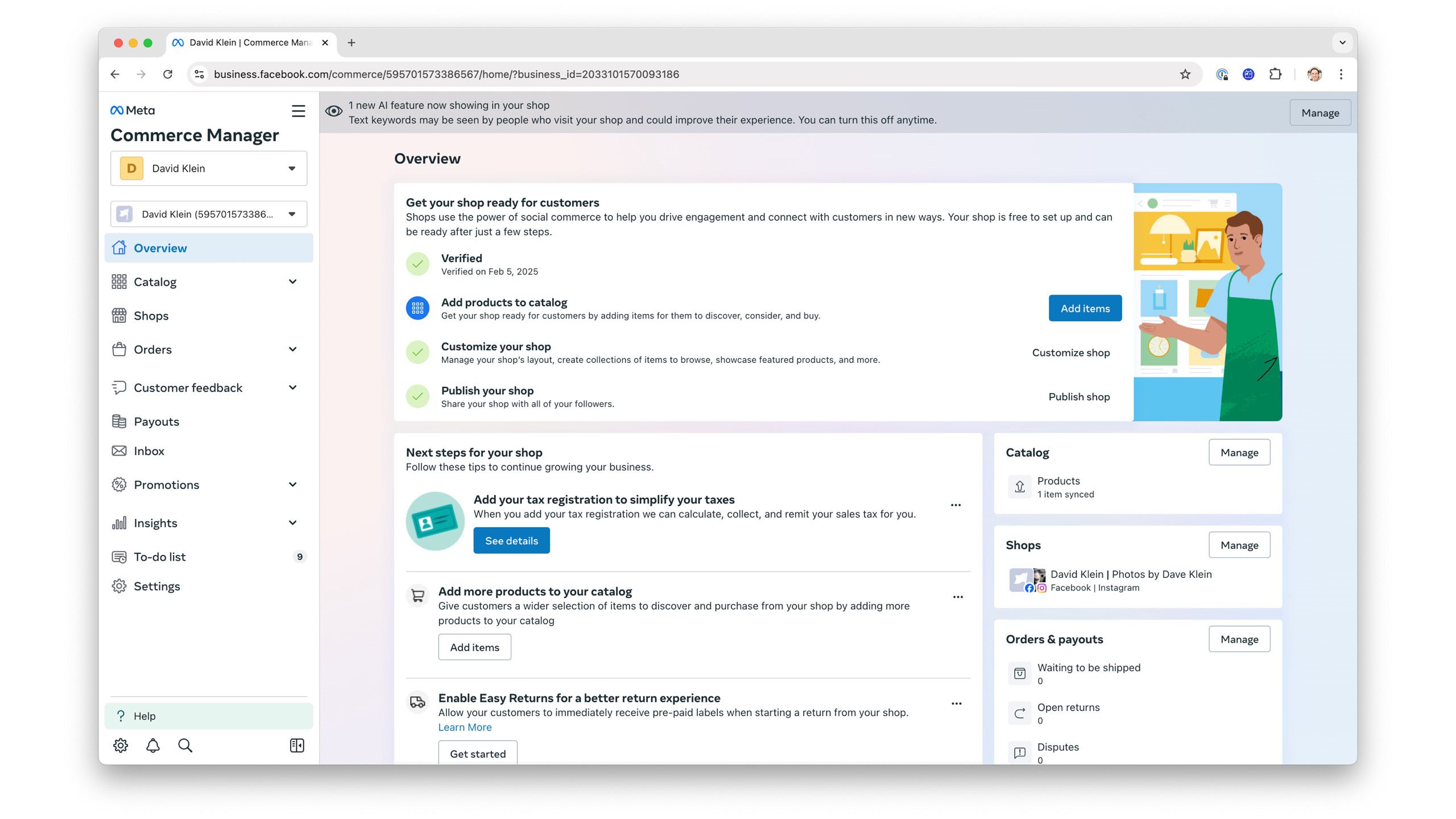
I’m normally intimidated by large, complex web applications, but I found Commerce Manager to be straightforward to set up. The big lesson learned during this step was it can take a full day for products in your store to appear in Instagram.
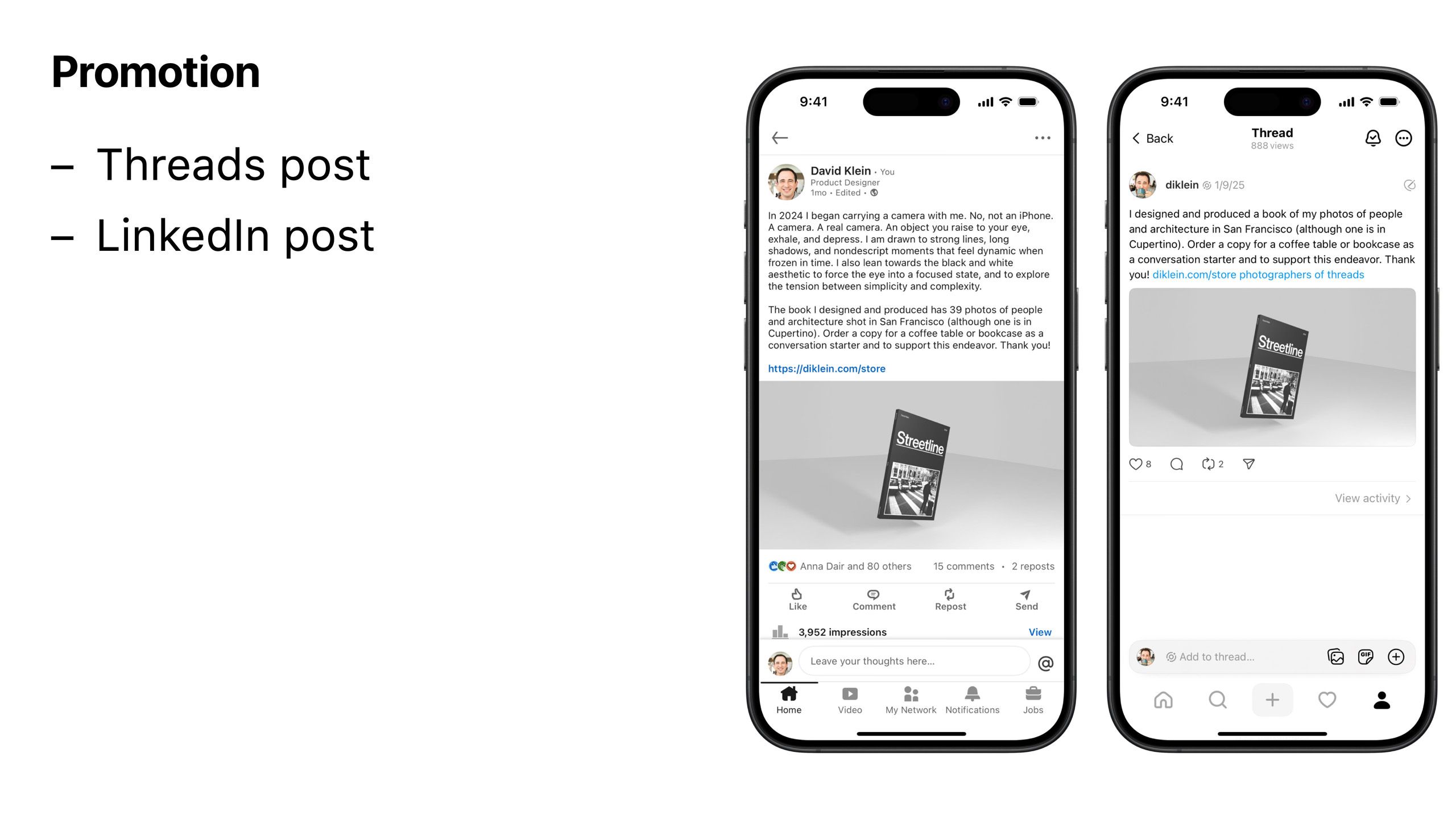
A Threads post announcing my book had a few interactions, but I was shocked by the activity on my LinkedIn post. I sold several books to acquaintenaces and former coworkers.
Most of my friends, coworkers, acquaintences, and family have moved on from Facebook proper to other apps. I received much less activity compared to Instagram and LinkedIn.
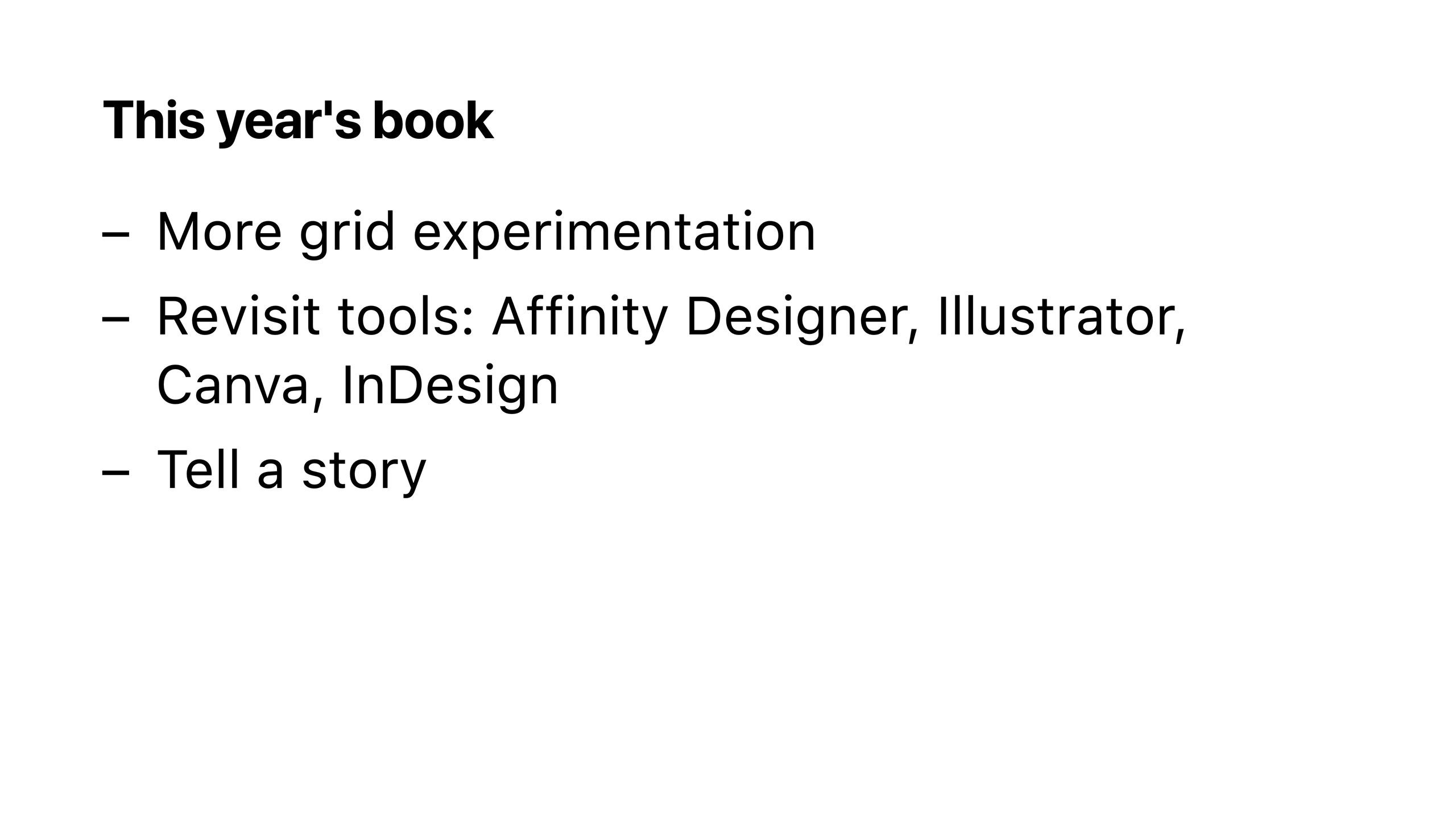
I have a few goals for this year’s book (yes, this is now an annual traiditon). I want to be a bit more adventurous with my grid selection(s). I also need to use a real tool for making a book. Perhaps it will be time to return to Adobe with either Illustrator or InDesign. Affinity Designer (or Publisher) are interesting as high quality, Apple-centric apps. I’ve also heard good things about Canva.
The most exciting challenge will be attempting to tell a real story with photos. Streetline is honestly random from page to page. I want have a single idea throughout the book.
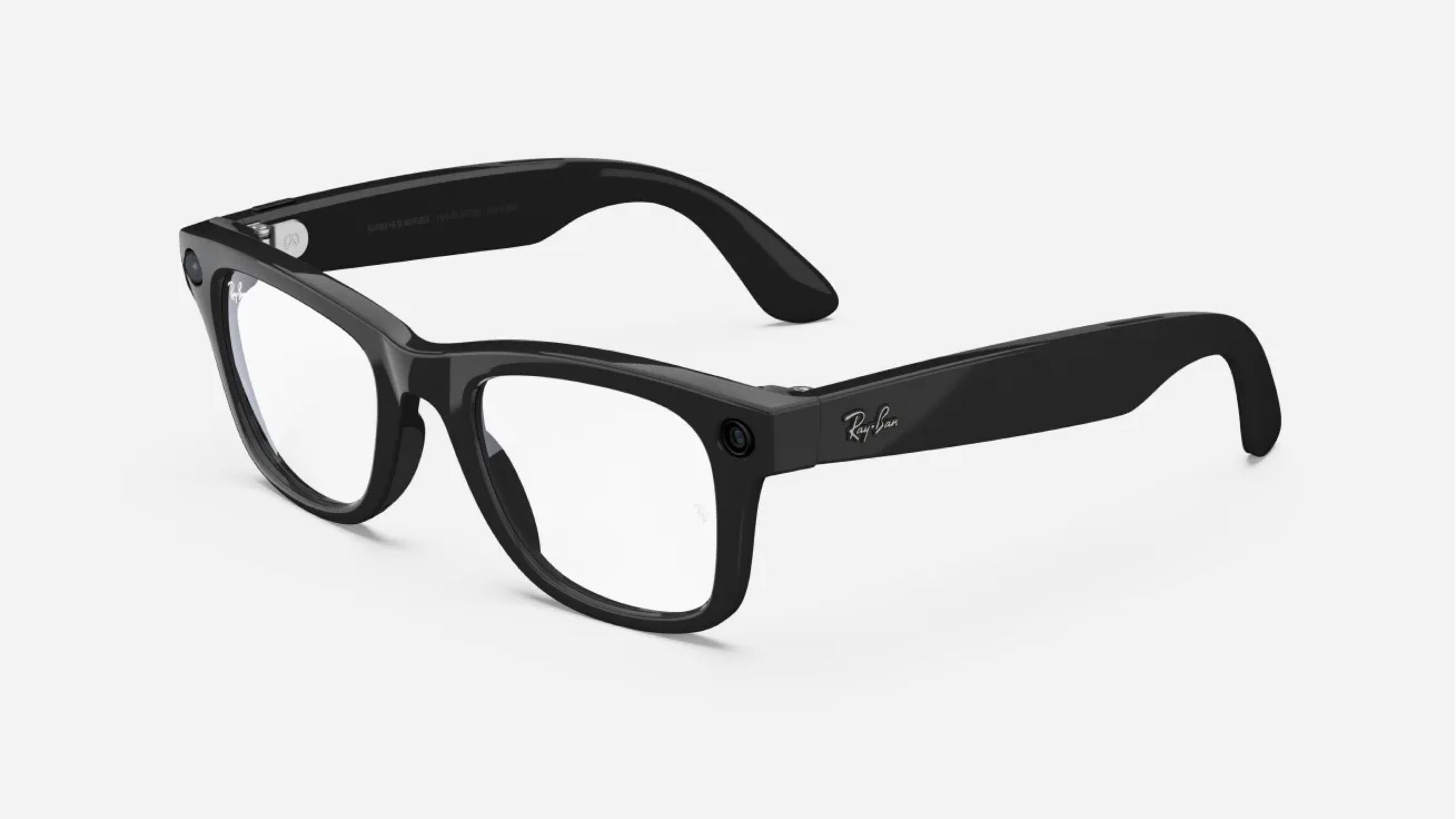
In addition to exploring layouts and tools, I also plan on expanding my camera options. For example, I now work at Meta! I should try to incorporate some photos using the Ray-Ban Meta glasses. The perspective from those glasses feels unique with their ability to include the photographer’s hands in the frame.
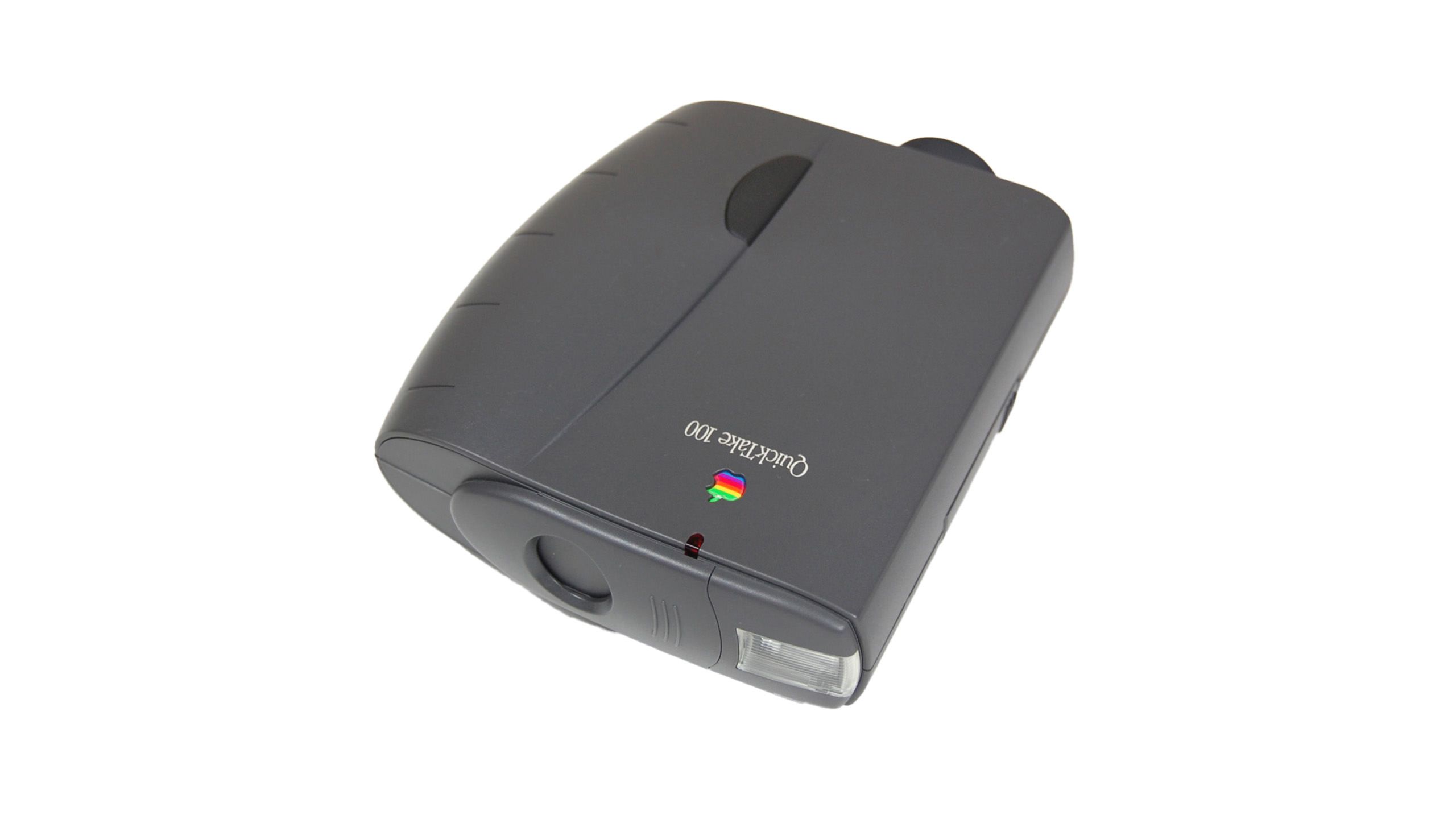
As an avid Apple product collector I want to include a few photos using a real Apple camera: the QuickTake 150. With its paltry 640×480 resolution I’ll need to get creative.
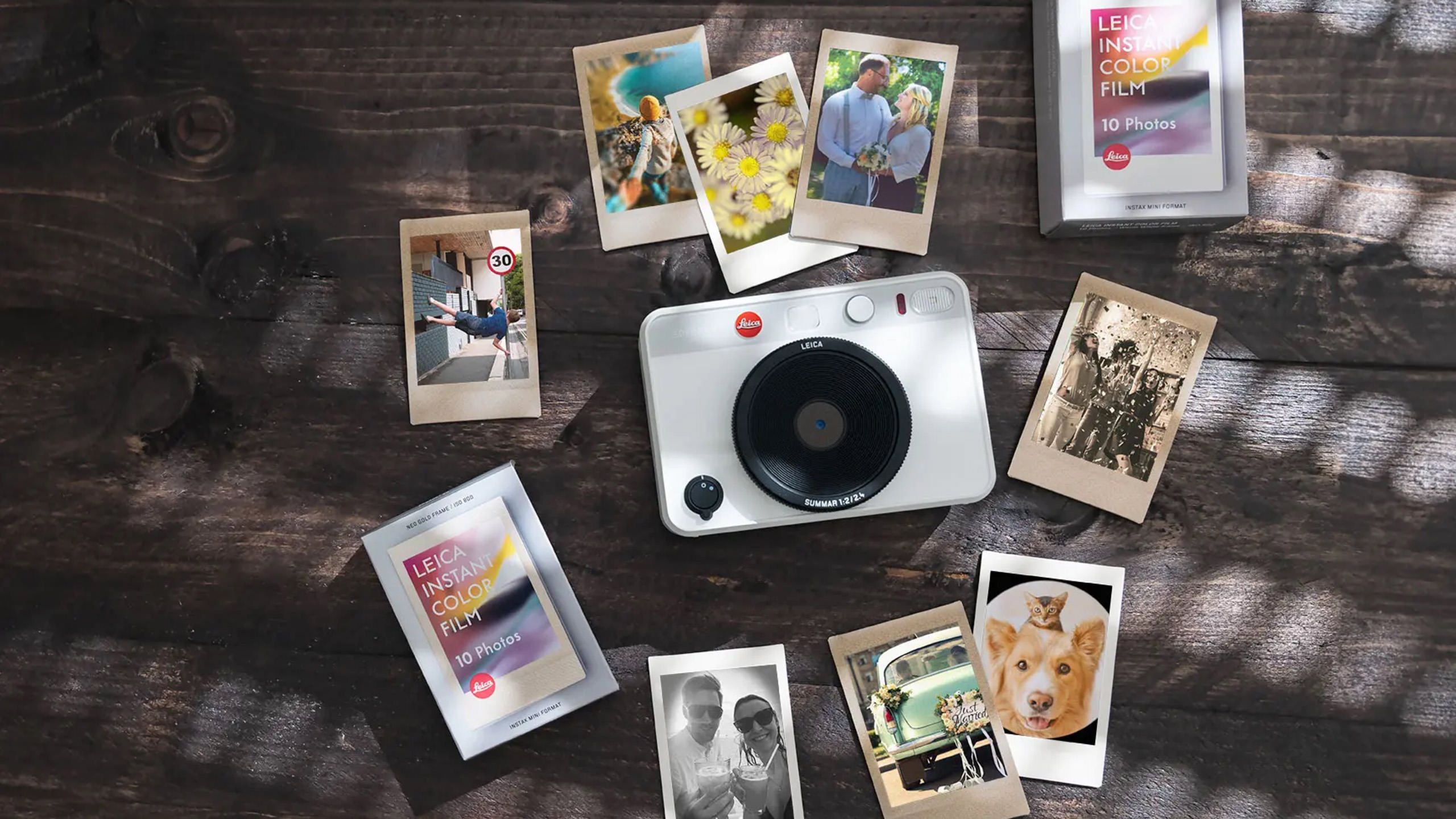
The Leica Sofort 2 is a truly fun camera to use. I brought it to a cousins ski weekend in Utah, printed photos throughout each night, and placed them on a table as I printed. By the end of the third night the table was covered in photos. It brought so much entertainment to the trip. Maybe a photo of a collage will make its way into the next book.
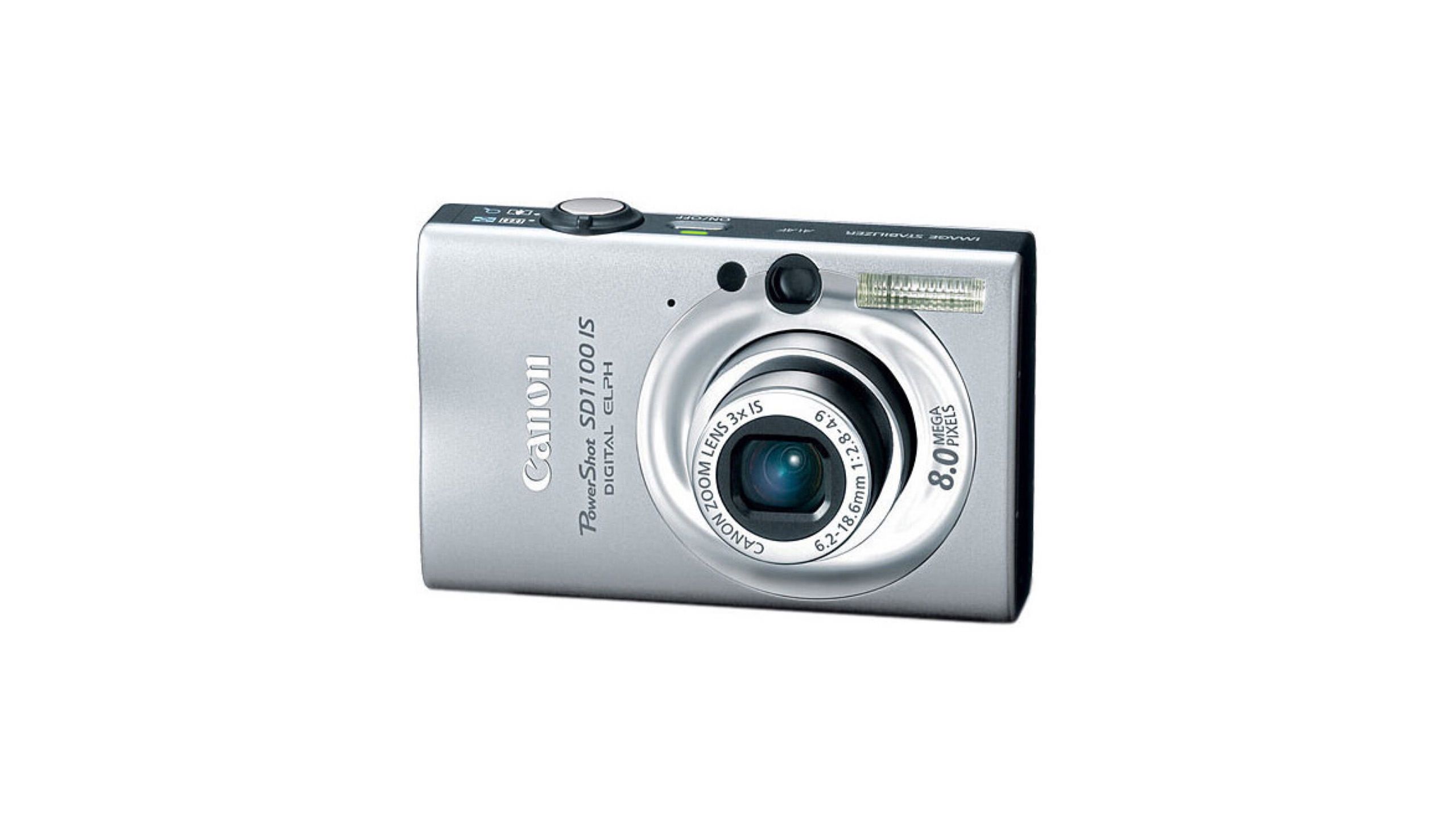
Lastly, I recently acquired a throwback camera to join the kiddos in their enthusiasm for retro photography: the Canon PowerShot SD1100. Its photos feel like college and I love it. Similar to the other cameras, using this will be a fun creative challenge.
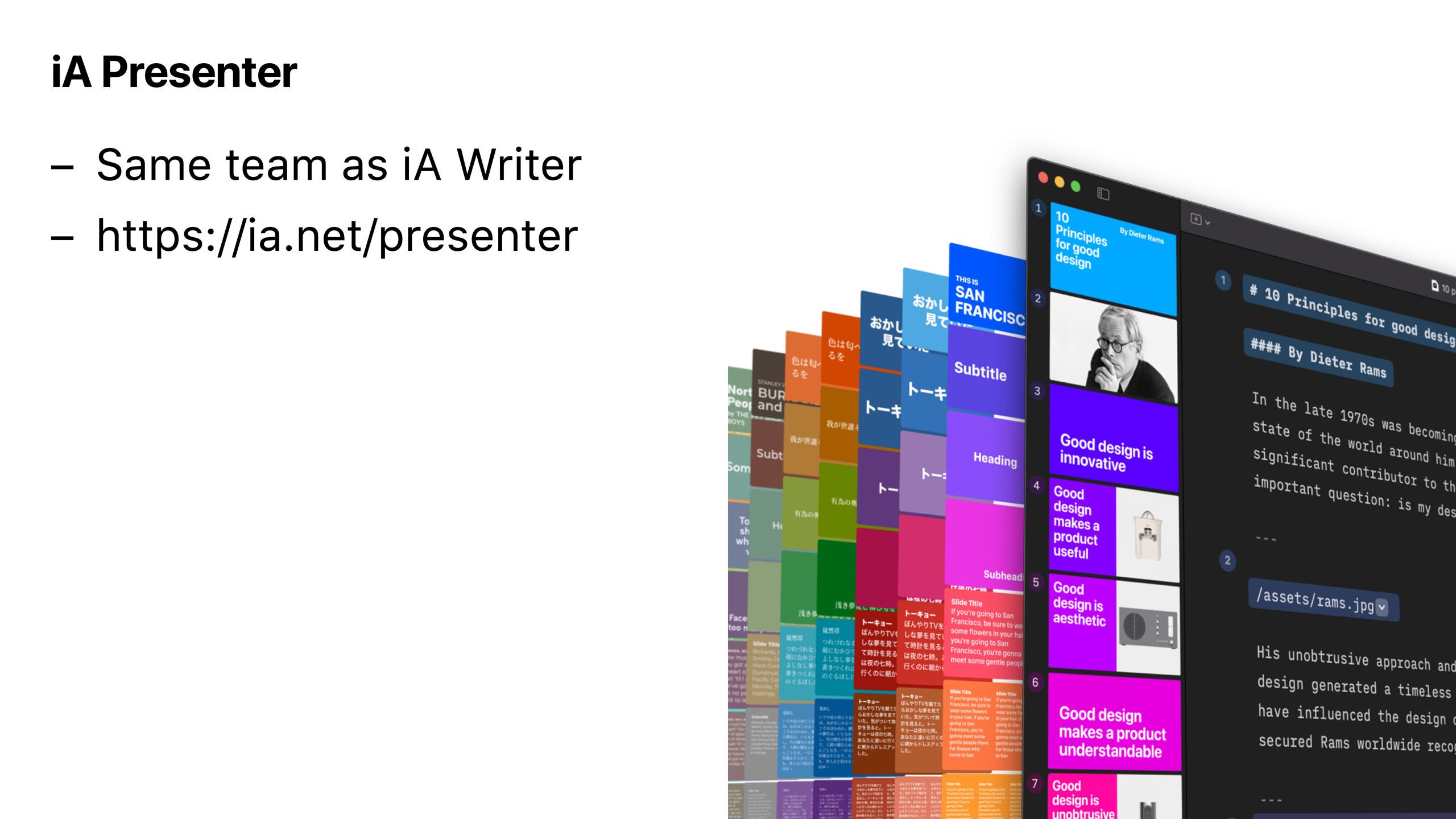
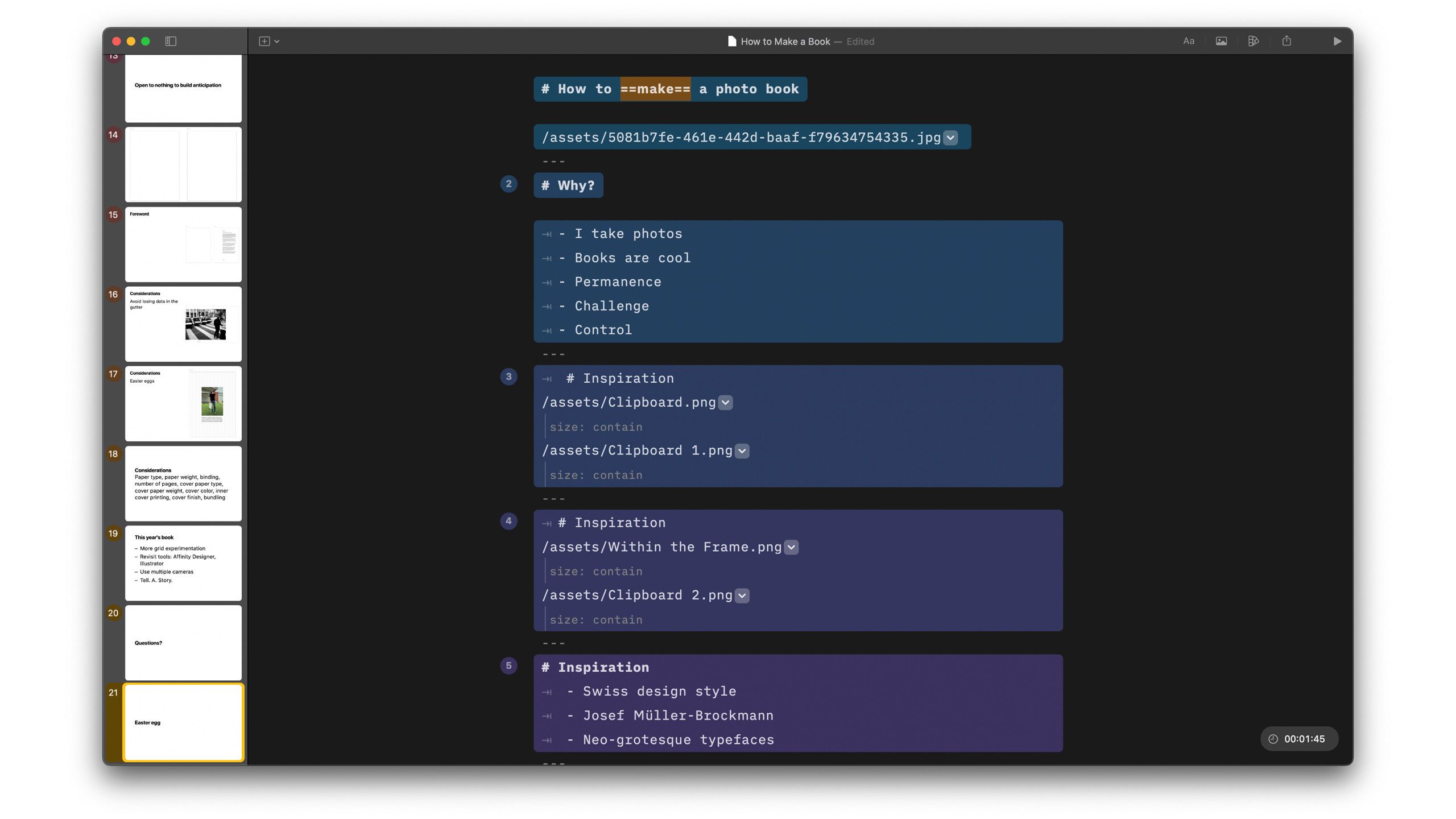
While I was in an extended period of experimentation, I thought it would be fun to try a new app for making a presentation. Naturally I’m inclined to use Keynote, but I recalled that last year iA, the company that makes iA Writer, launched a presentation app named iA Presenter. The pitch is simply write out your presentaiton using Markdown and the app will handle making slides. I enjoyed using the app even though I wish there were just a few more controls over slide designs.
Every slide in this presentation was made using iA Presenter!
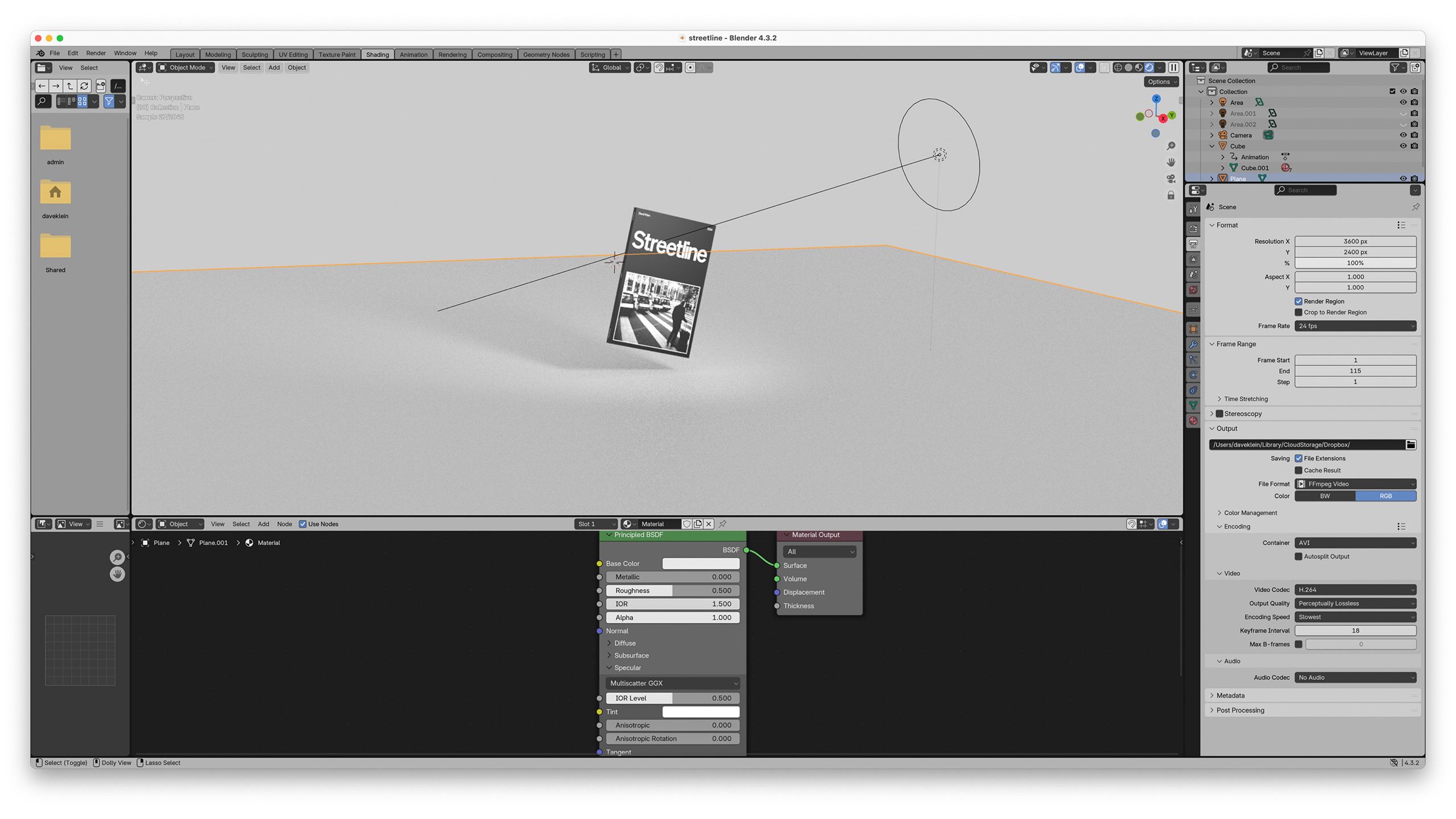
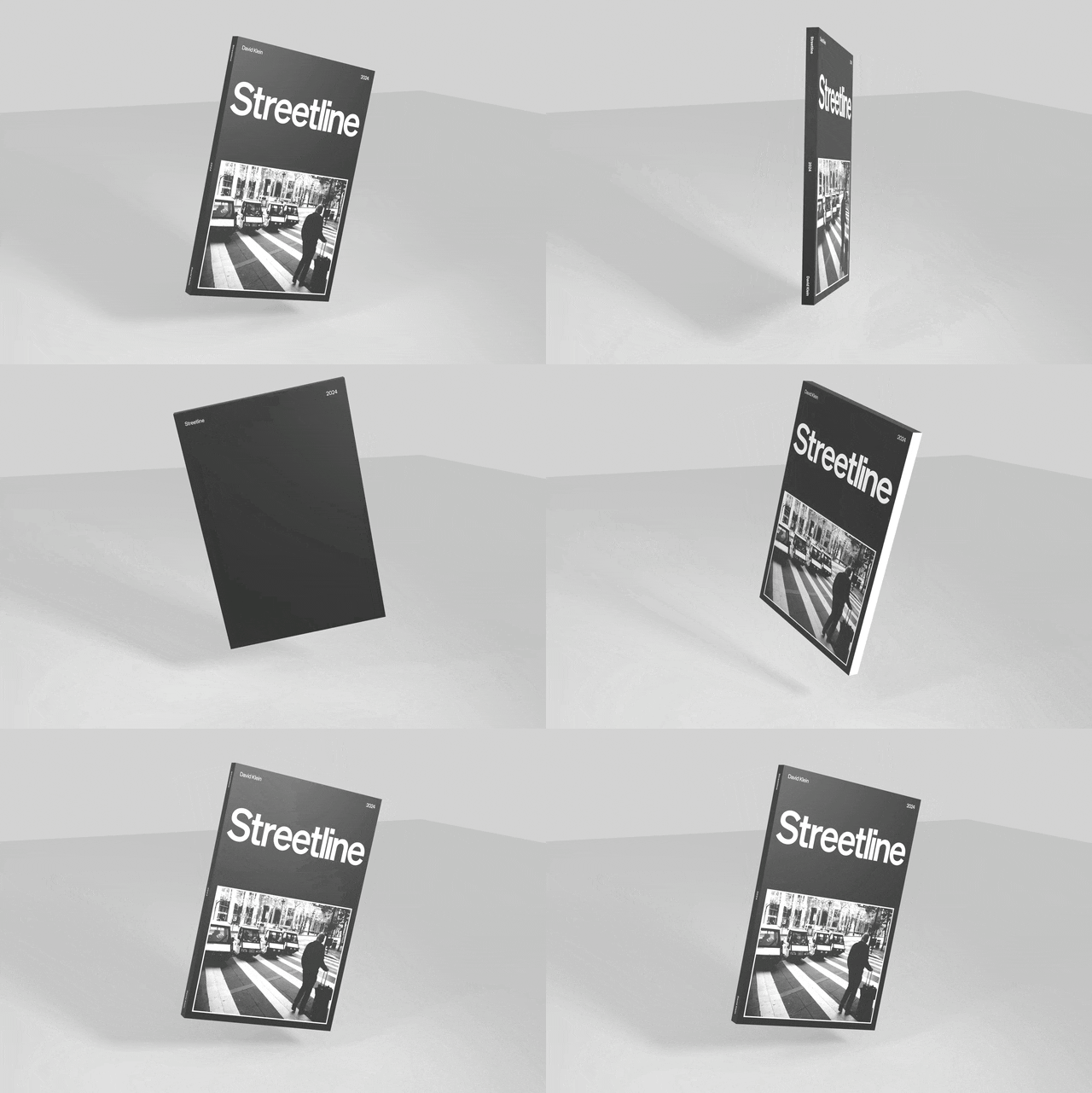
When it came time to promote the book I wanted to go beyond a Figma export. I decided it was time to learn 3D software again (I frist learned to use Strata Studio Pro and Bryce 3D at summer school in 1994). I heard Blender is an approachable app to enter the field. After dozens of ChatGPT prompts and a few calls with a coworker, I managed to get PNGs attached to a rectangular prism. I then placed the book above a plane, dropped a light source in, and delicately placed a camera near the object.
I couldn’t stop. I recalled my days of using Macromedia Flash and figured out how to use keyframes to make the book spin and levetate. I love how you can see the object’s shadow mnoving.
Alas we have arrived at the end. Please feel free to send me questions. Designing, printing, and ultimately selling copies of Streetline has been the most rewarding experience of my design career. I finally designed and made something for myself and loved ones.
Thank you for joining me on this journey, and don’t forget to buy a book.
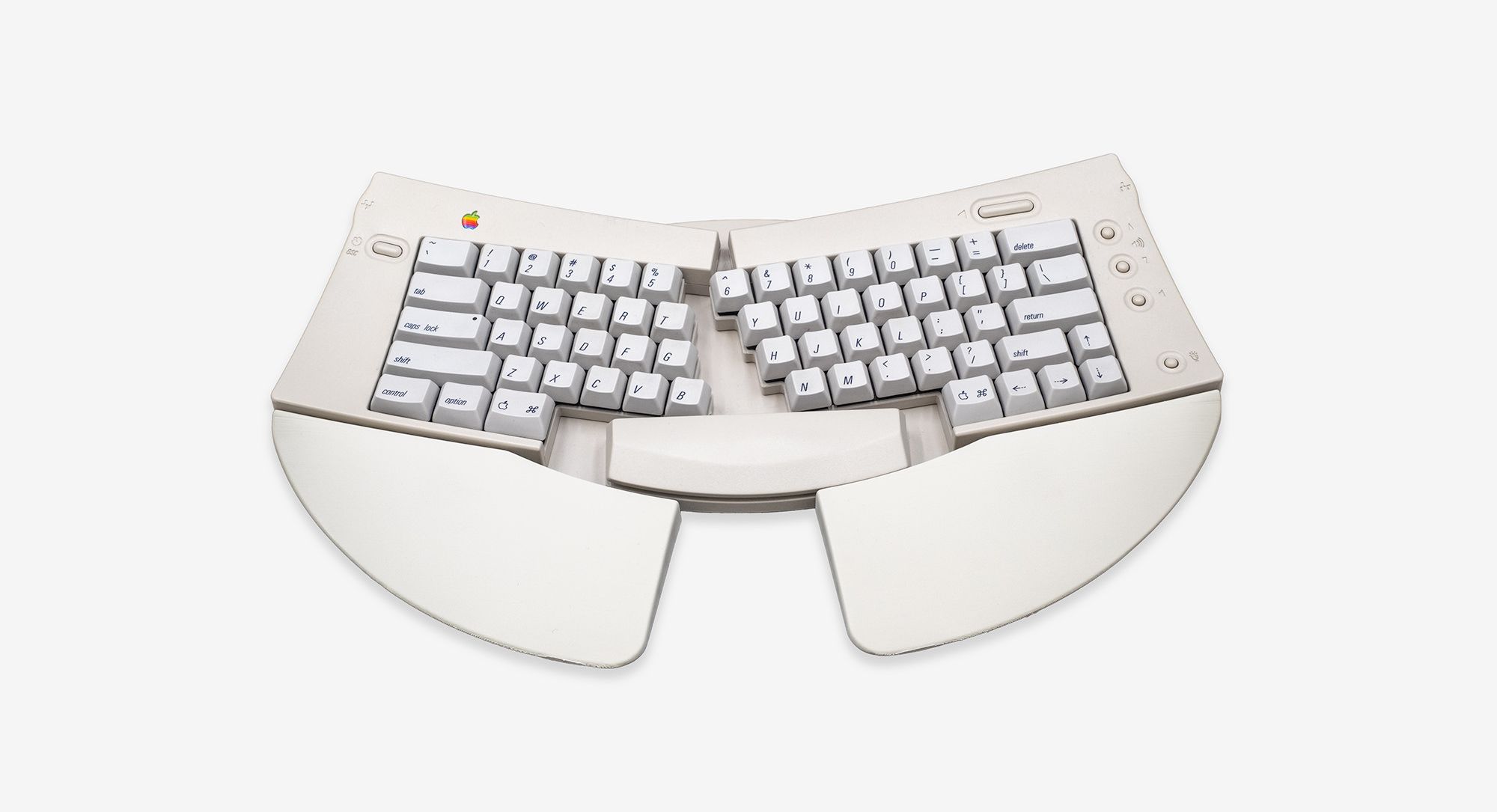
Last year I acquired an Apple Adjustable Keyboard for my collection. I do not recall ever seeing this keyboard in person, and I thought it would be both fun and pleasant to type on. Unfortunately it did not come with the curved palm rests that truly give the keyboard its presence on a desk. They’re almost as tall as the keyboard itself!
One day I was lamenting about this to a fellow Apple collector and friend who informed me that the 3D model files for the left and right rests are available on Printables. I do not have access to a 3D printer, but I had heard about companies that will just ship you prints.
After a bit of research I discovered a San Francisco-based company called Makelab. I uploaded a .stl file and was immediately overwhelmed by complexity. FDM, SLA, VCJ, MFJ, PLA, PETG, ASA, etc. What is all this nonsense? How is a newcomer supposed to just print?
I quickly learned that Makelab has an incredible support team. I explained the project and they provided a few quotes in addition to helping me choose a custom color that resembles “early 90s aged computer plastic.” I went with an FDM machine using PLA material at 200 microns. (Don’t ask me what that all means.) A few days later the parts arrived and… perfect. They attach easily, look great, and feel comfortable even after several hours of use.
In addition to 3D printing the rests I also had to find a way to connect an ADB keyboard to USB-C. The same collector friend gifted me a Drakware ADB2USB connector. It has some mild temperaments (make sure you connect the keyboard to the connector and then the connector to a USB-A to USB-C dongle) but otherwise works beautifully. Now I’m up and running with the keyboard at my home office and slowly adjusting to the home key indicators’ placement on the “d” and “k” keys instead of modern “f” and “j” keys. Yes, Apple had to do everything their way in the 90s.
Oh one more thing… I purchased a second Apple Adjustable Keyboard for my desk at Meta.
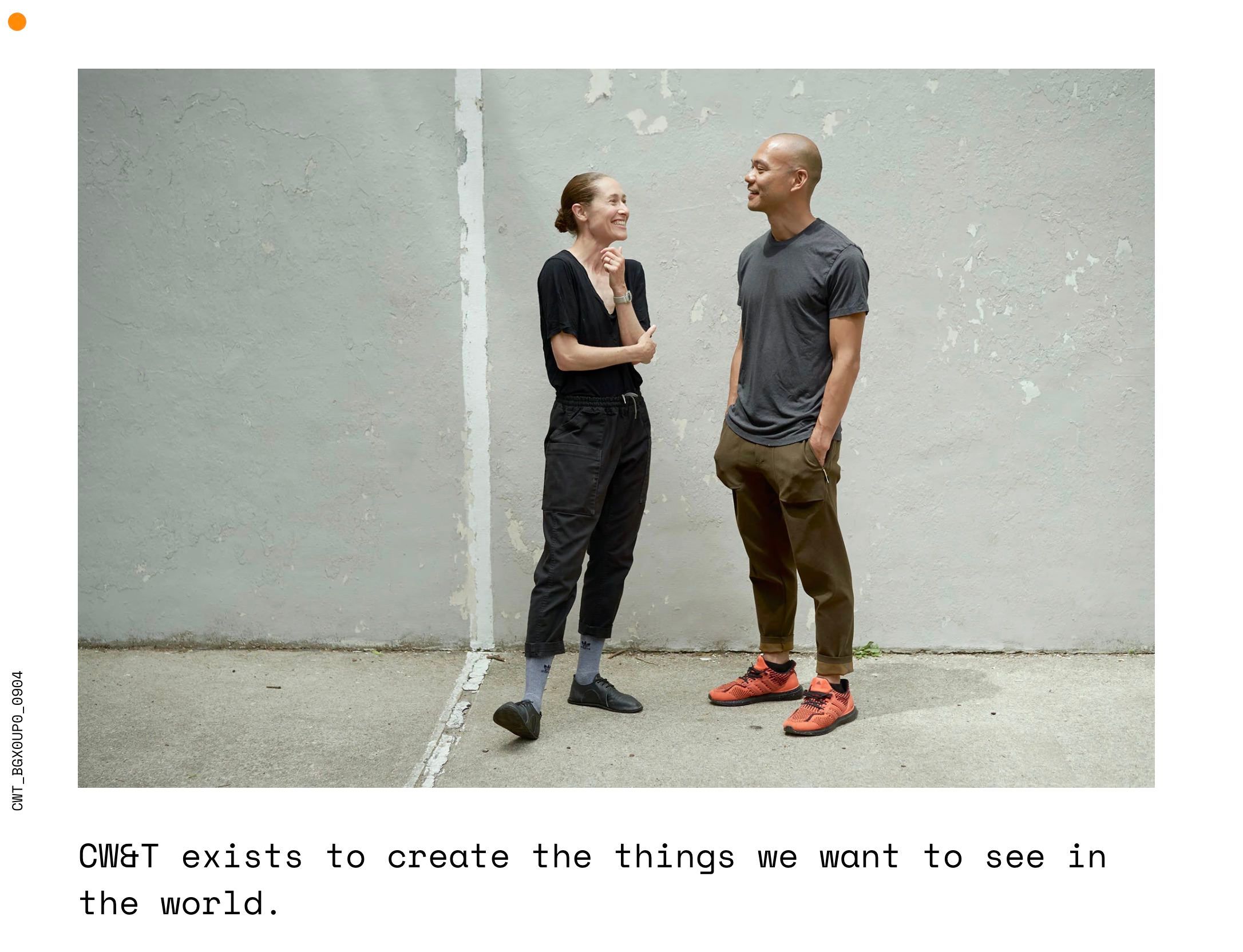
I’ve been following the team at CW&T since 2011 when they launched the Pen Type-A on Kickstarter. My design team gathered around to watch the campaign video and were immediately impressed by the delightful “pop” sound the pen makes when it is removed from its container.
The duo behind CW&T not only makes thoughtful proudcts, but they also come across as thoughtful people with genuine kindness and emphathy. You can clearly see this from their Instagram content, weekly newsletter, and podcast appearances.
Many years, product launches, and awards later, CW&T launched a product for me: the 55 66 88. It’s “a phone stand set at 3 useful angles for positioning your camera.” Clever and unique!
CW&T’s product photography is always stellar.
After having children we found ourselves regularly making FaceTime calls from the table during meals, and we used a few different average looking phone stands to free up hands and stabilize the video. When CW&T launched the 55 66 88 I immediately backed it thinking it would replace our current stands.
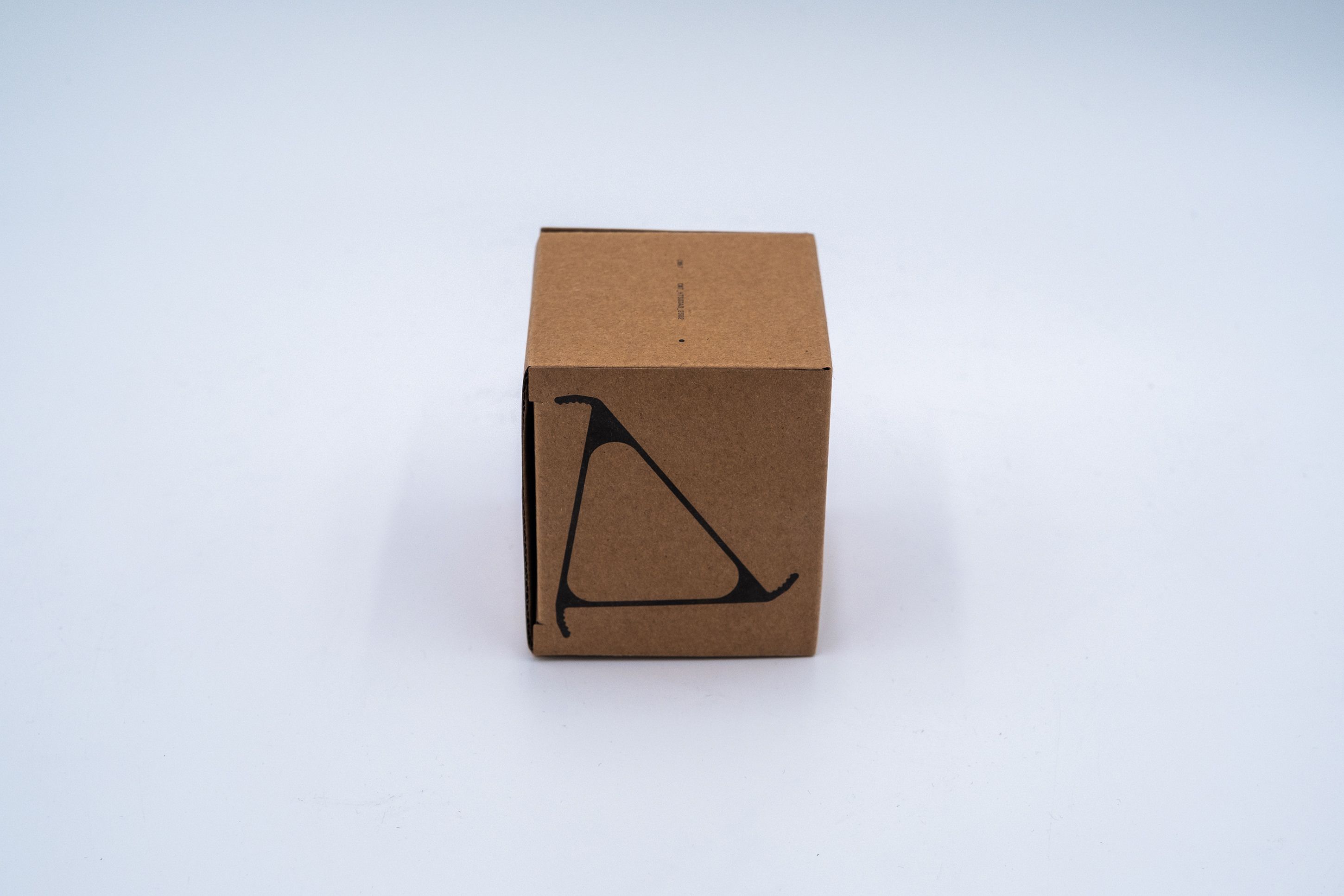
What surprised me beyond the cleverness of a stand that can display a phone at 3 different angles was the box’s design. It somehow manages to both demonstrate the product and perfectly encapsluate the CW&T brand. At first glance it looks like a typical box with an illustration of the product on the side.
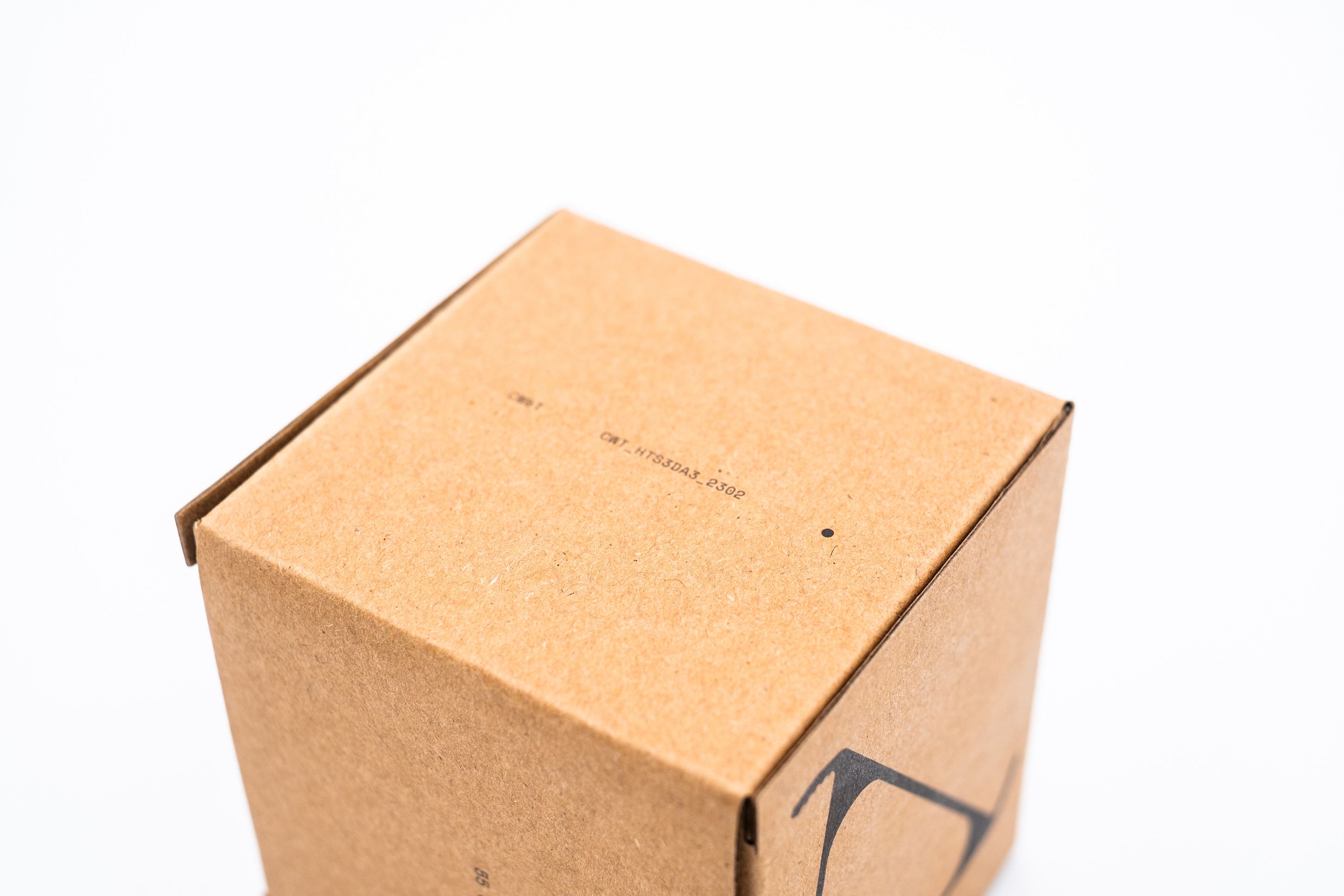
If one takes a closer look a few details quickly emerge. First, the circle.
CW&T uses the circle as either a foundational element in a product or as a colorful accent. For example, the Studio Sketchbook, the Solid State Watch (which I have come close to purchasing several times), the Orange Dot, and Salty all leverage the circle in unique ways. It’s even a core part of the website’s design as a consistent element in the upper left corner.
Next, the product name. It’s the same typeface, color, and font size as the rest of the box’s text. One can imagine designing this side of the box with a much larger size so the product name shouts at the customer.
Why not include a description like “a phone stand with 3 useful angles?” Simplicity. Let this side simply show the product name, and allow other sides to be busier.
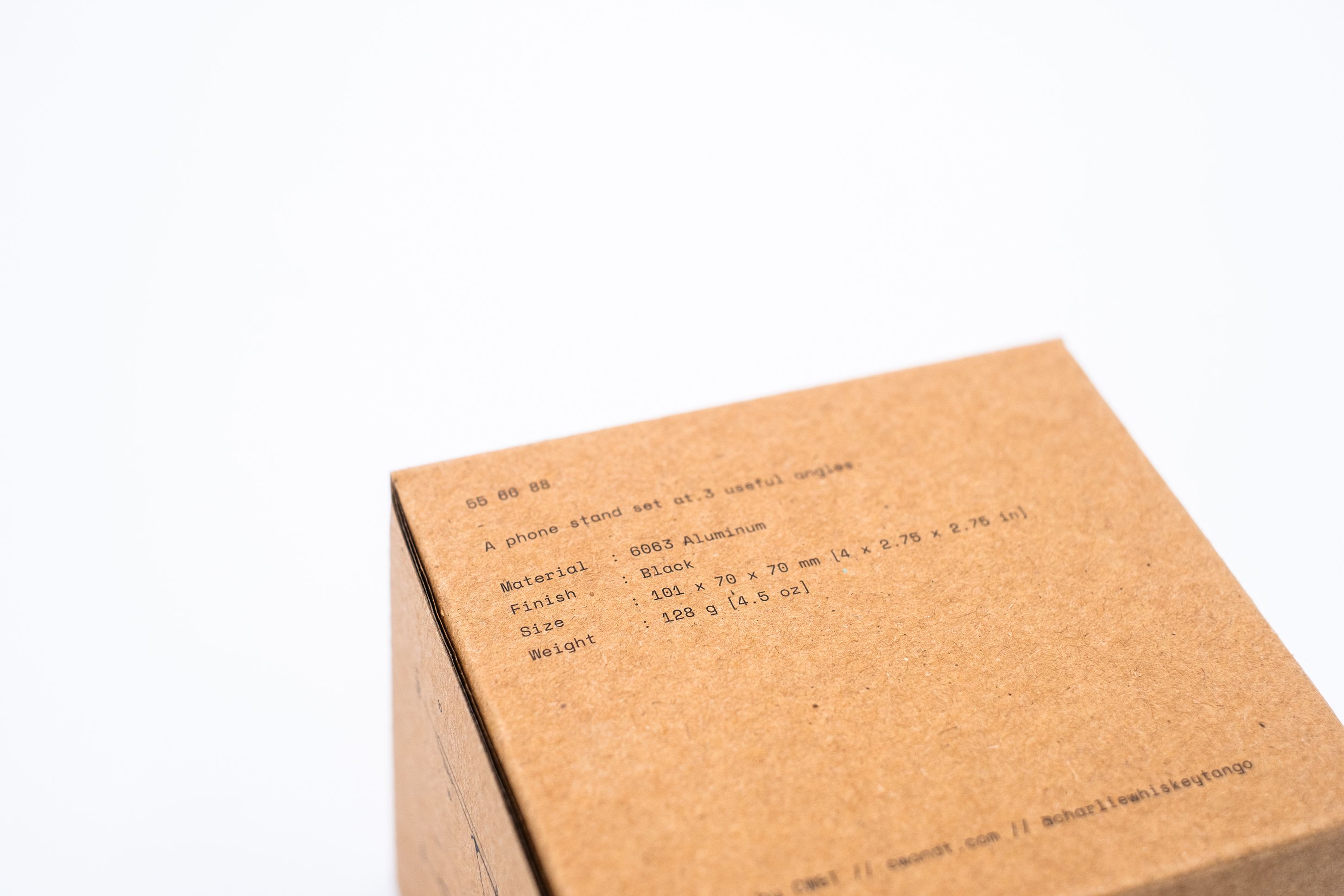
Now for a few product details.
Ah hah! There’s the description: “A phone stand set at 3 useful angles.” Concise and clear. Along with the description are the material, finish, size, weight, and contact information. Instead of the obvious design of “Material: 6063 Aluminum,” CW&T inserts space after each label to ensure the semicolons and values are aligned. This leads to a much cleaner, uniform aesthetic.
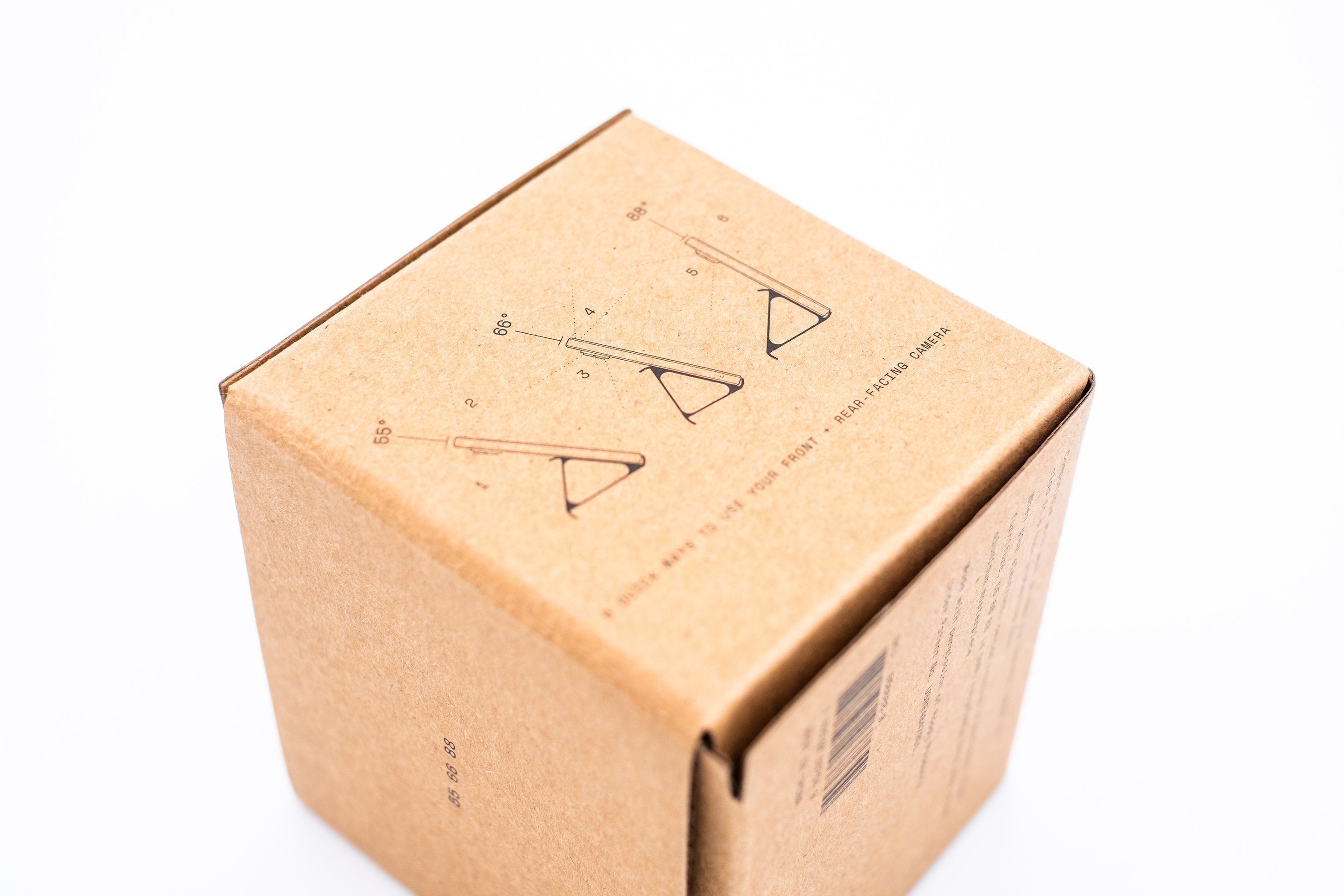
Lastly, a demonstration of the product.
“6 quick ways to use your front + rear facing camera.” 6?! It didn’t occur to me that with 3 angles one could achieve 6 orientations by leveraging all of a phone’s cameras. In retrospect this is obvious and I was too focused on solving the FaceTime calls at the table use case. The illustrations are educational and they connect the product’s purpose to its name using the degrees symbol: 55°, 66°, and 88°. I also adore the subtle dots on the sides of each phone indicating what the cameras will be pointing at for each orientation. Again, clever details abound.
I highly recommend keeping an eye on CW&T, and I can’t wait to back the Pencil Type-C on Kickstarter.
I designed and produced a book of my street photography and added a Store page to this website. I’m kvelling that people are already placing orders. Buy a copy for yourself! It’s only $24 including shipping anywhere to the United States.
I spent weeks agonizing over every detail. Grids, typefaces, photos, etc. Fortunately Mixam has a patient support team that was helpful with all of my questions. I learned so much and I already have ideas and improvements for my next book coming later this year.
My hypothesis is that consumer AI experiences fall short because it’s lonely out there. There isn’t a way to engage, connect, build and learn from, collaborate and build on with other people.
Albert previously writes about the visual consistency of popular AI chat apps from Microsoft, Google, Anthropic, and OpenAI. During the race to build the most popular AI client in the last two years, interface designs appear to have converged aside from the occasional differentiating feature. I give Anthropic points here for having the gumption to use a serif typeface and opinionated set of colors.
I assume this consistency will live on for the foreseeable future until companies truly begin to reimmagine software with an AI foundation. I think of it like baking a cake. Right now all software is a finished cake, and we are simply adding AI as frosting. Who will bake a new cake with AI as flour?
People First AI shouldn’t just be a set of features, it’s a way to create shared contexts for learning, enable creative expression while maintaining safety, build trust through transparency, and foster genuine connections rather than just transactions. The next wave of AI needs to move beyond individual chat interfaces to create richer spaces for human connection and growth. These are just some thought starters for a People First AI, ensuring people are at the heart of what we do, why we do it, and how we do it.
It’s hard to believe that the most exciting breakthrough since the GUI (or maybe iPhone OS) has virtually the same interface that Matthew Broderick uses in Wargames, a movie from 1983. However, is there an allegory for what Albert is suggesting? We have collaborative text editors, presentation tools, and spreadsheets, but they are certianly not “rich spaces” and AI will not change that.
Is Meta going to integrate AI into the Quest and Horizon Workrooms? The answer is definitely yes, but I still wonder what the actual product is. A virtual whiteboard that has an AI observer to chime in like a professor with exerptise and guidance sounds compelling. I recall as a CS student I would sit in an alcove with classmates working on problem sets and feeling stumped (understatement). An AI observer that could guide us through challenges would have been most welcome. To help that young, stressed version of Dave Klein I can imagine Google integrating Gemini into Jamboard to accompany our work with notes, drawings, and helpful corrections on a TV that acts as a whiteboard. This would be fun to prototype!
Should Google revisit Wave for a “richer space for human connection?” Probably not, but attaching a single-player mode chat interface to Google web apps is not the long-term solution Albert is imagining. And yes, I thoroughly enjoy talking about Wave.
 Dave Klein